Estimating Boiler Manifold Replacement Cost in the Current UK Market
Calculating the boiler manifold replacement cost for a commercial plant room in 2026 requires a nuanced approach that considers both the physical asset and the complexities of system downtime. In the current economic climate, mechanical contractors are factoring in a 5% to 8% annual increase in high-grade carbon steel and stainless steel components, alongside rising skilled labor rates. For mid-sized commercial installations ranging from 150kW to 500kW, the cost is not merely the price of the fabricated pipework but also the integration of hydraulic separation components that ensure the new manifold functions correctly with modern modulates pumps. Accurate budgeting must therefore account for site-specific constraints such as restricted access in basement plant rooms which can significantly inflate the total installation price.
When assessing the boiler manifold replacement cost, procurement leads should look beyond the initial purchase price and evaluate the Total Cost of Ownership (TCO). A cheap, poorly fabricated manifold often leads to early corrosion issues or poor flow distribution, necessitating expensive remedial work within five years. By contrast, investing in a high-quality UKGP low loss header alongside a new manifold arrangement ensures better hydraulic balance and air/dirt separation, which ultimately reduces the frequency of maintenance call-outs. In 2026, we expect the market to lean heavily toward prefabricated solutions that arrive on-site pressure tested and ready for immediate flanged or threaded connection, reducing the high cost of onsite site welding and associated hot works permits in occupied commercial buildings.
Facility Managers must also consider the cost implications of BSRIA BG29 and BG50 compliance during a manifold overhaul. A replacement project is the ideal time to ensure the system is flushed and chemically treated to prevent rapid degradation of new components. If the boiler manifold replacement cost is minimized by skipping proper system cleaning or ignoring the need for advanced air and dirt separation, the lifespan of the entire primary circuit is compromised. Planning for a 2026 replacement involves coordinating with M&E consultants to specify units that meet current BS EN standards, ensuring that the heavy-duty insulation jackets are included to meet part L of the building regulations, which mandates minimal heat loss from pipework and distribution headers in unconditioned spaces.
- Anticipated 5-8% annual inflation on raw material costs.
- Impact of basement access and plant room geography on labor hours.
- Integration costs for secondary circuit hydronic balancing.
- Cost savings of pre-fabricated vs. site-welded manifolds.
- Compliance costs for building regulation Part L insulation requirements.
Why Hydraulic Separation Impacts Your Total Replacement Budget
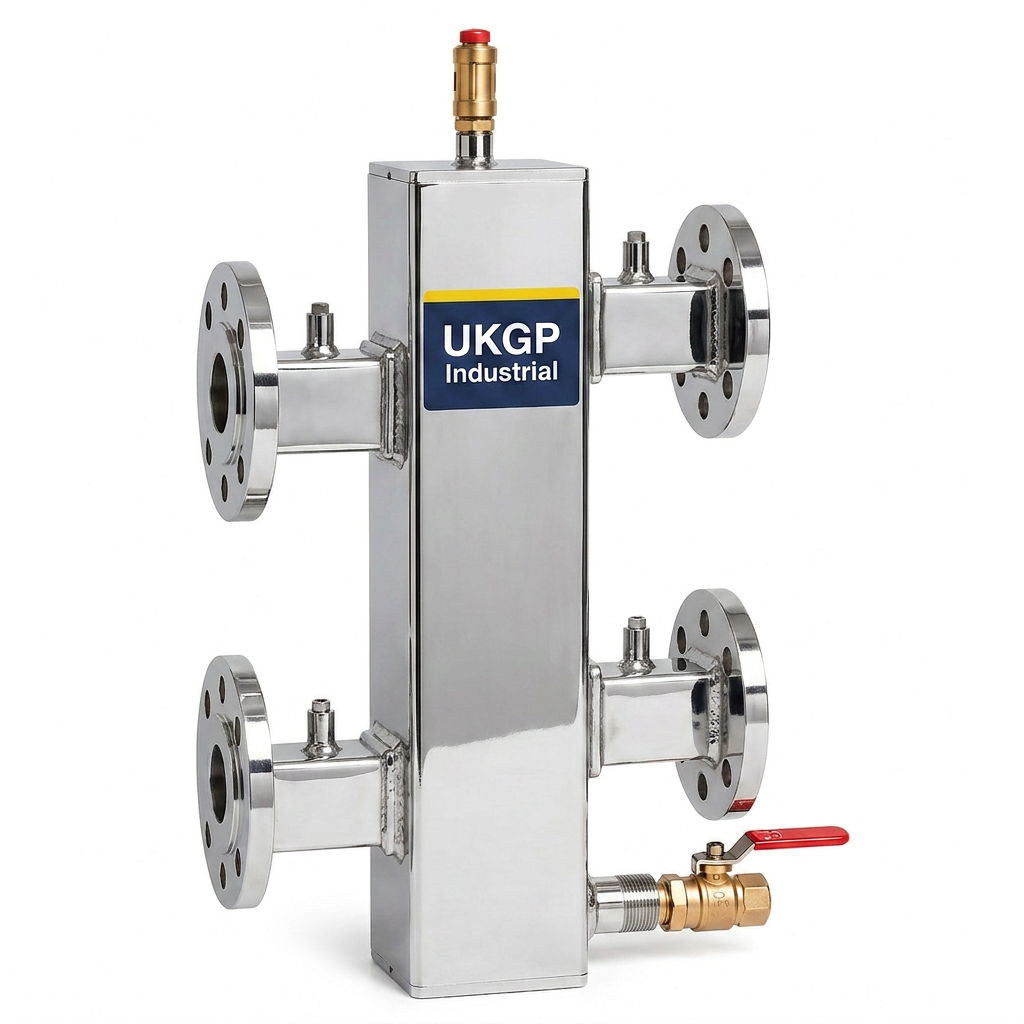
A critical factor in the boiler manifold replacement cost is the inclusion of a low loss header to provide necessary hydraulic separation between the primary boiler circuit and the secondary heating loops. Without this, modern high-efficiency boilers often experience flow rate issues that trigger expensive sensor errors or localized overheating. A low loss header acts as a neutral point of pressure, allowing pumps on either side to operate independently without interference. UKGP Industrial provides commercial low loss headers ranging from 40kW to 2000kW, designed to integrate seamlessly into new manifold designs. These units are available with BSP or PN16 flanged connections, making them adaptable for any UK plant room configuration while maintaining commercial viability.
By specifying a UKGP low loss header, contractors can mitigate the risk of premature boiler failure, which would otherwise dwarf the initial boiler manifold replacement cost. Our units come with a 2-year warranty and a standard lead time of 2-3 weeks, allowing for precise project scheduling for 2026 refurbishments. These headers also feature integral sensor pockets and air/drain venting points, which simplify the installation of CIBSE-compliant monitoring systems. When you factor in the included insulation jacket, which is often a hidden extra cost with other suppliers, the value proposition for UKGP headers becomes clear for procurement teams focused on long-term efficiency and reduced assembly time on-site.
Furthermore, the decision between flanged or threaded connections will influence the labor portion of the boiler manifold replacement cost. For larger commercial headers (above 2000 kW or high-flow systems), flanged PN16 connections are the industry standard for durability and ease of maintenance. For smaller 40-150kW modular systems, BSP threaded connections offer a faster and more cost-effective installation path. Regardless of the size, ensuring that your manifold is equipped with a robust header ensures that the system maintains the delta-T required by modern condensing boilers, preventing the short-cycling that wastes fuel and increases carbon emissions in large-scale residential or office developments.
- Range from 40-2000 kW to suit all commercial applications.
- Flanged PN16 or BSP threaded options for installation flexibility.
- Supplied with high-efficiency insulation jackets as standard.
- Rapid 2-3 week lead time for UK-wide delivery.
- 2-year warranty providing long-term asset security.
Material Selection and Its Effect on Component Longevity
The choice of materials is the single biggest driver of the boiler manifold replacement cost in the 2026 forecast. While carbon steel remains the benchmark for most UK commercial systems, the quality of the finish and the wall thickness must be specified according to BS EN standards to prevent internal erosion. Thinner-walled manifolds may offer a lower upfront price, but they are susceptible to velocity-induced wear, particularly at the junctions where branch lines meet the main header. In high-pressure environments, the use of heavy-duty materials is not an option but a requirement to ensure the safety and reliability of the plant room, especially when operating at high temperatures required for legionella secondary loop pasteurization.
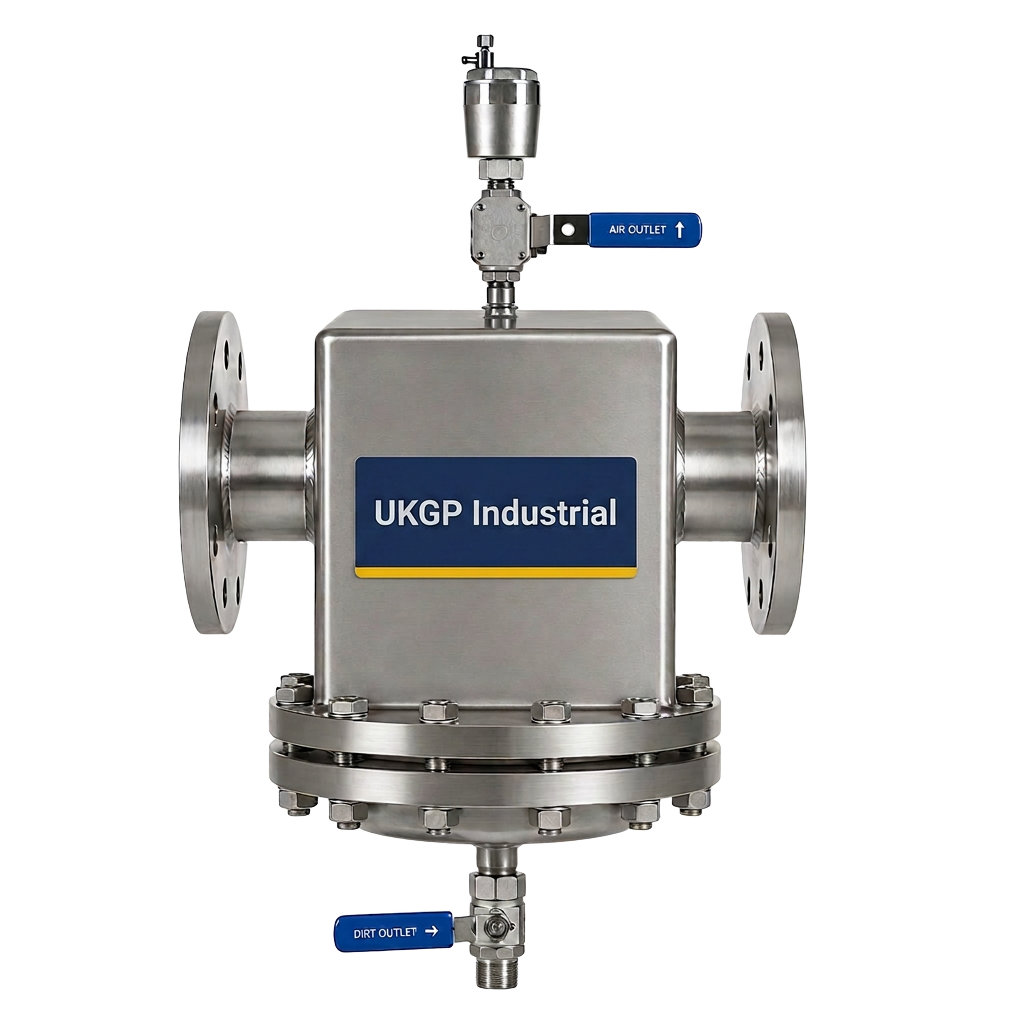
Specifying the correct air and dirt separators alongside your manifold is an essential strategy for protecting your investment. By removing microbubbles and magnetite from the system, you extend the life of the new manifold and the heat exchangers within the boilers. This proactive approach to system health reduces the long-term boiler manifold replacement cost by ensuring that the 2026 installation is the last one needed for at least two decades. UKGP Industrial’s range of air and dirt separators are designed to complement our manifolds and headers, providing a comprehensive solution for HVAC water quality management that satisfies the stringent requirements of BSRIA BG50.
Budgeting for 2026 should also include the cost of external coatings and corrosion protection. In humid or damp basement environments, external corrosion can degrade a manifold as quickly as internal scaling. Professional-grade manifolds should be supplied with a durable protective finish and, where appropriate, custom-fitted insulation to prevent condensation and energy loss. When comparing quotes, it is vital to check if these protective measures are included or if they will appear as variations later in the program. Transparent pricing models, like those offered by UKGP, help consultants provide more accurate cost estimates to their clients for upcoming capital works programs.
- High-grade carbon steel construction for maximum durability.
- Importance of wall thickness in high-velocity commercial systems.
- Reducing TCO through integrated air and dirt separation.
- Compliance with BSRIA BG50 water quality guidelines.
- Evaluating the role of external finishes in corrosive environments.
BSRIA Standards and Legal Compliance Costs
Adhering to BSRIA BG29 'Pre-commission Cleaning of Pipework Systems' is an inescapable part of the true boiler manifold replacement cost. For any 2026 project, the cost of chemical cleaning and flushing must be factored into the mechanical package. If a new manifold is connected to an old, debris-filled system without proper flushing, the new steelwork will immediately become a site for galvanic corrosion and bacterial growth. This is particularly relevant in systems where low-carbon steel manifolds are introduced to older systems with significant amounts of mixed-metal components. The labor required for the sampling, testing, and flushing process according to BS 8552 should be accounted for in the initial tender stage to avoid budget overruns.
Legally, the installation must also comply with the Pressure Equipment Directive (PED) where applicable, which necessitates rigorous testing protocols. The boiler manifold replacement cost includes the documentation of these tests, which prove the integrity of the welds and the pressure rating of the vessel. For M&E contractors, choosing a supplier that provides full certification is a non-negotiable requirement to mitigate professional indemnity risks. UKGP Industrial ensures all units meet the necessary British and European safety standards, providing peace of mind for site managers who must sign off on complex plant room refurbishments involving high-pressure hot water (HPHW) or medium-pressure systems.
The 2026 regulatory landscape will likely see even tighter controls on energy efficiency and heat loss. This means the 'hidden' cost of insulation—once an afterthought—will become a major line item. High-density PIR or rock wool insulation with aluminum cladding is often required for commercial manifolds to meet the U-values specified in modern building codes. By sourcing a manifold with a pre-fitted, purpose-designed insulation jacket, contractors can drastically reduce the onsite labor cost associated with traditional lagging methods, further optimizing the total project spend while ensuring maximum operational efficiency for the end-user.
- Integrating BG29 flushing protocols into replacement budgets.
- Significance of BS 8552 water sampling during commissioning.
- Meeting PED and UKCA certification requirements for safety.
- Cost-efficiency of modular insulation vs. traditional lagging.
- Impact of future 2026 carbon-reduction regulations on HVAC design.
Labour and Installation Complexity Factors in 2026
As we look toward 2026, the scarcity of skilled pipe-fitters and coded welders in the UK is expected to drive the labor portion of the boiler manifold replacement cost higher. Traditional on-site fabrication is becoming increasingly difficult to justify financially and logistically. Prefabricated manifolds and low loss headers allow for a 'plug and play' approach, where the majority of the high-precision work is completed in a controlled factory environment. This reduces the number of days a boiler house must be offline, which is a critical consideration for hospitals, schools, and large residential blocks where hot water supply must be maintained via temporary boiler hire during the transition.
The complexity of the piping headers also dictates the price. A simple bypass manifold is significantly cheaper than a multi-branch header with integrated sensor ports, drain valves, and flushing connections. When requesting a quote for a boiler manifold replacement cost, it is essential to provide a detailed P&ID (Piping and Instrumentation Diagram). This ensures that the manufacturer can include every necessary outlet in the fabrications, preventing the need for costly site modifications that delay the project. At UKGP Industrial, we work closely with engineers to ensure our products match the exact specifications of the design, ensuring a smooth installation process regardless of project scale.
Access remains the 'wildcard' in any HVAC cost estimation. A manifold that needs to be craned into a rooftop plant room or maneuvered through a narrow basement corridor will always incur a higher installation fee. By 2026, many contractors will be opting for modular manifold sets that can be bolted together in situ, effectively bypassing these access issues. Planning for the demolition of the old manifold and its removal from the site should also be included in the project scope, as the disposal of large-scale commercial steel can involve significant transport and recycling fees that are often overlooked in preliminary estimates.
- Shift from onsite welding to factory-controlled prefabrication.
- Minimizing plant room downtime through modular design.
- The importance of accurate P&ID documentation for quoting.
- Logistical costs of rooftop vs. basement installations.
- Disposal and recycling costs for decommissioned steelwork.
The Long-Term ROI of a Quality Manifold Replacement
Ultimately, the boiler manifold replacement cost should be viewed as an investment in the building's infrastructure. A well-designed system using premium components will enhance the efficiency of the boilers, potentially reducing fuel consumption by 5-10% through improved hydraulic control. In a 1000kW system, these energy savings can pay for the manifold and the low loss header within just a few heating seasons. Modern building owners are increasingly focused on ESOS and SECR reporting, where improved HVAC efficiency plays a major role in meeting corporate sustainability goals. A modern manifold arrangement also facilitates easier integration of heat pumps in a bivalent system as the UK moves away from pure gas-fired solutions.
Maintenance costs are also drastically reduced when a manifold is designed correctly. By including easy-to-access drain points and sensor pockets, technicians can perform routine checks without having to shut down the entire system. This prevents the buildup of sludge in the headers, which is a common cause of flow restriction and localized corrosion. UKGP’s focus on practical, engineer-led design means our headers and manifolds are built for those who have to maintain them. This practical focus ensures that the 2026 boiler manifold replacement cost is a one-time capital expense rather than the start of a series of recurring operational headaches caused by sub-standard equipment.
In conclusion, preparing for a manifold replacement in 2026 requires balancing the immediate capital outlay with the long-term benefits of system stability and energy efficiency. By choosing high-quality UK-made components like the UKGP low loss header and ensuring compliance with BSRIA and BS standards, facility managers can secure their heating systems for the future. For an accurate quote on high-performance low loss headers and manifold components, contact UKGP Industrial today. Our technical team is ready to help you navigate the complexities of plant room refurbishment with units that offer a 2-year warranty and a fast 2-3 week lead time to keep your projects on schedule.
- Energy savings through enhanced hydraulic balancing.
- Future-proofing systems for bivalent heat pump integration.
- Reducing long-term O&M costs through better accessibility.
- Enhancing SECR and ESOS sustainability reporting metrics.
- The reliability of UK-manufactured commercial HVAC components.
Frequently asked questions
What is the typical lead time for a UK-made low loss header?
- At UKGP Industrial, our standard lead time for commercial low loss headers (40-2000 kW) is approximately 2-3 weeks, ensuring timely delivery for scheduled plant room refurbishments.
How does a low loss header affect the boiler manifold replacement cost?
- While adding a low loss header increases the initial material cost, it significantly reduces long-term expenses by protecting boilers from flow-related damage and improving overall system efficiency.
Are UKGP manifolds and headers supplied with insulation jackets?
- Yes, our low loss headers are supplied with efficient insulation jackets as standard to help systems meet Building Regulations Part L requirements for energy conservation.
Can I get a manifold with PN16 flanged connections?
- Absolutely. We offer both BSP threaded and PN16 flanged connections to suit various commercial HVAC pressure and flow requirements.
What warranty is provided on UKGP Industrial products?
- We offer a 2-year warranty on our low loss headers, providing confidence in the durability and engineering quality of our UK-supplied components.