The Physics of Hydraulic Separation
In any complex hydronic system, the primary pumps (circulating water through the boilers) and the secondary pumps (circulating water to AHUs, radiators, or UFH) have different flow requirements. Without a low loss header, these pumps would operate in series, leading to hydraulic interference where the stronger pump dictates the flow of the weaker one. This often results in boilers being starved of flow or secondary zones receiving insufficient heat.
The low loss header functions as a 'neutral point' or 'common pipe' in the system. By providing a large-diameter vessel where the water velocity is significantly reduced, the pressure differential between the flow and return headers is effectively zero. This allows the primary and secondary circuits to be hydraulically decoupled. According to CIBSE AM14, this decoupling is essential for protecting modern heat exchangers which are sensitive to flow rate fluctuations.
There are three primary flow conditions within a header: balanced flow, where primary and secondary flow rates are equal; primary bypass, where primary flow exceeds secondary flow (ideal for maintaining boiler temperature); and secondary bypass, where secondary demand exceeds primary supply. The latter must be avoided in condensing systems as it results in 'temperature dilution,' where return water mixes with flow water, raising the return temperature and preventing condensation in the boiler.
The '4v' and '3v' Sizing Rules
The most common empirical method for sizing a low loss header is the '4v' or '3v' rule. These rules relate the diameter of the header body to the diameter of the inlet and outlet nozzles. In a standard '4v' configuration, if the inlet pipework is diameter 'D', the body of the header should be at least '4D'. This massive increase in cross-sectional area ensures that the vertical velocity within the header is kept extremely low, typically below 0.1 m/s to 0.2 m/s.
While the '4v' rule is a safe 'rule of thumb' for many M&E contractors, it can lead to over-engineering in larger industrial plant rooms. Many engineers now move toward a '3v' rule for systems where space is at a premium, provided that the physical velocity calculations support the decision. The objective is always to ensure that the kinetic energy of the incoming water is dissipated, allowing the pressure to equalise.
It is vital to note that velocity is the critical factor, not just the physical dimension. If a system is designed with a high ΔT (e.g., 20°C or 30°C for district heating), the volume of water is reduced, potentially allowing for a smaller header compared to a traditional 11°C ΔT system. Always calculate the volume flow rate (m³/h) before selecting a header based solely on pipe diameters.
Calculating Flow Rates and Header Diameter
To size a low loss header accurately, the engineer must first determine the maximum flow rate. This is derived from the total boiler plant output (kW) and the design temperature differential (ΔT). Use the formula: Q = m × Cp × ΔT, where Q is the heat output in kW, m is the mass flow rate in kg/s, and Cp is the specific heat capacity of water (approx 4.187 kJ/kg°C). For building services, we usually convert this to m³/h for easier hardware selection.
Once the maximum flow rate (the higher of either the primary or secondary circuit) is known, the internal diameter of the header can be calculated using the continuity equation: A = V / v, where A is the cross-sectional area, V is the volume flow rate (m³/s), and v is the target internal velocity (initially use 0.1 m/s for best practice). For example, a 500kW system with a 20°C ΔT requires approximately 21.5 m³/h. To keep the velocity at 0.1 m/s, the header internal diameter would need to be approximately 275mm.
UKGP Industrial low loss headers are manufactured to accommodate these specific flow velocities, ensuring that the turbulent flow from the boiler return or secondary flow is calmed immediately upon entry. Over-sizing the header is rarely an issue for hydraulic performance, but under-sizing is a frequent cause of system noise and poor heat distribution.
Impact on Boiler Condensing Efficiency spinning
Modern condensing boilers, such as those from leading commercial boiler manufacturers, require return temperatures below 54°C to achieve latent heat recovery. The low loss header plays a pivotal role in protecting this ΔT. If the secondary pump is oversized compared to the primary flow, it will pull return water back up the header into the flow stream. This reduces the flow temperature to the building and increases the return temperature to the boiler, 'knocking' the boiler out of condensing mode.
To avoid this, engineers should design for 'Primary Flow > Secondary Flow' whenever possible. This ensures that the water returning to the boiler is strictly from the return circuit, not mixed with bypass flow. This is particularly important in BREEAM-rated buildings where seasonal efficiency targets are stringent. BSRIA BG29/21 guidelines also highlight the importance of system cleanliness within these vessels, as debris can increase turbulence and disrupt the thermal stratification in the header.
When commissioning, the use of variable speed pumps (standard in CIBSE flow control strategies) means that the flow balance in the header will change throughout the day. A correctly sized low loss header acts as a buffer for these fluctuations, preventing the primary boiler flow from hunting or cycling prematurely.
Integrated Air and Dirt Separation
While the primary function of an LLH is hydraulic, its secondary function is atmospheric venting and dirt collection. Because the velocity drops so significantly within the vessel (the 'low loss' element), microbubbles have the opportunity to rise to the top, and heavy particulates have the opportunity to settle at the bottom. This follows the principles of Stokes' Law, where the settling velocity of a particle is influenced by the fluid's velocity.
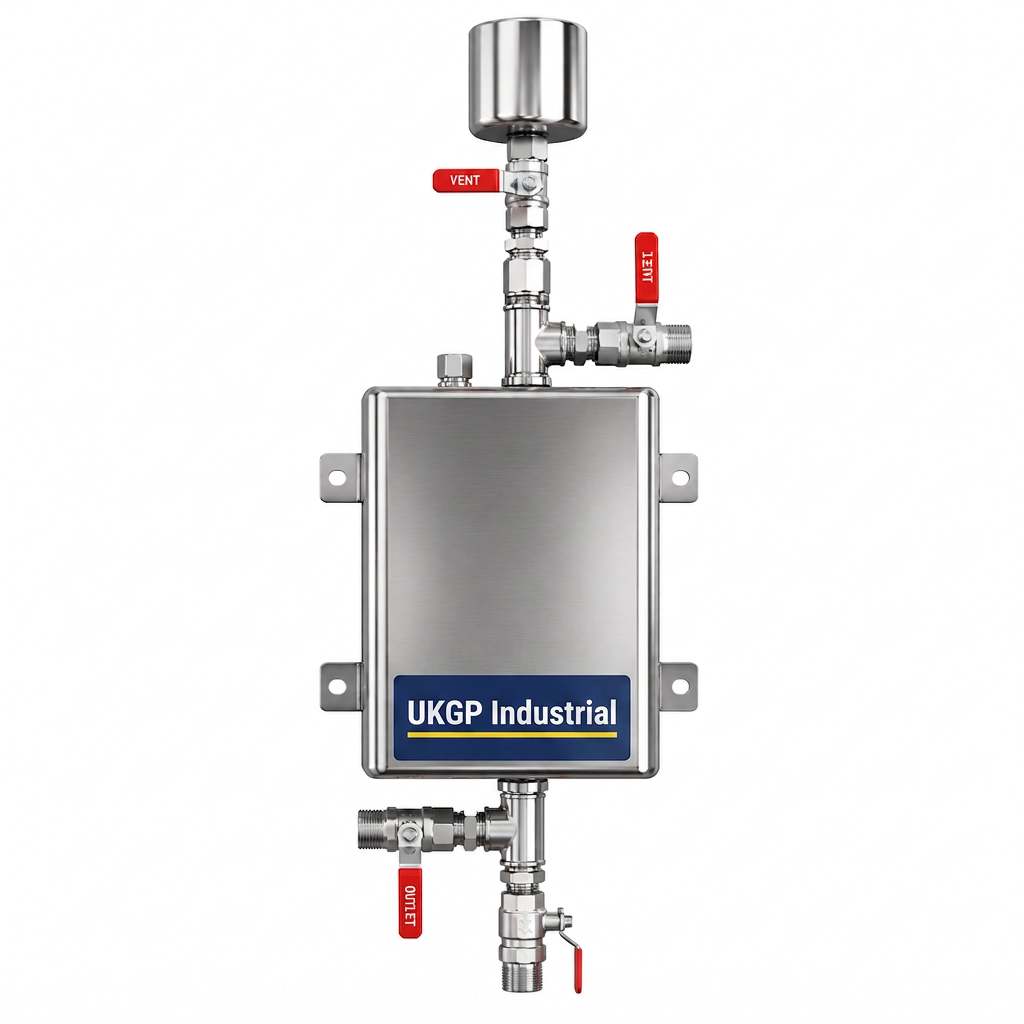
Many UK engineers specify LLHs with internal baffles or Pall rings to further encourage this separation. These internals disrupt the flow and provide a surface for microbubbles to coalesce. According to BSRIA BG50, managing water quality is essential for the longevity of modern thin-walled heat exchangers. Therefore, the LLH should always be fitted with a high-quality automatic air vent (AAV) at the top and a full-bore drain valve or ‘blow-down’ valve at the base.
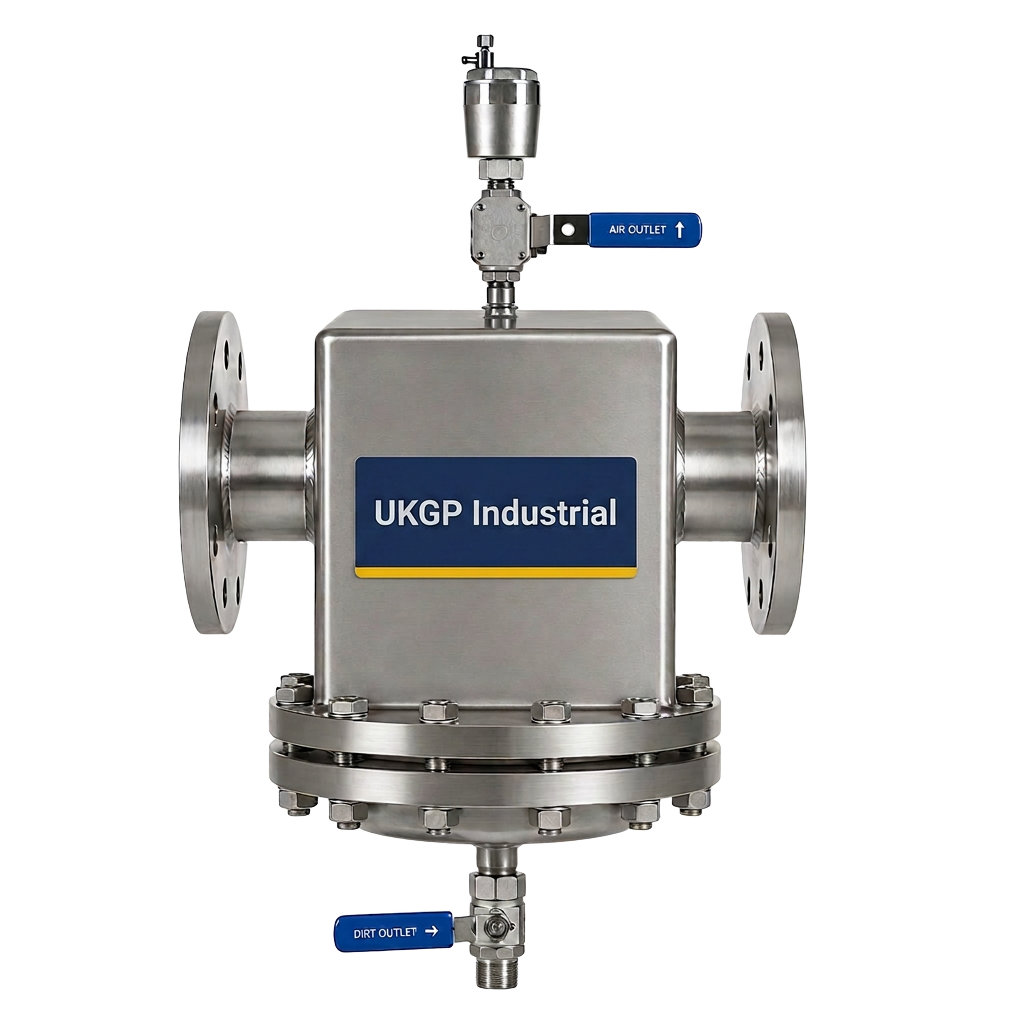
While an LLH provides some separation, in systems with high magnetite levels—common in retrofits involving older cast-iron radiators—a dedicated magnetic dirt separator should still be installed on the return leg. The LLH acts as the final line of defence, but it should not be the sole means of water treatment and filtration.
Installation Requirements and Positioning
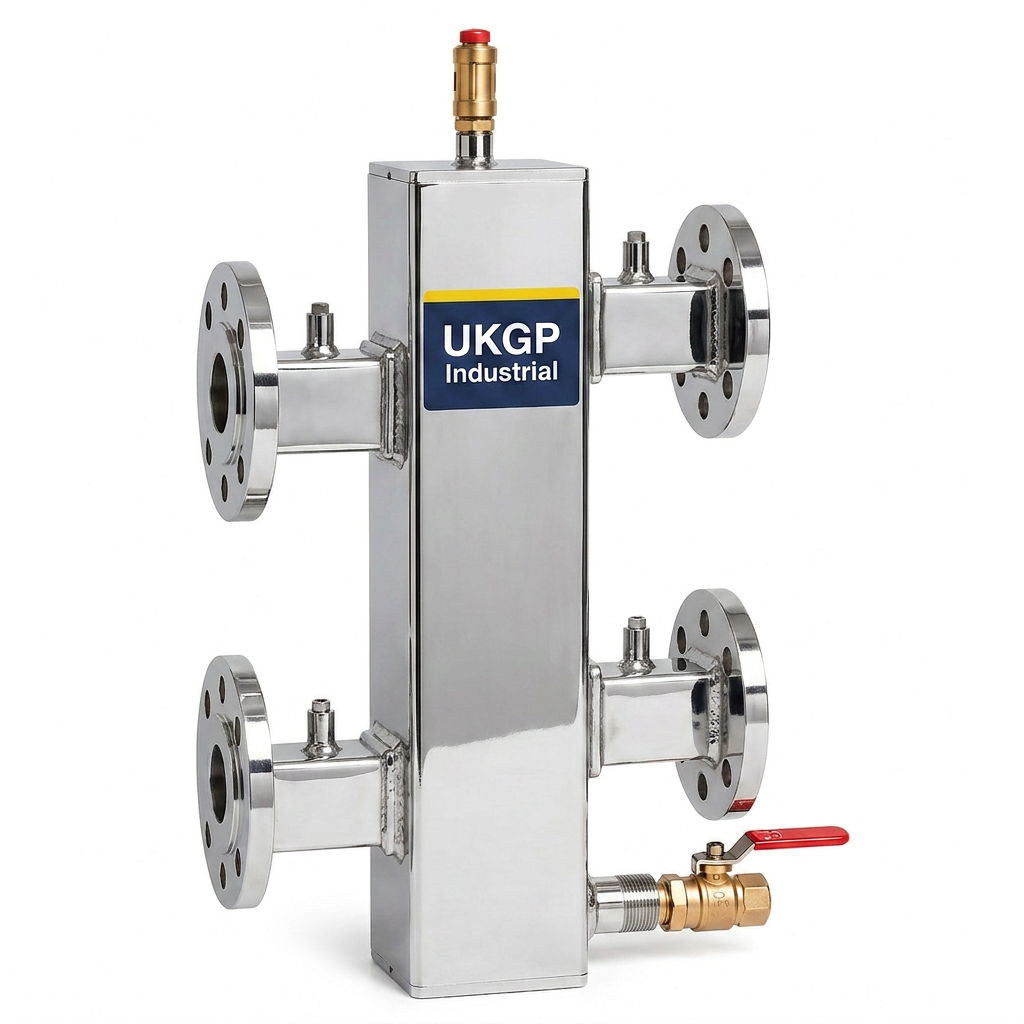
The physical orientation and location of the low loss header are as important as its diameter. It must be installed vertically to facilitate air and dirt separation. The flow from the boilers should enter the top side-inlet, and the flow to the secondary circuit should exit from the opposite top side-outlet. This ensures that the hottest water is harvested from the top of the vessel, respecting natural thermal buoyancy.
Horizontal low loss headers are rarely recommended in commercial plant rooms unless height is extremely restricted. In a horizontal configuration, the ability to vent air and collect sludge is significantly compromised. Furthermore, internal 'short-circuiting' of flow is more likely, where the water bypasses the neutral zone and creates a pressure gradient across the header.
Access for maintenance is a requirement under the CDM (Construction Design and Management) Regulations. The engineer must ensure there is sufficient clearance above the header to replace the air vent and enough clearance below to operate the drain valve. For large headers, a permanent platform or ladder access may be required if the top of the vessel exceeds 2 metres from the finished floor level.
BSRIA and CIBSE Compliance in Design
Compliance with CIBSE AM14 (Non-domestic Hot Water Heating Systems) and BSRIA guidelines is non-negotiable for professional UK M&E consultants. These documents stress the importance of 'variable flow' secondary circuits. As TRVs (Thermostatic Radiator Valves) close, the secondary flow rate drops. The low loss header must be able to handle the resulting bypass flow without causing the boilers to short-cycle. Short-cycling is a leading cause of premature failure in commercial burner components.
Furthermore, when using stainless steel boilers, the header material should be considered. While carbon steel headers are standard, they must be treated with appropriate corrosion inhibitors as per BS 7593. If the system is a 'mixed metal' installation, the risk of galvanic corrosion increases. The presence of a low loss header actually helps mitigate some of the turbulence-induced erosion that can occur in high-velocity systems, protecting the system's thin-walled components.
Finally, the header itself must be insulated to satisfy Part L of the Building Regulations. Because an LLH has a large surface area, it can become a significant source of standing heat loss in the plant room if left unlagged. Most industrial headers are supplied with pre-formed foam or mineral wool jackets to meet these thermal requirements.
Sizing for Cooling and Process Applications
While primarily discussed in the context of heating, low loss headers (or 'decouplers') are equally vital in chilled water (CHW) systems. In cooling applications, the LLH prevents the chiller from being affected by the varying flows of AHU cooling coils. The sizing logic remains similar, but the ΔT is typically much narrower (e.g., 6°C), meaning the volume flow rate per kW is significantly higher than in heating. This often results in much larger headers for seemingly smaller capacities.
In process engineering, where the load may fluctuate instantly (such as in a laundry or industrial wash-down process), the low loss header provides a small amount of thermal 'inertia.' While not a full buffer vessel, the volume within a large-diameter LLH can help dampen the shock of rapid load changes on the boiler's modulation logic.
Whether for heating or cooling, the low loss header is the most effective way to ensure the primary plant operates at its manufacturer-designed flow rate, regardless of what is happening in the building. By adhering to a maximum velocity of 0.1 m/s and following the 4D rule, engineers can eliminate hydraulic issues before they manifest during commissioning.
Frequently asked questions
Can a low loss header replace an air and dirt separator?
- No. While a low loss header provides a degree of settlement and venting, it is not a substitute for a dedicated cyclonic air and dirt separator or high-velocity microbubble deaerator, especially in systems prone to magnetite.
Should the primary flow always exceed the secondary flow?
- Ideally, the primary flow should be slightly higher (approx. 10%) than the secondary flow to ensure the secondary flow temperature remains as close to the flow temperature as possible, though this depends on whether you are prioritising boiler efficiency or emitter output.
What is the maximum internal velocity for a low loss header?
- Standard headers are typically sized for 0.1m/s. If velocities exceed 0.2m/s, the pressure drop increases, and the quality of hydraulic separation diminishes, potentially causing 'ghost' flows in inactive circuits.
Does BS 6644 cover low loss header sizing?
- BS 6644 provides guidance on the installation of gas-fired hot water boilers, and while it doesn't dictate header dimensions, it reinforces the requirement for neutral pressure zones to ensure safe and efficient burner operation.