The Operating Principle of Normally-Closed Solenoid Valves
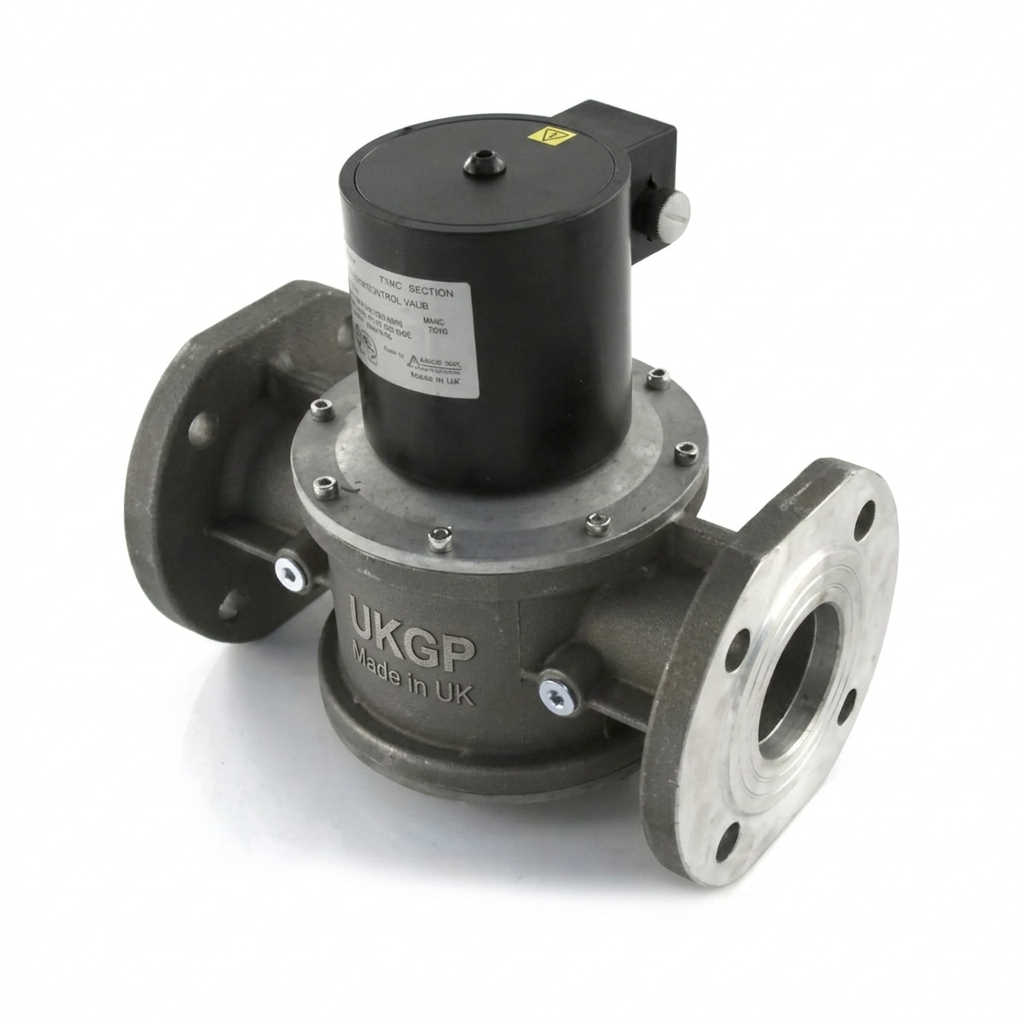
A gas solenoid valve is an electromechanical device used to control the flow of natural gas (methane), LPG, or town gas. In a 'normally-closed' configuration—the standard for UK safety applications—the valve remains shut by mechanical spring force when de-energised. This ensures that in the event of a power failure, gas flow is instantly terminated. When an electrical current is applied to the solenoid coil, it creates an electromagnetic field that pulls a plunger (or armature) upward, overcoming the spring tension and lifting the valve disc off its seat to allow gas flow.
The efficiency of this process is dependent on the coil's ability to maintain the magnetic field over long periods. For commercial plant rooms, coils must be rated for 100% duty cycle (Class H insulation), meaning they can remain energised indefinitely without overheating. In larger pipe diameters, typically above 2 inches (DN50), the valve may use a pilot-operated mechanism where the solenoid opens a small bypass port to equalise pressure across the main diaphragm, but for most UK safety shut-off applications, direct-acting or power-assisted valves are preferred for their speed of closure.
Safety shut-off valves are classified by their closing time. According to EN 161, a Class A valve must close in less than one second once the power supply is interrupted. This rapid response is essential for preventing the accumulation of unburnt gas in the event of a flame failure or emergency shutdown signal from a gas detection system or Building Management System (BMS).
Regulatory Framework: EN 161 and IGEM/UP/2
Every gas solenoid valve installed in a UK commercial or industrial setting must comply with BS EN 161 (Automatic shut-off valves for gas burners and gas appliances). This standard categorises valves by their operating pressure and sealing capabilities. Most specifiers require 'Class A' valves, which provide the highest level of shut-off integrity. Furthermore, valves are categorised into Groups 1 or 2; Group 2 valves are designed to withstand higher mechanical stresses and are generally the standard for industrial pipeline installations.
The Gas Safety (Installation and Use) Regulations 1998, along with IGEM/UP/2 (Gas installation pipework, boosters and compressors on industrial and commercial premises), dictate where and how these valves must be positioned. A key requirement is the implementation of an Automatic Isolation Valve (AIV) where pipework enters a building or feeds high-output plant. This provides a single point of isolation that can be triggered by fire alarms, earthquake sensors, or gas leak detectors.
For commercial catering environments, BS 6173 is the definitive standard. It mandates that gas flow must be interlocked with the ventilation system. If the extract or supply fans fail, the gas solenoid valve must automatically close to prevent the build-up of combustion by-products (CO and CO2). This necessitates a gas proving system or a simple electrical interlock, depending on the age and risk assessment of the kitchen.
Technical Specifications and Sizing Metrics
Selecting the correct valve size is not merely a matter of matching the pipe diameter. Engineers must calculate the pressure drop (Δp) across the valve to ensure the downstream pressure remains sufficient for the appliance’s burner train. A valve that is undersized will cause excessive pressure loss, potentially leading to 'nuisance tripping' of low-pressure switches during peak demand. Conversely, an oversized valve can lead to sluggish response times and unnecessary costs.
Flow rates are typically measured in cubic metres per hour (m³/h) at a specific pressure drop. Standard natural gas solenoids are rated for 230V AC or 24V DC operation. The maximum operating pressure (MOP) is another critical metric; plant room valves usually handle pressures from 200 mbar to 500 mbar, while industrial high-pressure variants can exceed 6 bar. It is essential to ensure the valve body material is compatible with the gas type; for natural gas, die-cast aluminium or brass is standard, while certain LPG applications may require specific seal materials like NBR (Nitrile Butadiene Rubber) or Viton.
Environmental factors also dictate the specification. For outdoor installations or damp plant rooms, the solenoid coil must have an appropriate Ingress Protection (IP) rating, typically IP65. Many UKGP Industrial valves feature a 'Power-Reduced' coil design, where an internal circuit reduces the current once the valve is open, significantly lowering the operating temperature and extending the component's lifespan.
Interlocking with Fire Alarms and BMS
In modern integrated buildings, the gas solenoid valve acts as the 'muscle' for the site’s safety logic. Wiring the valve through the Building Management System (BMS) allows for automated shut-down protocols. For example, if a smoke detector in a non-gas area is triggered, the BMS can be programmed to isolate the gas supply to the entire floor as a precautionary measure. This is often achieved through a normally-closed circuit; if the cable is cut or the BMS controller fails, the valve loses power and shuts safely.
Emergency Stop (EM-Stop) buttons are another vital integration. Positioned at plant room exits and in kitchen corridors, these 'mushroom' buttons provide a hard-wired break in the power supply to the solenoid. Under BSRIA and CIBSE guidelines, these circuits should be monitored. Some engineers specify valves with 'Closed Position Indicator' (CPI) switches. These are micro-switches attached to the bottom of the gas valve that provide a physical confirmation back to the BMS that the valve is indeed closed, offering a higher level of safety assurance than internal current monitoring alone.
For applications involving large boilers or multiple appliances, a 'Gas Proving System' is often installed. The solenoid valve remains closed until the proving system performs a leak test on the downstream pipework by monitoring pressure decay. Only once the system is proved gas-tight does the controller energise the solenoid valve to allow the main flow.
Differences Between Automatic and Manual Reset Valves
A fundamental distinction in valve selection is the reset mechanism. An 'Automatic Reset' gas solenoid valve will return to the open position as soon as electrical power is restored. This is ideal for unmanned plant rooms or applications where power flickers are common and would otherwise cause the heating system to fail unnecessarily. However, the designer must ensure that the downstream appliances have their own flame-safeguard controls to prevent gas escaping when the valve re-opens.
A 'Manual Reset' solenoid valve requires a human operator to physically pull a lever or press a button to re-open the valve after a power interruption, even if the electrical supply has returned. These are frequently used in schools, laboratories, and commercial kitchens where a safety assessment is required before gas flow is restored. This ensures that no gas hobs or Bunsen burners were left in the 'on' position during the power outage.
The choice between the two is often governed by a site-specific risk assessment. In most commercial boiler houses, automatic reset valves are the standard because the boilers themselves have an internal start-up sequence that includes a pre-purge and ignition safety check. However, where gas is supplied to manual appliances, manual reset valves provide a crucial layer of secondary protection against accidental gas release.
Installation Best Practices and Orientation
The longevity and reliability of a gas solenoid valve are heavily influenced by its installation. Valves should ideally be installed in a horizontal pipe run with the solenoid coil pointing vertically upwards. While some models allow for a 90-degree tilt, installing a valve upside down is strictly prohibited as it allows moisture and particulate matter to collect in the plunger tube, causing the valve to stick or the coil to short out. One must also observe the direction of flow, indicated by an arrow on the valve body; installing a valve backwards will prevent it from sealing against the gas pressure.
Upstream filtration is a non-negotiable requirement under BSRIA BG29/21. Even small amounts of pipe scale, welding slag, or dust can prevent the valve disc from seating correctly, leading to 'let-by.' A gas filter with a 50-micron element should be installed immediately before the solenoid valve. Furthermore, the valve should be positioned away from sources of excessive heat or vibration, which can fatigue the electrical connections and degrade the coil insulation.
Electrical connections must be made using heat-resistant cabling if the valve is in close proximity to a boiler. A local isolation switch should be provided for maintenance purposes, clearly labelled 'Gas Shut-off Valve.' When commissioning, the engineer should perform a 'tightness test' on the entire assembly to ensure there are no leaks at the flanged or threaded connections, particularly after the mechanical stress of tightening the valve into the pipework.
Maintenance according to BG50 and CIBSE Guidelines
Routine maintenance is essential to ensure the fail-safe operation of the gas supply. BSRIA BG50 recommends that gas safety systems be tested at least annually. The primary test for a solenoid valve is the 'drop test,' where power is intentionally cut to ensure the valve closes within the mandated one-second window. During this test, the downstream pressure should be monitored to ensure the valve is achieving a bubble-tight seal; any rise in pressure indicates the valve is letting by and requires servicing or replacement.
Over time, the solenoid coil may exhibit a 'humming' or 'buzzing' sound. This is often caused by debris between the plunger and the tube or a failing shading ring within the AC coil assembly. If left unaddressed, this vibration can lead to mechanical wear and eventual coil burnout. In environments with high humidity or chemical vapours, the coil's casing should be inspected for cracks or swelling. If the coil shows signs of discolouration due to heat, it should be replaced immediately, and the ambient temperature should be assessed.
For larger valves, internal components such as the springs and NBR seals can be replaced using manufacturer-approved overhaul kits. However, for smaller threaded valves (below 2 inches), it is often more cost-effective to replace the entire unit. Every maintenance intervention must be logged, and the gas safety certificate updated to show that the ASV (Automatic Shut-off Valve) remains functional and compliant with UK gas safety regulations.
UKGP Industrial: Solutions for Gas Safety Control
UKGP Industrial provides a comprehensive range of gas solenoid valves designed specifically for the rigours of UK plant rooms and industrial processes. Our valves are fully certified to EN 161 Class A standards, ensuring they meet the highest safety requirements for natural gas and LPG applications. From 1/2" BSP threaded valves for kitchen interlocks to large DN flange valves for district heating headers, we offer robust solutions for every scale of installation.
Our products are engineered with the contractor in mind, featuring clear wiring diagrams, high-quality die-cast bodies, and coils rated for continuous duty. We understand the importance of avoiding downtime back-charges, which is why our valves are tested for high-cycle reliability and rapid response. Whether you are replacing an aged valve during a BSRIA BG50 audit or specifying a new BMS-controlled safety system, our technical team can provide the sizing data and flow coefficients required for a precise installation.
In addition to standard automatic-reset valves, we supply versions with CPI (Closed Position Indicator) switches for advanced safety monitoring and manual-reset options for educational and catering facilities. By choosing UKGP Industrial, engineers gain access to reliable hardware that ensures compliance with IGEM/UP/2 and BS 6173, backed by UK-based technical support and stock availability.
Frequently asked questions
What standards must a gas solenoid valve meet for UK commercial installations?
- In the UK, gas solenoid valves must be CE or UKCA marked and certified to EN 161. They are typically classified by 'Groups' and 'Classes' (e.g., Class A Group 2), which define their sealing integrity and operational pressure range.
What is the difference between NC and automatic reset?
- A 'Normally Closed' (NC) valve remains shut by spring force until electrical power is applied to the solenoid coil. An 'Automatic Reset' valve will automatically re-open once power is restored, whereas a manual reset valve requires a physical intervention to restore flow.
How should a gas solenoid valve be integrated into a BMS?
- The gas valve is the final element in the safety chain. It must be interlocked with the Emergency Stop (EM-Stop) circuit, fire alarm interfaces via the BMS, and, in commercial kitchens, the fan proving system as per BS 6173.
Why do solenoid coils burn out in plant room environments?
- Thermal stress is the primary cause. When a valve is energised, the coil generates heat. If the ambient plant room temperature is high or the coil is inadequately rated for 100% duty cycle, the insulation may fail. Ensure valves are rated for S1 continuous duty.
What are the maintenance requirements for gas solenoids under BG50?
- Valves should be inspected annually. Testing involves checking for 'let-by' (internal leakage) and ensuring the valve closes within one second of power being removed. Debris on the valve seat is a common cause of failure, which is why upstream filtration is mandatory.