Regulatory Framework and Compliance Standards
The installation and operation of automatic gas shut-off valves in the UK are governed by a strict hierarchy of British and European standards. Primary amongst these is EN 161, which classifies automatic shut-off valves into different groups and classes. For most commercial plant room applications, a Class A valve is required, signifying the highest level of sealing integrity and durability. These valves are designed to withstand the rigours of continuous duty while ensuring a bubble-tight seal when de-energised.
Beyond the component vibration and pressure ratings, the application-specific guidance provided by the Institution of Gas Engineers and Managers (IGEM) is critical. IGEM/UP/2 provides the framework for gas pipework in industrial and commercial premises, highlighting the necessity for emergency control valves (ECVs) and automatic isolation. Compliance with these standards is not merely a best practice but a statutory requirement under the Gas Safety (Installation and Use) Regulations, which mandate that all gas systems must be maintained in a safe condition.
For facilities managers and M&E contractors, ensuring that the selected solenoid valve carries the CE or UKCA mark and is explicitly rated for the intended gas family (Natural Gas, LPG, or Town Gas) is the first step in compliance. Failure to specify a valve that meets EN 161 standards can lead to insurance invalidation and, more importantly, a failure of the safety chain during a gas escape event.
- EN 161: Automatic shut-off valves for gas burners and gas appliances.
- IGEM/UP/2: Installation of pipework on industrial and commercial premises.
- BS 6173: Specification for installation of gas-fired catering appliances.
- Gas Safety (Installation and Use) Regulations 1998 (GSIUR).
Technical Characteristics of Normally-Closed Valves
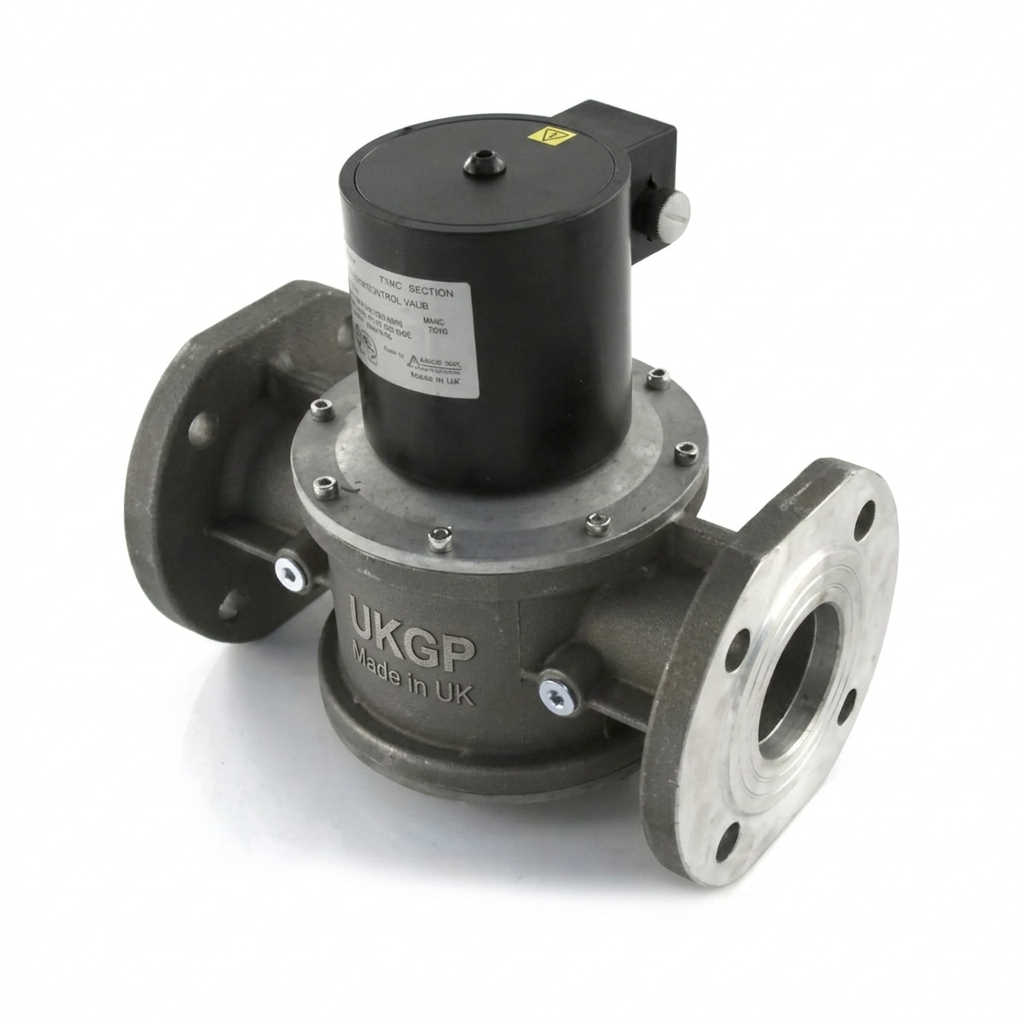
Normally-Closed (N/C) solenoid valves are the industry standard for safety applications because they are inherently fail-safe. In their de-energised state, a heavy-duty internal spring holds the valve disc firmly against the seat, preventing gas flow. When a 230V or 24V signal is applied to the solenoid coil, an electromagnetic field is generated, lifting the plunger and allowing gas to pass. This design ensures that if there is a power cut or a signal from a gas detection panel, the gas supply is immediately severed.
Automatic-reset valves are distinct from manual-reset versions. While manual-reset valves require a technician to physically reset a lever after a trip, automatic-reset valves will re-open as soon as power is restored to the coil. This is particularly advantageous in remote plant rooms or facilities where a BMS manages the safety sequences. However, it is essential that the control logic (via the gas detection panel) prevents the valve from resetting until the 'gas cleared' state is confirmed and any latched alarms are manually acknowledged.
Modern industrial solenoid valves are engineered to handle high flow rates with minimal pressure drop across the orifice. For larger pipework, typically above 50mm (2"), flanged connections (PN16) are standard, whereas smaller installations utilise threaded BSP connections. The internal components, including the NBR or Viton seals, must be compatible with the chemical composition of the gas to prevent degradation over time, which is a common cause of internal leakage or 'passing'.
- Instantaneous cut-off (typically <1 second) upon loss of power.
- Automatic reset capability once the electrical signal is restored.
- Die-cast aluminium or brass bodies for robust industrial use.
- Visual indicators (LED or mechanical) showing valve status.
Integration with Gas Detection Systems
A gas solenoid valve is only as effective as the detection system that triggers it. In a typical UK plant room, the gas detection panel acts as the 'brain' of the safety system. This panel monitors signals from various sensors—typically catalytic bead or electrochemical cells—calibrated for specific gases. When the concentration of gas reaches a pre-set threshold (usually 10% or 20% of the Lower Explosive Limit, LEL), the panel breaks the circuit to the solenoid valve, triggering an immediate shutdown.
The synergy between the valve and the detectors requires careful engineering. For instance, the placement of sensors is governed by the vapour density of the gas being monitored. In a boiler house using natural gas, sensors must be located near the ceiling where methane accumulates. Conversely, in an LPG storage area, sensors must be at floor level. The solenoid valve should be positioned as close to the point of entry as possible to isolate the maximum amount of internal pipework.
In many high-output installations, the system is also interlocked with the fire alarm and emergency stop buttons (break-glass units). This 'common-trip' logic ensures that the gas supply is isolated not just during a leak, but also during a fire or manual emergency, preventing the fuel from feeding a conflagration or presenting a hazard to first responders.
- Sensor placement: Methane (Natural Gas) is lighter than air (high level), LPG is heavier (low level).
- Multi-zone monitoring for large industrial halls.
- Interlocking with ventilation systems (e.g., fan proving).
- Calibration and self-test routines for gas detectors.
BMS Interfacing and Remote Monitoring
The role of the Building Management System (BMS) in gas safety is twofold: monitoring and secondary control. While the gas detection panel must remain a standalone safety-rated system, it is standard practice to provide volt-free contacts to the BMS for remote monitoring. This allows facilities managers to receive real-time alerts on valve status (Open/Closed) and alarm conditions through a centralised head-end. Many UKGP Industrial valves can be fitted with auxiliary switches to provide physical confirmation of the valve position to the BMS.
Advanced BMS integration allows for sophisticated sequencing. For example, during a planned building shutdown, the BMS can demote the gas valve signal to save energy or perform routine 'exercise' cycles of the valve to prevent the armature from sticking due to infrequent use. However, the safety logic within the gas detection panel must always override the BMS commands; a 'safe' signal from the BMS cannot open a valve if the gas detector is sensing a leak.
Engineers must also consider the electrical inrush current when multiple solenoid valves are energised simultaneously through the BMS or a control panel. High-power solenoids can draw significant current during the 'pull-in' phase. Utilising power-reduction circuits or sequenced startup through the BMS helps protect control relays and prevents voltage drops that could lead to valve 'chatter', which causes premature wear on the valve seat.
Sizing and Specification Considerations
Correct sizing of a gas solenoid valve is a critical engineering task that goes beyond simply matching the pipe diameter. The valve must be sized based on the maximum gas flow rate (m³/h) and the available inlet pressure (mbar). An undersized valve will induce a high pressure drop, potentially starving the burners and causing combustion instability or 'nuisance' tripping of the flame reversal switches. Conversely, an oversized valve can lead to poor control and unnecessary cost.
UK gas pressures typically range from 21mbar for domestic/light commercial to several bar for industrial process lines. Solenoid valves are rated for specific Maximum Operating Pressures (MOP). Using a low-pressure valve on a high-pressure line is a significant safety risk, as the solenoid may fail to close against the force of the gas, or the diaphragm may rupture. For industrial applications, 200mbar, 360mbar, and 6bar rated valves are the most common benchmarks.
Environmental conditions also dictate material choice. In corrosive environments or coastal areas, standard aluminium-bodied valves may suffer from external oxidation. In these cases, epoxy-coated bodies or stainless-steel variants are required. Additionally, the IP (Ingress Protection) rating must be appropriate for the location; an IP65 rating is generally sufficient for indoor plant rooms, but higher protection or heated jackets may be needed for outdoor LPG tanks where freezing is a risk.
- Pressure drop (Delta P) must be calculated to ensure sufficient burner inlet pressure.
- Ambient temperature ratings, especially for outdoor LPG installations.
- IP rating (typically IP65) for protection against dust and moisture.
- Duty cycle: Valves must be rated for 100% continuous duty.
Installation and Maintenance Protocols
Installation of gas solenoid valves must be performed by a Gas Safe registered engineer with the appropriate commercial qualifications. The valve must be installed in the orientation specified by the manufacturer—typically with the coil upright or within 90 degrees of the vertical. Installing a valve upside down can lead to debris accumulating in the armature tube, preventing the valve from opening or closing fully. Prior to installation, the pipework must be purged and cleaned in accordance with BSRIA BG29/21 to ensure no swarf or grit enters the valve.
Most industrial gas valves are fitted with an internal mesh filter at the inlet. This filter protects the delicate seating surfaces from pipe scale and debris. During routine maintenance (at least annually), this filter should be inspected and cleaned. A blocked filter is a common cause of gradual pressure drop increases across the gas train. If the valve is 'passing' (leaking downstream when closed), it typically indicates that debris has scarred the nitrile seat or is preventing the plunger from fully homing.
Maintenance should also include a functional test of the entire safety loop. This involves applying a test gas to the detectors and verifying that the solenoid valve closes within the required timeframe. The electrical connections should be checked for tightness, and the coil should be inspected for any cracks or discolouration, which may indicate that the valve is operating at excessive ambient temperatures or experiencing voltage fluctuations.
- Internal leak testing (bubble-tightness).
- Visual inspection of the coil for signs of overheating.
- Verification of the 'trip' time from the gas detector.
- Cleaning of the internal mesh filter.
Advanced Safety Features and Future Trends
As the UK moves towards a Net Zero gas grid, the compatibility of safety valves with hydrogen blends is becoming a primary concern. Hydrogen molecules are significantly smaller than methane, which increases the risk of 'leakage at the molecular level'. Current research and update of EN 161 are focusing on ensuring that the seal materials and casting densities of solenoid valves are suitable for up to 20% hydrogen blends without compromising safety. Engineers should now be specifying 'hydrogen-ready' valves for any new long-term infrastructure projects.
Another emerging trend is the integration of 'smart' diagnostics directly into the solenoid coil. These valves can monitor their own opening/closing times and current draw, sending a 'service required' warning to the BMS before a failure occurs. This shift from reactive to predictive maintenance is particularly valuable in critical process industries where an unplanned gas shutdown can result in significant financial losses.
Finally, the use of gas proving systems is becoming more widespread in commercial boiler rooms. A gas proving system performs a leak-tightness test on the downstream pipework every time the system is powered up, before the main solenoid valve is allowed to open. This ensures that no manual valves have been left open and no leaks have developed during the 'off' period, providing an additional layer of automated security that complements the gas detection system. Borging these systems together creates a robust, multi-layered safety architecture.
- Hydrogen blends and the impact on seal materials.
- Wireless gas detection for retrofit applications.
- Energy-efficient 'low-power' coils to reduce plant room heat loads.
- Digital twin integration for predictive maintenance.
Conclusion: Ensuring System Integrity
Specifying a gas solenoid valve for use with a detection system is a critical task that bridges the gap between mechanical pipework and electrical safety systems. The valve is the final actor in the safety chain, and its reliability is paramount. By adhering to UK standards such as IGEM/UP/2 and ensuring correct sizing and orientation, engineers can provide a safety solution that is both compliant and durable.
The integration of these valves into a wider Building Management System provides the transparency needed for modern facility management, but it must never compromise the standalone safety function of the gas detection loop. As we look forward to changes in gas composition and the adoption of more 'intelligent' plant rooms, the fundamental principle remains: a fail-safe, normally-closed solenoid valve is the most effective way to protect lives and property from gas-related hazards.
For consultants and contractors, the choice of a high-quality valve from a reputable supplier is an investment in the long-term safety and uptime of the building. Regular maintenance and a thorough understanding of the interlocks between detection, fire systems, and gas delivery are the hallmarks of a well-engineered gas safety strategy.
- Ensure the valve is EN 161 compliant.
- Verify the gas type and pressure rating.
- Check the voltage requirement for control panels.
- Select the appropriate connection type (BSP vs Flanged).
Frequently asked questions
Is gas proving mandatory for all automatic solenoid valves?
- Under BS 6173, gas proving (leak tightness testing) is mandated for commercial kitchens where manual isolation valves are the only form of control or where interlocking exists. However, for large plant rooms and boiler houses covered under IGEM/UP/2, proving is a recommended best practice to ensure the integrity of the downstream pipework before the valve resets.
What is the benefit of a Normally Closed valve over a Normally Open type?
- A Normally Closed (N/C) valve requires a continuous electrical signal to remain open. In the event of a power failure, gas detection trigger, or E-stop activation, the magnetic field collapses, and an internal spring forces the valve shut. This 'fail-safe' mechanism is vital for life safety systems.
Where should the solenoid valve be positioned in the gas train?
- The valve should be installed downstream of the primary meter and manual isolation valve, typically at the point of entry to the plant room. It must be accessible for maintenance and clearly labelled. It should always be installed upstream of the appliances it serves.
Can standard natural gas solenoids be used for biogas applications?
- No. Standard solenoids are designed for clean fuel gases. For biogas or 'sour' gas applications, specialised valves with EPDM or Viton seals and corrosion-resistant coatings are required to prevent premature diaphragm failure.
What are the common failure modes for automatic gas valves?
- If the valve is humming, it usually indicates a dirty armature, low voltage, or a failing coil. If it fails to open, check the electrical supply and ensure the inlet pressure does not exceed the valve's maximum operating pressure (MOP), as excessive pressure can prevent the plunger from lifting.