Applications and Constraints of Threaded Solenoid Valves
Threaded gas solenoid valves are the standard for small-to-medium commercial installations, typically ranging from 1/2" to 2" (DN15 to DN50). These valves are usually manufactured from die-cast aluminium or brass, conforming to EN 161 Class A safety standards. In applications such as modular boiler cascades or commercial catering environments governed by BS 6173, threaded valves provide a cost-effective and space-efficient solution. Because they rely on the mechanical integrity of the pipe thread, they are best suited for systems where vibration is minimal and the pipework is adequately supported to prevent stress on the valve body.
However, the primary limitation of threaded valves is the risk of 'galling' or cross-threading during installation, especially when working with larger 2" variants. Furthermore, maintenance becomes complex in rigid pipework systems; removing a threaded valve often requires the dismantling of significant sections of the downstream pipework unless unions are strategically placed. For engineers following BSRIA BG29/21, the integrity of these joints is paramount during pressure testing, as threaded connections are more prone to micro-leaks over time compared to their flanged counterparts.
- Parallel threads (Rp) per BS EN 10226-1 for pressure-tight joints.
- Compact footprint suitable for tight manifold configurations.
- Direct integration with gas meter regulators and residential/light commercial headers.
The Engineering Shift to Flanged Connections (DN65 and Above)
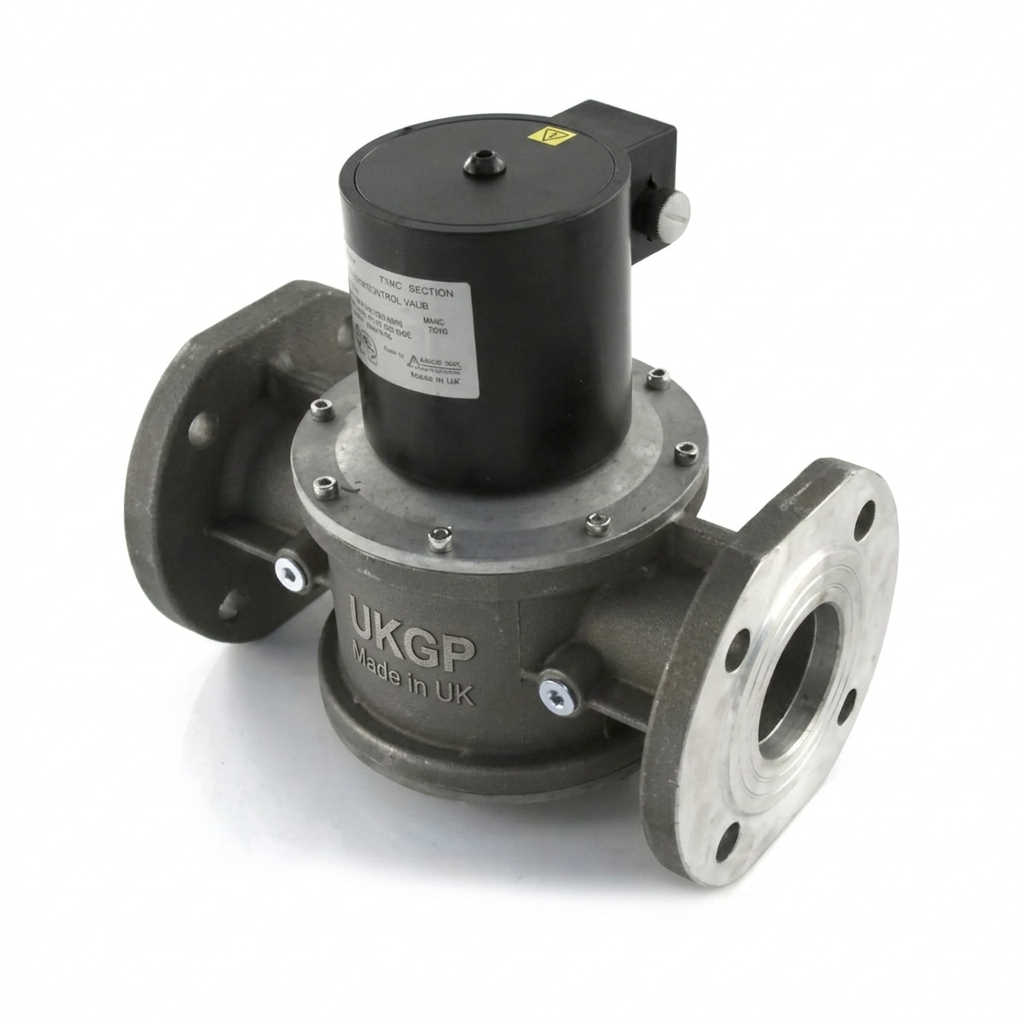
As pipe diameters exceed 50mm, the torque required to achieve a gas-tight seal on a threaded joint becomes impractical and increases the risk of component failure. Flanged gas solenoid valves, typically starting at DN65 and extending to DN300, are the industry standard for main plant room headers and high-output industrial burners. These valves utilise PN16 or ANSI flanges, providing a robust interface that distributes mechanical loads evenly across the valve casing. This is critical in large-scale boiler houses where thermal expansion and contraction can exert significant forces on the gas train.
From a maintenance perspective, flanged valves are vastly superior. In accordance with IGEM/UP/2, gas systems must be regularly inspected and tested. A flanged UKGP Industrial gas solenoid valve can be isolated and removed from the line by simply extracting the bolts, without disturbing the surrounding pipework. This 'drop-out' capability reduces downtime during mandatory safety checks or solenoid coil replacements. Additionally, the use of high-quality gaskets (such as compressed aramid fibre) ensures a more reliable seal under wide temperature fluctuations than PTFE tape or thread hemp.
- Enhanced structural rigidity for large-diameter pipework.
- Ease of removal via flange bolts, facilitating regular inspection per BG50.
- Reduction in potential leak paths on high-flow industrial gas lines.
Technical Performance and Flow Dynamics
The internal geometry of a solenoid valve significantly affects the flow of gas. Threaded valves often have a more restrictive internal bore relative to their connection size, which can lead to higher pressure drops (ΔP). For gas-fired equipment where the inlet pressure is marginal, such as a 21mbar supply, excessive pressure drop across a solenoid valve can lead to burner instability or lockout. Engineers must consult the flow rate charts—typically measured in m³/h of air or natural gas—to ensure the selected valve size maintains a pressure drop below 1-2 mbar at peak demand.
Flanged valves generally offer a more 'full-bore' equivalent flow path. Because the valve body is larger, the internal orifice can be optimised to reduce turbulence. When designing systems under IGEM/UP/2 Edition 3, engineers should calculate the total pressure loss from the meter to the burner. If a 2" threaded valve introduces an unacceptable ΔP, up-sizing to a DN65 flanged valve with reducers may be necessary to ensure the downstream appliance receives gas at the required dynamic pressure.
- Calculation of Kv values to ensure minimum pressure drop across the seat.
- Impact of valve orientation on solenoid lifespan and closing speed.
- Ensuring Class A shut-off performance (EN 161) under peak load.
Safety Standards and BMS Integration
Both threaded and flanged automatic-reset valves function as the primary safety cut-off in the event of an emergency. In the UK, these are frequently interlocked with fire alarm systems, CO2 monitors, or emergency stop buttons. While the core solenoid function is identical, larger flanged valves are more frequently specified with Closed Position Indicator (CPI) switches. These micro-switches provide a volt-free contact to the BMS, confirming that the valve has physically closed. This is a critical safety requirement for larger industrial burners where 'proof of closure' is mandated before a purge cycle can commence.
For contractors installing these units, the electrical requirements remain consistent: 230V AC is standard, though 24V DC and 110V options exist. The valve must be 'normally closed,' meaning it requires power to open and will fail-safe to the closed position upon loss of power. Whether using a threaded UKGP Industrial valve or a larger flanged model, ensure it is rated to IP54 or higher to protect the solenoid coil from the ambient conditions found in industrial plant rooms or semi-outdoor enclosures.
- Integration with Gas Interlock Systems (GIS) for kitchen safety.
- Connection to Building Management Systems (BMS) for remote monitoring.
- Use of Closed Position Indicator (CPI) switches on larger flanged valves.
Best Practices for Installation and Maintenance
Regardless of the connection type, the longevity of a gas solenoid valve depends on the cleanliness of the gas stream. It is a fundamental requirement to install a gas filter upstream of the valve (within 1 metre) to prevent welding slag, pipe scale, or debris from damaging the soft NBR seal. For threaded valves, ensure that no excess thread sealant enters the valve body. For flanged valves, bolts should be tightened in a star pattern to the manufacturer's specified torque to prevent distortion of the valve seat.
Finally, consider the orientation. Most automatic-reset valves are designed for horizontal pipework with the solenoid coil pointing upwards (within 90 degrees of vertical). Installing a flanged valve upside down can lead to premature wear of the internal guides and may collect moisture or debris in the solenoid housing, leading to electrical failure. Following these British standards and manufacturer guidelines ensures the gas safety system remains robust for its intended service life.
- BSRIA BG50 guidelines for gas system cleanliness and scale prevention.
- Installation of upstream gas filters to protect valve seats.
- Annual tightness testing procedures per IGEM/UP/1.
Frequently asked questions
Do commercial kitchens require flanged valves by law?
- While BS 6173 requires an automatic gas shut-off for most commercial kitchens, the choice of connection depends on the pipe size. Generally, kitchens use 1/2" to 2" threaded valves, but high-output central production units with 65mm+ manifolds require flanged variants.
Is the closing time slower for larger flanged valves?
- Class A valves (conforming to EN 161) must close in less than one second. This requirement remains the same regardless of whether the valve is threaded or flanged, as it is a function of the internal spring-return mechanism.
What pressure ratings are typical for these valves?
- Standard industrial valves are usually rated to 200mbar or 360mbar. For high-pressure gas boosters or industrial kilns, you must specify high-pressure flanged valves (up to 6 bar), which are rarely available in threaded formats above 1".
Can I use the same flanged valve for LPG and Natural Gas?
- Yes, provided the valve is rated for the specific gas. Most UKGP Industrial solenoid valves are certified for Natural Gas, LPG, and Town Gas. Always check the seal material (NBR or Viton) for compatibility with specific gas compositions.