The Mechanics of Plate Heat Exchanger Pressure Drop
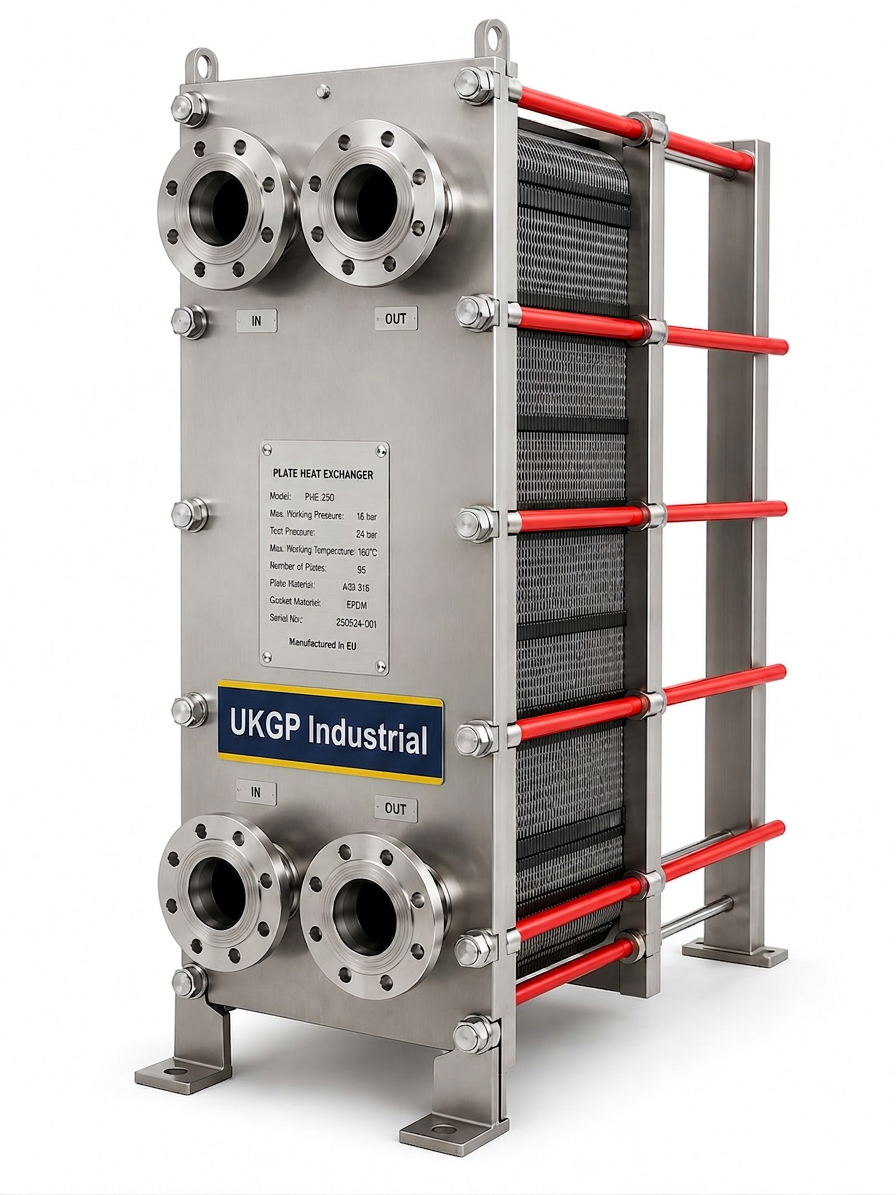
In modern UK commercial plant rooms, the plate heat exchanger is the cornerstone of efficient heat transfer, yet its performance is fundamentally limited by available pump head. Pressure drop occurs as the fluid travels through the narrow, corrugated channels between the stainless steel plates, where turbulence is intentionally created to enhance the heat transfer coefficient. While high turbulence improves thermal efficiency, it exponentially increases the resistance to flow. For M&E contractors, selecting a plate heat exchanger with an excessively high pressure drop can lead to increased operational costs and premature pump wear, necessitating a careful review of the system's hydraulic curve during the design phase.
Effective sizing involves calculating the 'Alpha' and 'Beta' angles of the plate corrugations. High-theta plates offer high heat transfer but greater resistance, whereas low-theta plates allow for higher flow rates at the cost of thermal length. When UKGP Industrial engineers review a thermal spec, we analyze these variables to ensure the plate heat exchanger operates within the sweet spot of the primary and secondary circuits. This technical oversight prevents the common mistake of over-specifying plate surface area, which can lead to low velocities and subsequent fouling, especially in systems where BSRIA BG50 water quality standards are not strictly maintained during the initial commissioning phases.
From a commercial perspective, ignoring the pressure drop across a plate heat exchanger can invalidate the energy model of a building. As UK building regulations become more stringent regarding auxiliary power, every kilopascal of unnecessary resistance must be accounted for. By specifying a unit that aligns with the specific pump characteristics of the project, engineers can ensure that the system achieves the desired Delta T without necessitating oversized centrifugal pumps. UKGP provides comprehensive thermal data for all plate heat exchanger enquiries, ensuring that your procurement lead has the exact figures required for accurate energy performance certificates and life-cycle cost analysis.
- Analysis of chevron angles and their impact on hydraulic resistance
- Balancing thermal length (NTU) against available system pump head
- Impact of plate thickness on structural integrity and heat transfer
- Verification of pressure drop for BSRIA BG29 compliance
Sizing Trade-offs for Gasketed and Brazed Units
Choosing between a gasketed and a brazed plate heat exchanger often comes down to the required DN size and the maintenance philosophy of the facility manager. Gasketed units, available from UKGP in sizes DN20 up to DN300, offer the advantage of being fully serviceable and expandable. If the thermal load of a building increases, additional plates can be added to the chassis. However, this flexibility means the unit carries a larger physical footprint in the plant room. Sizing these units requires precise thermal specs to ensure that the chosen frame can handle any future expansion without exceeding the maximum allowable pressure drop for the existing pipework infrastructure.
Brazed plate heat exchangers are the compact alternative, ideal for district heating substations or integrated heat pump modules where space is a premium. Because they lack gaskets and frames, they are incredibly cost-effective but cannot be opened for manual cleaning. When specifying a brazed plate heat exchanger, it is vital to account for the potential for scaling. If the system experiences high levels of hardness or particulate matter, the pressure drop will increase over time as the internal channels narrow. Our 2-year warranty provides peace of mind, but we always recommend robust pre-filtration to protect these high-efficiency components from debris often found in older UK secondary heating loops.
For procurement leads, the lead time is often as critical as the technical spec. UKGP Industrial maintains a streamlined supply chain allowing for a 4-6 week lead time on most gasketed and brazed units sized from a full thermal spec. This ensures that M&E contractors can stay on schedule despite the complexities of modern site logistics. Whether you are dealing with a standard LTHW circuit or a more complex process cooling application, we provide the technical documentation required to justify the selection to the client, including detailed pressure drop curves and material certification in line with BS EN standards.
- Range from DN20 to DN300 for varied commercial capacities
- Selection between NBR, EPDM, and Viton gaskets for chemical compatibility
- Comparison of frame heights and footprint for tight plant room spaces
- Thermal specification requirements for accurate quotation
Impact of Water Quality on Heat Exchanger Longevity
Thermal performance is not a static metric; it is heavily influenced by the condition of the circulating media. This is where British Standards like BS 8552 and BSRIA BG29 come into play. A plate heat exchanger operating in a system with poor water chemistry will quickly accumulate biofilm or magnetite. This fouling significantly increases the plate heat exchanger pressure drop while simultaneously acting as an insulator, reducing the heat transfer rate. For FM teams, a sudden rise in the differential pressure across the heat exchanger is a primary indicator that the system requires chemical cleaning or secondary filtration intervention to restore original design efficiency.
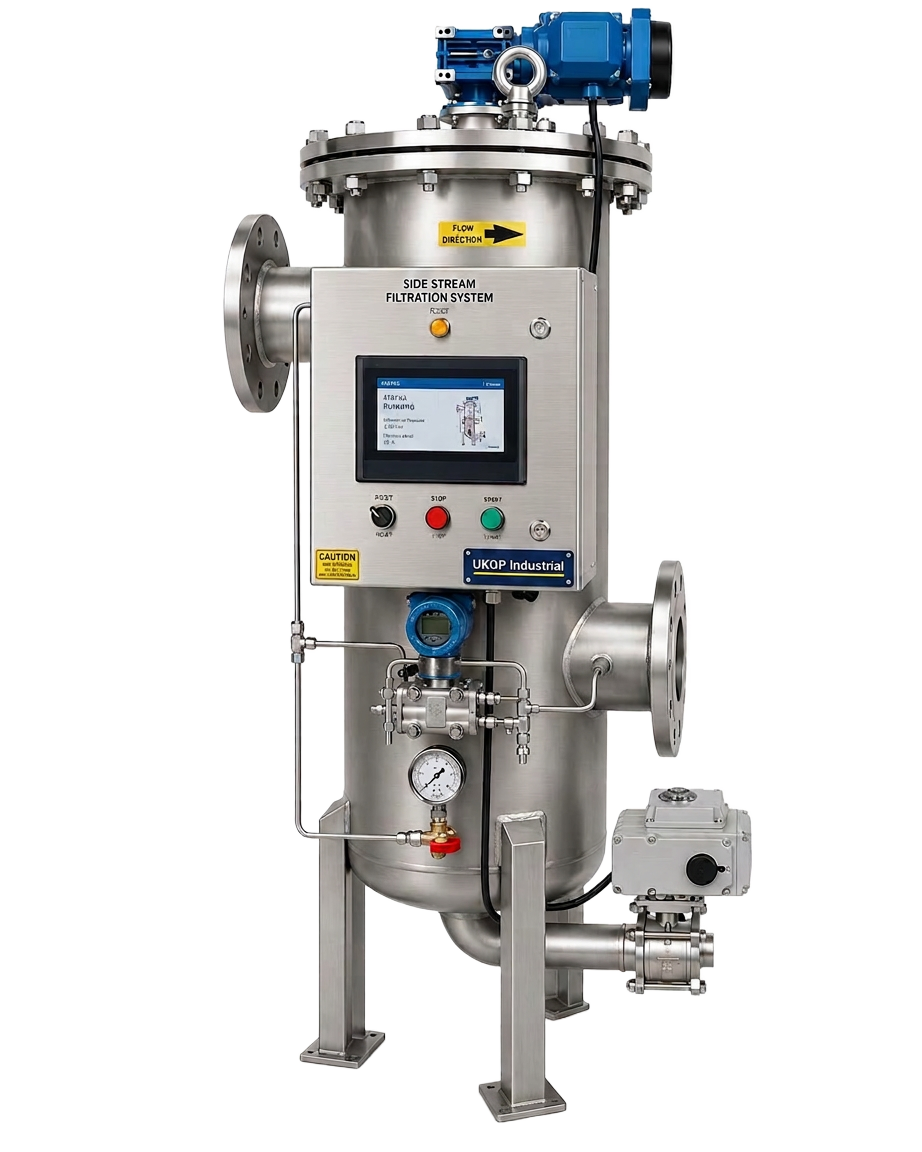
To mitigate these risks, UKGP recommends the integration of side stream filtration. By removing suspended solids down to five microns, you protect the narrow channels of the plate heat exchanger from blockages. This is particularly important for high-efficiency corrugated plates that are more susceptible to 'bridging' by larger particles. In industrial environments where the primary side may be steam or high-temperature hot water, the thermal stresses on the gaskets can also be exacerbated by poor water quality, leading to premature failure. Maintaining the chemical balance of the system is the most cost-effective way to preserve the 2-year warranty on your heat transfer equipment.
Ultimately, the goal is to create a resilient system that meets CIBSE CP1 standards for heat networks. This involves not just the initial sizing of the plate heat exchanger, but an ongoing commitment to system hygiene. By installing pH sensors and transmitters alongside your heat exchanger, you can monitor the corrosive potential of the fluid in real-time. This proactive approach prevents the pitting corrosion that can lead to cross-contamination between the primary and secondary circuits. When you request a quote from UKGP, we don't just look at the kW rating; we look at the entire plant room ecosystem to ensure peak performance and long-term reliability.
- Relationship between LSI (Langelier Saturation Index) and plate scaling
- Importance of BSRIA BG50 guidelines for closed-loop system maintenance
- Monitoring pressure gauges to detect early-stage heat exchanger fouling
- Influence of fluid velocity on the self-cleaning effect in plate channels
Navigating BS EN 14917 and Expansion Management
The physical installation of a plate heat exchanger must also account for the thermal expansion of the connecting pipework. In high-temperature applications, the rigid nature of the heat exchanger frame means that any thermal growth in the headers can exert significant mechanical stress on the nozzles. To prevent leaks and structural damage, the use of expansion bellows is mandated under BS EN 14917 guidelines. These components absorb the axial and lateral movement, ensuring that the plate heat exchanger remains isolated from the stresses of the wider distribution network. This is a critical consideration for plant room engineers when designing the layout for large-scale heat transfer stations.
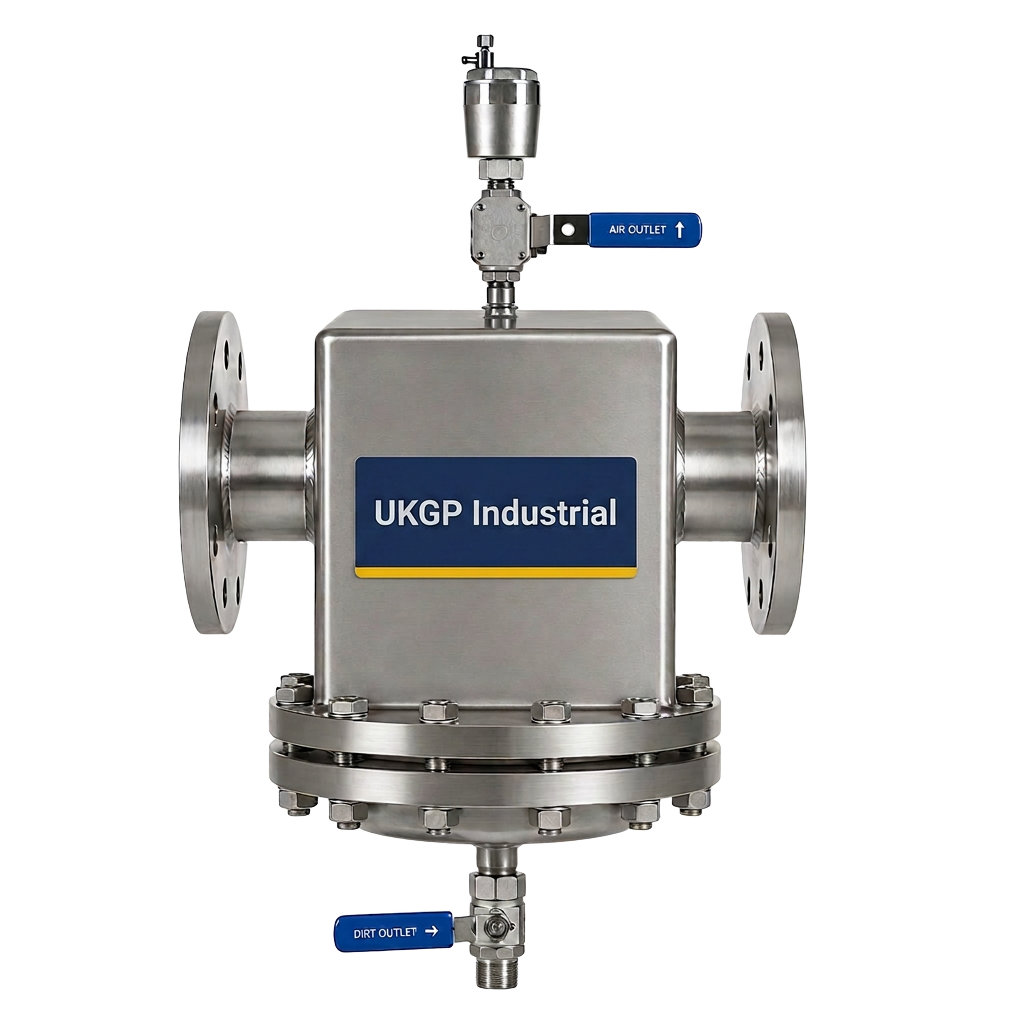
In addition to expansion concerns, the presence of air and microbubbles can drastically alter the hydraulic characteristics of the system. An air-locked plate heat exchanger will exhibit erratic pressure drop readings and a significant loss in thermal capacity. UKGP’s range of air and dirt separators should be installed upstream of the heat exchanger to ensure that the circulating media is homogenous. This not only protects the heat transfer surfaces but also ensures that the pumps are moving liquid rather than a two-phase mixture, which is essential for maintaining the calculated design flow rates and achieving the predicted temperature approach on the secondary side.
When we size a plate heat exchanger from your thermal spec, we also consider the potential for water hammer and pressure surges. In systems with fast-acting valves, the sudden change in momentum can damage the internal gaskets or the thin stainless steel plates themselves. By incorporating low loss headers and properly sized expansion vessels, you create a buffer that protects the heat exchanger from these hydraulic shocks. UKGP’s technical team is available to assist in the selection of these ancillary components, ensuring that your entire plant room is balanced, compliant, and ready for commissioning within the standard 4-6 week delivery window.
- Adherence to BS EN 14917 for expansion bellow integration
- Protection of internal gaskets from hydraulic shock and water hammer
- The role of air & dirt separation in maintaining laminar flow
- Coordinating DN size connections with existing pipework standards
The Role of Dosing Pots in System Protection
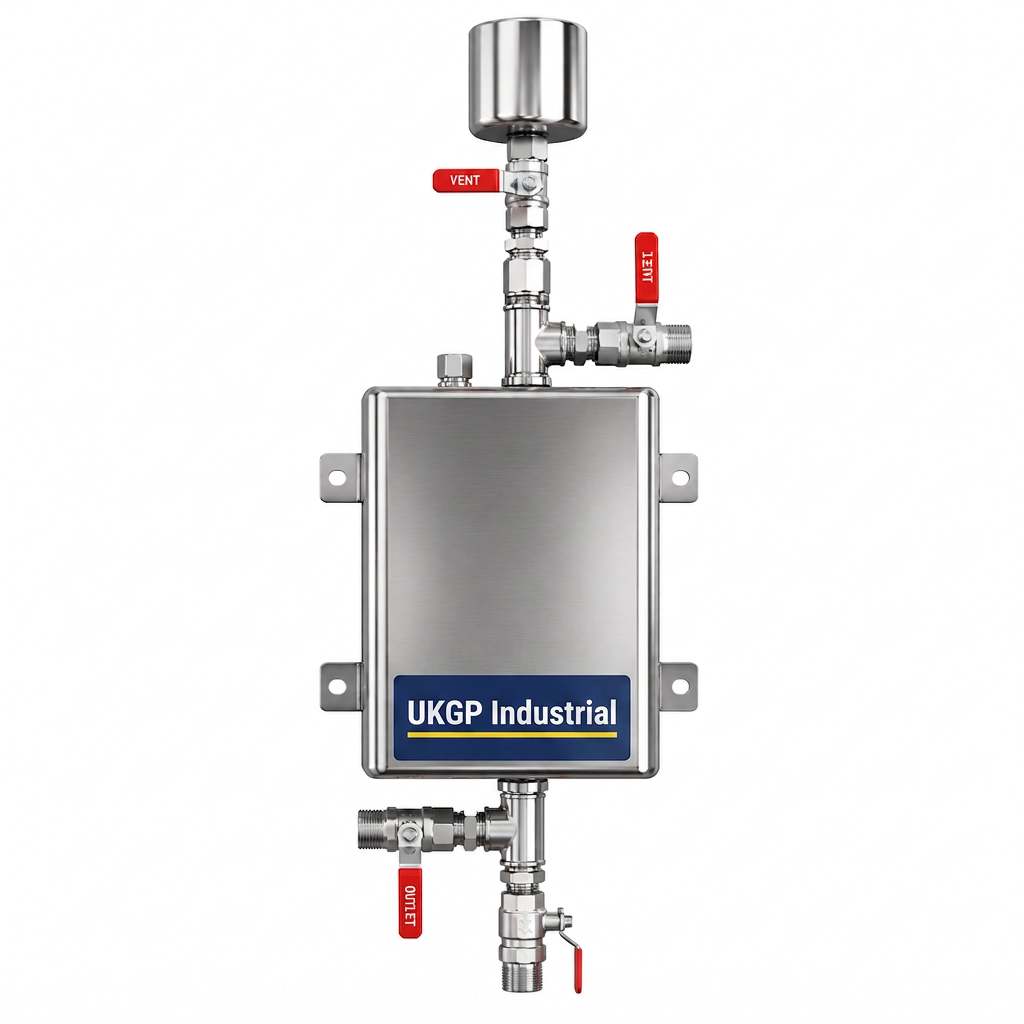
The introduction of chemical inhibitors is a non-negotiable step in the commissioning of any new UK plant room. Using a chemical dosing pot allows for the safe and controlled introduction of glycols or corrosion inhibitors into the circuit serving the plate heat exchanger. This is particularly vital in dual-fuel or multi-source heating systems where different metals, such as copper, steel, and stainless steel, are present. Without proper passivation, the stainless steel plates in your plate heat exchanger could be subject to galvanic corrosion, especially if the chloride levels in the fill water are high. Proper dosing ensures the longevity of the equipment and maintains the validity of the 2-year warranty.
For the building services consultant, the specification of the dosing pot must be proportionate to the system volume. A common error is under-dosing, which leaves sections of the heat exchanger vulnerable to localized corrosion. When UKGP Industrial supplies a plate heat exchanger, we often provide the accompanying dosing pots and separators as a package to ensure compatibility. This approach simplifies the procurement process for M&E contractors and ensures that all components are rated for the same operating pressures and temperatures. Our units are designed to withstand the rigours of commercial environments, offering DN20 to DN300 connection options to match the primary flow rates.
Maintenance teams should perform regular water sampling, as outlined in BSRIA BG29/2021, to check inhibitor levels. If the plate heat exchanger begins to show signs of reduced Delta T, the first check should always be the chemical concentration and the presence of any debris in the upstream strainers. By maintaining a clean, chemically-balanced system, the pressure drop across the plates remains stable, and the heat transfer efficiency is preserved at the design levels. UKGP’s commitment to technical excellence means we provide all the necessary data sheets and maintenance manuals to help the FM team achieve these results over the lifetime of the installation.
- Safe chemical introduction via stainless steel dosing pots
- Prevention of stainless steel pitting in high-temperature circuits
- Ensuring compatibility between inhibitors and gasket materials
- Simplifying the procurement of complete plant room sub-assemblies
Optimising Thermal Efficiency and Flow Balance
Achieving the optimal temperature approach in a plate heat exchanger depends heavily on the flow balance between the primary and secondary sides. In many modern UK developments, we see the implementation of low loss headers to decouple the boiler or chiller circuit from the distribution circuit. This decoupling is essential for maintaining a constant flow through the plate heat exchanger, which ensures predictable pressure drop and thermal performance. When the flow rate is allowed to fluctuate wildly, the heat exchanger may operate in a laminar flow regime where heat transfer is significantly less efficient, leading to higher return temperatures and reduced boiler condensing efficiency.
Precision in sizing is what sets UKGP Industrial apart. When you provide a full thermal spec, our engineers use advanced software to calculate the exact number of plates and the specific channel arrangement required for your application. We can provide solutions for DN20 domestic hot water sets up to DN300 industrial process coolers. Our objective is always to minimize the footprint while maximizing the heat transfer area, all while keeping the plate heat exchanger pressure drop within the limits of your system design. This technical rigour is why we are the preferred supplier for many of the UK's leading M&E contractors and facility management firms.
Finally, the long-term operational success of any plate heat exchanger installation rests on the quality of the manufacture and the support provided. With a 4-6 week lead time and a robust 2-year warranty, UKGP Industrial stands behind every unit we supply. We encourage all engineers to reach out during the early design stages to discuss their thermal requirements. Whether you need a gasketed unit for easy cleaning or a brazed unit for a compact skid, our team has the technical expertise to ensure your project is a success. Contact us today for a detailed quote and take the first step toward a more efficient, BSRIA-compliant plant room.
- Decoupling circuits for stable heat exchanger performance
- Achieving the target 'approach temperature' for high efficiency
- Software-driven sizing for precision and reliability
- Project support from design stage to final commissioning
Frequently asked questions
What is the standard lead time for a UKGP plate heat exchanger?
- Our standard lead time for both gasketed and brazed units, sized from a full thermal spec, is 4-6 weeks.
Do your plate heat exchangers come with a warranty?
- Yes, all UKGP plate heat exchangers are supplied with a 2-year warranty as standard, covering manufacturing defects.
Can you size a heat exchanger for me if I provide the temperatures?
- Absolutely. We require a full thermal spec including inlet/outlet temperatures and flow rates (or total kW load) to accurately calculate the sizing and pressure drop.
What DN sizes do you offer for your heat transfer range?
- We offer a wide range of connection sizes from DN20 for smaller applications up to DN300 for large industrial or commercial plant rooms.
Is the pressure drop across a plate heat exchanger adjustable?
- The pressure drop is fixed by the unit's design and flow rate. To reduce it, we must increase the number of plates or change the plate configuration, which we can advise on during the sizing process.