The Physics of Hydraulic Resistance in PHEs
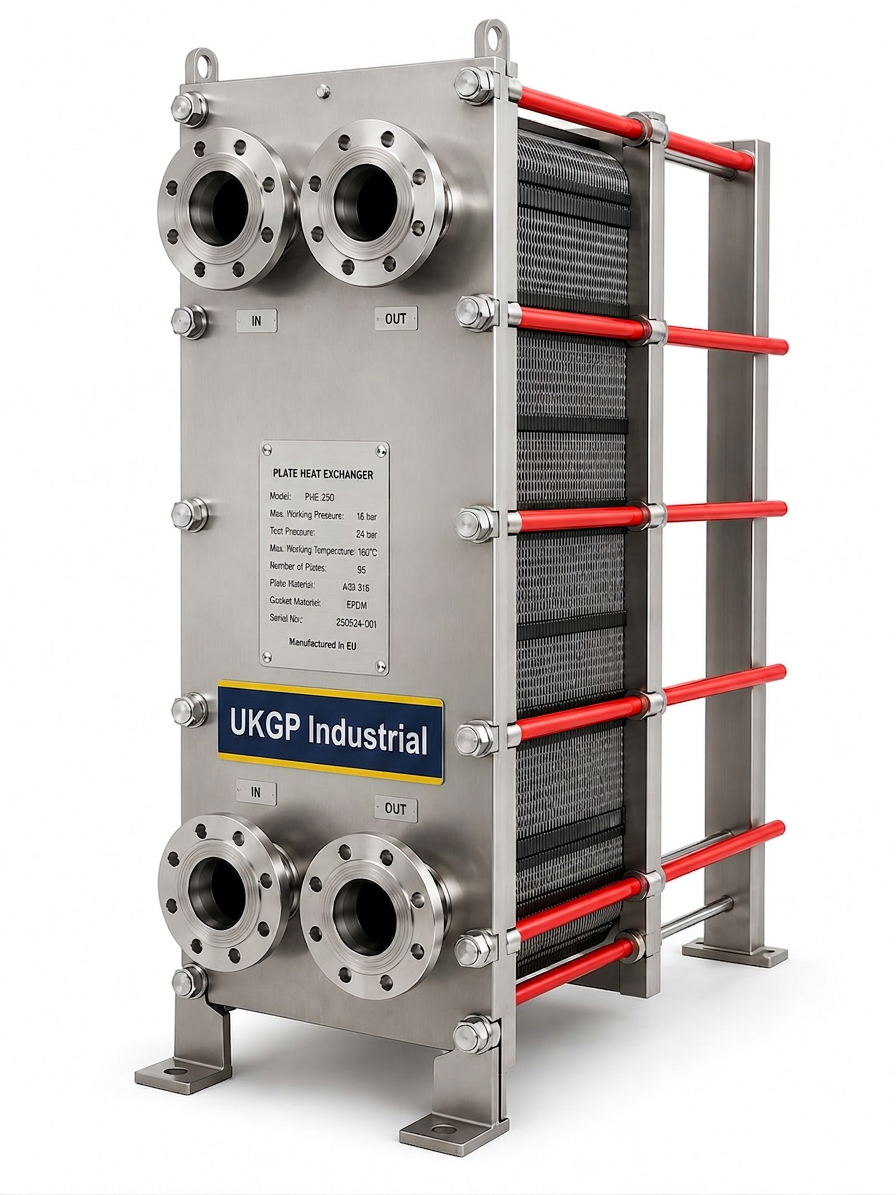
Pressure drop (ΔP) in a plate heat exchanger is the loss of fluid pressure as it moves through the narrow channels between plates. This resistance is not a design flaw but a necessary byproduct of creating the turbulence required for high heat transfer coefficients. In a PHE, the fluid is forced to change direction constantly as it flows over the corrugated surfaces, which disrupts the boundary layer and enhances the 'U' value of the heat exchanger.
The correlation between pressure drop and heat transfer is intrinsic. Generally, a higher allowable pressure drop allows for a smaller, more cost-effective heat exchanger because it facilitates higher velocities and more turbulent flow. Conversely, specifying a very low pressure drop results in a larger unit with more plates to provide the same thermal duty, which can lead to laminar flow conditions and increased rates of fouling.
- Fluid velocity and volumetric flow rates.
- Plate geometry: 'High theta' vs 'Low theta' patterns.
- Physical properties of the medium (Viscosity and Density).
- Number of passes and plate count.
Plate Geometry and the Heat Transfer Coefficient
Engineers must select the correct plate 'theta'—the term used to describe the thermal length of a plate. High-theta plates feature a chevron angle (typically 60°) that creates high turbulence and high pressure drop, ideal for applications with close temperature approaches. Low-theta plates have a shallower angle (typically 30°), offering lower resistance but requiring more surface area to achieve the same temperature change.
In modern UK plant room design, particularly with low-temperature networks and heat pumps, we often use a 'mixed' plate pack. By alternating high and low theta plates, manufacturers can fine-tune the pressure drop to match the available pump head exactly. This bespoke configuration ensures the unit operates within the 'turbulent flow' regime, which is vital for preventing the sedimentation of suspended solids as highlighted in BSRIA BG50.
Frequently asked questions
Does increasing flow rate exponentially increase pressure drop?
- Yes, pressure drop increases with the square of the flow rate. Doubling the flow rate through a PHE will result in approximately four times the pressure drop, which can significantly exceed pump head capacity.
What is the 'sweet spot' for pressure drop in commercial heating?
- For most LTHW and DHW applications, a pressure drop between 30 kPa and 60 kPa is considered a balanced design. Lower drops lead to laminar flow and poor heat transfer; higher drops cause excessive pumping costs.
How can I tell if a PHE is fouled using pressure drop readings?
- A sudden increase usually indicates macro-fouling (debris), whereas a gradual increase over months typically points to scaling or bio-fouling. Monitoring via differential pressure sensors is recommended per BSRIA BG50.
What are the risks of designing for too low a pressure drop?
- Low pressure drop reduces turbulence, leading to 'laminar' flow. This creates a stagnant boundary layer on the plate surface, which drastically reduces the heat transfer coefficient and encourages sediment to settle.
Is there a maximum allowable pressure drop for PHEs?
- While high DP can increase the risk of erosion-corrosion on stainless steel plates, the primary limit is usually the available Net Positive Suction Head (NPSH) for the pumps and the energy efficiency criteria of Part L.