Identifying the Symptoms of Plate Heat Exchanger Fouling
The first stage of troubleshooting is distinguishing between a control valve malfunction and physical fouling. In UK plant rooms, fouling typically manifests as a 'performance creep' rather than an instantaneous failure. If a DHW calorifier is failing to reach its 60°C setpoint during peak demand, or if a district heating substation shows a rising return temperature to the primary network, the heat transfer efficiency of the PHE is likely compromised. This is professionally quantified by the heat transfer coefficient (U-value), which drops as the fouling layer adds thermal resistance.
Pressure drop monitoring is the most reliable field diagnostic. Every PHE is designed with a specific pressure drop at a given flow rate (e.g., 30 kPa at 10 m³/h). If the measured ΔP exceeds the design value by more than 2 installation-adjusted percentages, fouling is present. Engineers should cross-reference manual gauge readings with the Building Management System (BMS) data to rule out sensor drift. It is essential to ensure that the flow rate is at the design point during testing, as ΔP varies with the square of the flow; a low ΔP at low flow does not necessarily mean a clean exchanger.
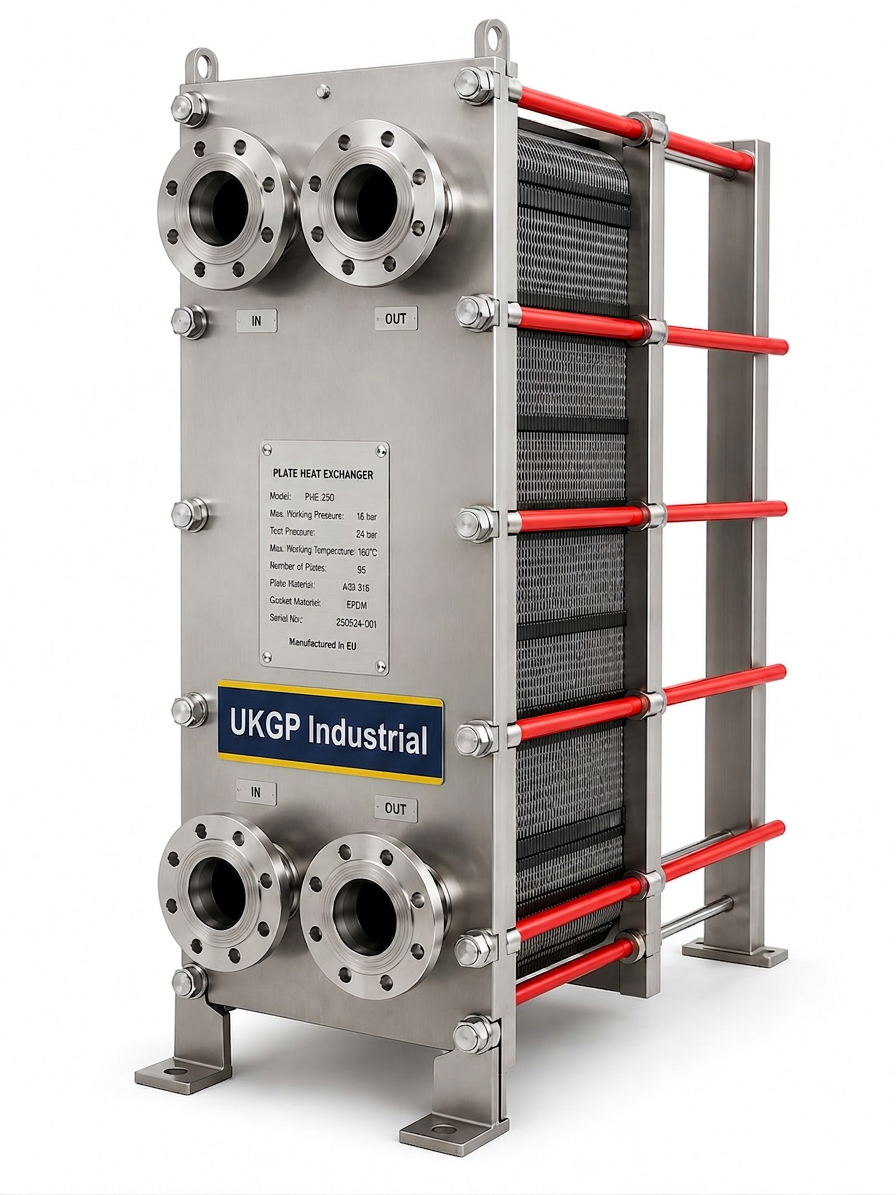
Thermal imaging can also be employed on the external frames of gasketed plate heat exchangers (GPHEs). Cold spots on the plate pack often indicate 'dead zones' where internal channels are completely blocked by debris or magnetite, forcing the fluid through a smaller number of active channels. This 'channeling' effect accelerates wear on the remaining open plates due to increased local velocity and erosion.
- Gradual decline in secondary outlet temperature despite constant primary flow.
- Increased approach temperature (the difference between the primary inlet and secondary outlet).
- Higher differential pressure (ΔP) across the exchanger compared to commissioning data.
- Pump VFDs running at higher frequencies to maintain design flow rates.
Frequently asked questions
How do I accurately measure pressure drop to confirm fouling?
- Standard system pressure gauges are often imprecise. Use high-accuracy digital differential pressure sensors or calibrated gauges across the PHE ports. A 10-15% increase over the design pressure drop (commissioned value) typically indicates the onset of fouling.
Can brazed plate heat exchangers be cleaned as effectively as gasketed units?
- Chemical cleaning (CIP) is preferred for brazed units as they cannot be opened. However, if the blockage is particulate (e.g., weld slag or heavy scale), brazed units often require replacement. Gasketed units (GPHEs) are superior for high-fouling applications as they can be mechanically cleaned.
Is BSRIA BG29/21 compliance enough to prevent PHE fouling?
- No. BSRIA BG29/21 focuses on pre-commission cleaning, whereas BG50 covers ongoing water treatment. Both are essential; BG29 ensures the PHE starts clean, while BG50 prevents the long-term accumulation of magnetite and scale that causes fouling.
What is 'thermal bypass' in the context of a fouled PHE?
- Thermal bypass occurs when fluid flows through the 'least resistant' clean channels, leaving fouled channels stagnant. This leads to a massive drop in heat transfer coefficient (U-value) even if the overall flow rate appears maintained by the pumps.