Technical Architecture of Normally-Closed Valves
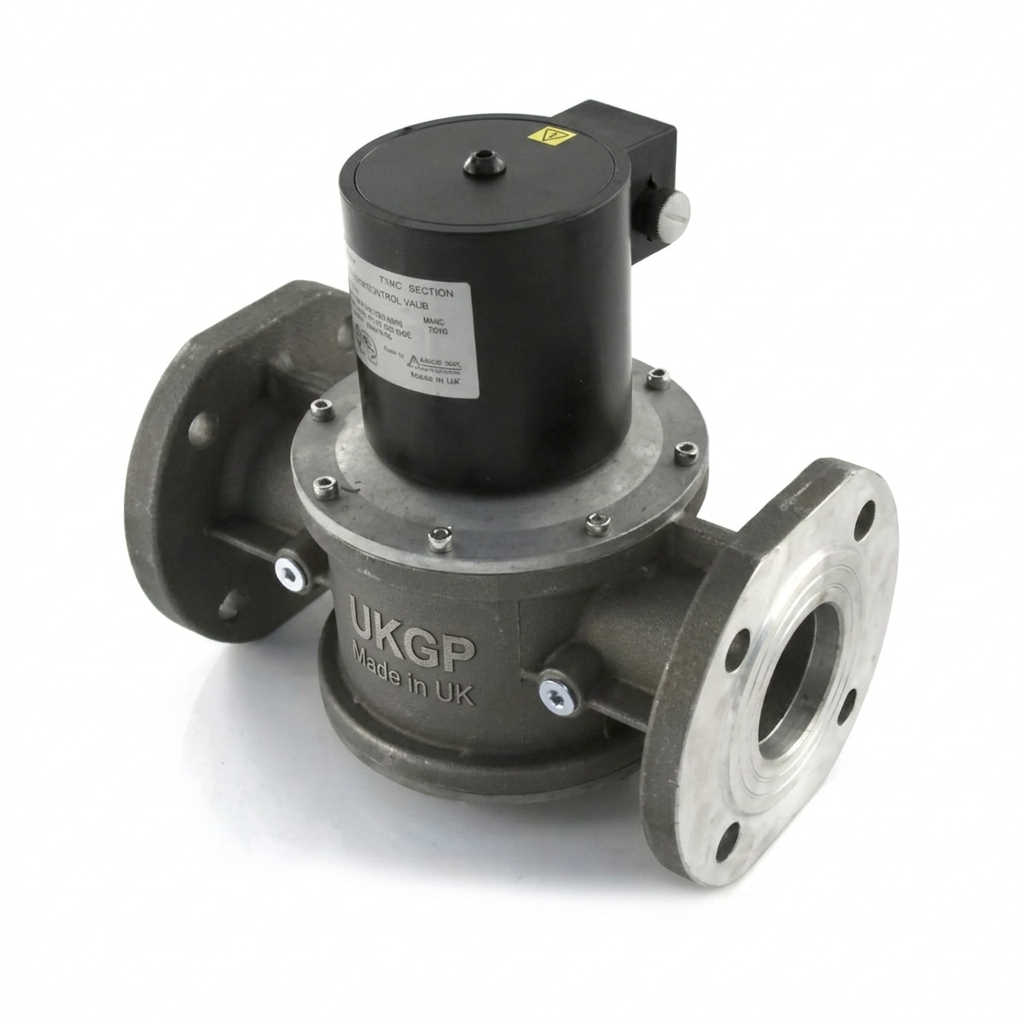
The normally-closed (NC) solenoid valve is the industry standard for safety isolation. In its de-energised state, an internal spring forces the valve disc or piston against the seat, creating a gas-tight seal. When the coil is energised by a 230V or 24V signal, an electromagnetic field overcomes the spring tension, lifting the plunger and allowing gas to flow. This 'fail-safe' design ensures that if power is lost—whether due to a local fault, a fire alarm trip, or a gas detection signal—the valve immediately returns to the closed position, isolating the supply.
In the UK, specifications for these valves are governed by EN 161, which categorises valves into classes based on their sealing integrity and robustness. For most plant room applications, a Class A valve is required. These units must be able to handle the maximum inlet pressure of the system (typically 200 mbar to 6 bar in industrial settings) and operate within the temperature ranges defined by BS EN 13611. UKGP Industrial units are typically constructed from die-cast aluminium or sand-cast brass to meet these arduous requirements.
- Class A EN 161 certification for safety shut-off.
- Automatic-reset functionality for seamless restoration of service.
- Direct-acting or servo-assisted mechanisms depending on pipe diameter.
- BMS compatibility for emergency stop (E-Stop) integration.
Applications and Interlocking Requirements
The primary application for NC valves is the main gas intake to a plant room or a commercial kitchen. Under BS 6173, gas flow to catering equipment must be interlocked with the ventilation system. This is achieved by wiring the solenoid valve through a current-sensing relay or air pressure switch on the extract fan. If the fan fails, the circuit breaks, the solenoid de-energises, and the NC valve closes, preventing the buildup of combustion products or unburnt gas in the space.
Beyond kitchens, IGEM/UP/2 Edition 3 outlines the requirements for gas installations in industrial and commercial premises. Here, the solenoid valve acts as the primary interface for the Gas Proving System. Before the valve is allowed to open, the control system performs a leak tightness test on the downstream pipework. The NC valve remains the 'gatekeeper' throughout this process, only opening once the system has confirmed there are no open taps or significant leaks.
The Role of Normally-Open Valves in Gas Systems industrial
Normally-open (NO) solenoid valves are a rarity in standard UK gas isolation but serve specific functions in complex industrial process trains. In an NO valve, the spring holds the valve open when de-energised, and electrical power is required to close it. This is diametrically opposed to the safety-first logic of heating systems, as a power failure would leave the gas supply open. Consequently, NO valves are never used as primary safety shut-off valves (SSOVs) for burners.
Where NO valves do find application is in 'vent-to-atmosphere' lines. In large-scale industrial burners, a 'double block and bleed' arrangement might be used. This involves two NC valves in series on the main line, with a smaller NO valve located on a vent line between them. When the system is running, the two NC valves are powered open, and the NO valve is powered closed. If a shutdown is triggered, all three lose power: the main valves close to stop gas flow, and the NO valve opens to vent any residual gas trapped between the two main valves to a safe location outside the building.
BMS Integration and Emergency Stop Circuits
Modern building management systems (BMS) require precise feedback from gas safety components. Most high-quality gas solenoid valves can be fitted with a closed-position indicator switch (CPI). This volt-free contact allows the BMS to monitor the actual status of the valve rather than just the status of the power supply. This is a critical distinction for facilities managers, as it can identify a mechanical failure where a valve has stuck open despite the coil being de-energised.
Wiring of the solenoid must always account for the Emergency Stop (E-Stop) circuit. In accordance with the Gas Safety (Installation and Use) Regulations 1998, a manual means of isolation must be accessible. By incorporating NC solenoid valves into a series circuit with 'break-glass' units and thermal cut-offs (fusible links), engineers ensure that the gas is isolated instantly in a fire or gas leak event. This hard-wired safety chain should generally bypass the BMS software to ensure operation even if the digital controller fails.
Selection Criteria: Pressure, Flow, and Media
When specifying a valve, engineers must calculate the pressure drop across the unit to ensure the burner manifold receives sufficient pressure. A valve that is too small will cause a high pressure drop (Δp), potentially leading to flame instability or nuisance shutdowns. Conversely, an oversized valve may be unnecessarily expensive and require larger pipework transitions. Standard natural gas valves are rated for Pmax of 200mbar or 360mbar for commercial use, but high-pressure variants up to 6 bar are required for industrial boost systems.
Material compatibility is also vital. While standard natural gas (methane) is compatible with NBR or Viton seals, LPG (Propane/Butane) or 'town gas' containing higher hydrogen concentrations may require specific seal compounds to prevent degradation over time. UKGP Industrial provides valves specifically tested for these media, ensuring longevity and compliance with the relevant UK gas families (1st, 2nd, and 3rd family gases).
Maintenance and Lifespan under BG50 and BG29
The maintenance of gas solenoid valves is often overlooked but is a requirement under BSRIA BG50 (Water treatment for closed heating and cooling systems - though often referenced for plant room management) and general IGEM standards. Coils are the most common point of failure; constant energisation generates heat, which over years can degrade the copper windings. It is recommended that valves are 'exercised' during quarterly maintenance visits to ensure the internal spring and plunger move freely.
If a valve develops a 'humming' noise, it is usually indicative of debris on the pilot orifice or a failing coil. Because these valves are safety-critical, repair is often discouraged in favour of replacing the entire unit or the actuator head. Engineers should always check for the presence of a gas filter upstream of the solenoid. Without a 50-micron filter, particulates in the gas stream can score the valve seat, leading to 'let-by' and a failure of the annual tightness test.
Frequently asked questions
Is a normally-closed valve mandatory in commercial kitchens?
- Yes, under BS 6173, commercial kitchens must have an interlocking system that prevents gas flow unless the ventilation system is operational. This is almost exclusively achieved using a normally-closed solenoid valve.
What is the industry standard for gas solenoid valves?
- Valves compliant with EN 161 (Class A) are required for safety shut-off applications. This ensures the valve can withstand the specified pressure and cycle life requirements for natural gas and LPG.
What is the difference between automatic and manual reset?
- Automatic-reset valves restore gas flow as soon as power is returned. Manual-reset valves require a physical intervention by a technician after a power failure or emergency trip, which is often preferred for high-capacity industrial burners.
Can I use these valves with 24V BMS control?
- Standard valves are rated for 230V AC or 24V AC/DC. In environments where high-frequency switching or noise is an issue, DC coils with rectified plugs are often specified to prevent 'hum' or chatter.