The Role of Automatic Solenoid Valves in Plant Safety
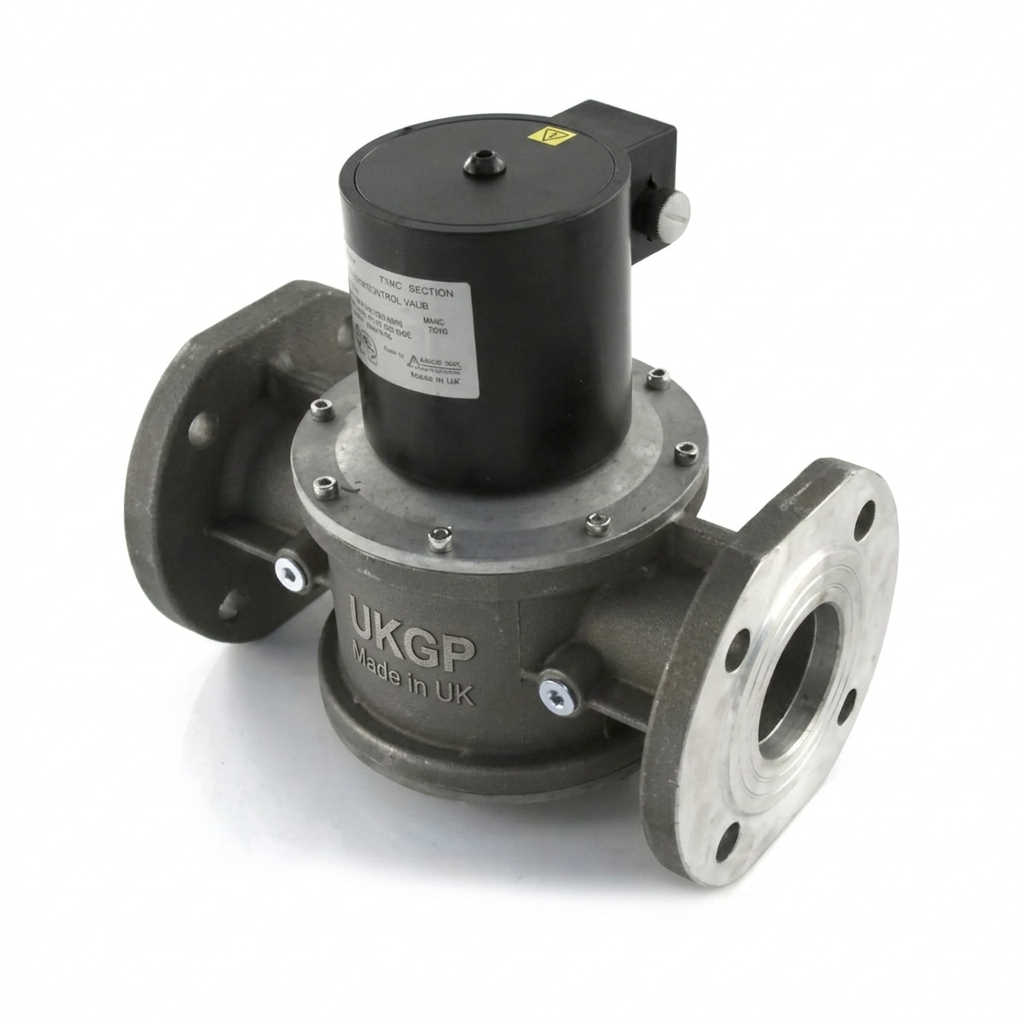
Automatic-reset gas solenoid valves serve as the primary safety cut-off point in modern gas installations. Unlike manual valves, these are 'Normally Closed' devices, meaning they require a continuous electrical signal to remain open. The moment power is lost—whether through a deliberate emergency stop, a fire alarm activation, or a gas detection event—the internal spring force snaps the valve shut in less than one second. This rapid response is a requirement under EN 161 for Class A safety shut-off valves used in the UK.
In commercial boiler rooms, solenoid valves act as the gatekeeper for the Gas Proving System. They are frequently interlocked with the Building Management System (BMS) to ensure gas is only available when ventilation systems are operational and no faults are detected. For UK building services engineers, the selection of an automatic-reset valve is essential for compliance with IGEM/UP/2, which governs the installation of gas piping in industrial and commercial premises.
- Class A or B classification according to EN 161.
- Automatic-reset functionality for unattended plant rooms.
- Compatibility with Natural Gas, LPG, and Town Gas.
- IP65 rating for high-humidity or industrial environments.
Manual Isolation: The Foundation of Physical Safety
Manual shut-off valves, typically lever-operated ball valves or butterfly valves, remain the bedrock of any gas train. Their primary function is not automation, but safe isolation for maintenance and commissioning. Under the Gas Safety (Installation and Use) Regulations 1998, every gas installation must have a means of manual isolation that is easily accessible. Unlike solenoids, manual valves do not suffer from electrical 'hum' or heat dissipation and provide a zero-power solution for securing a site during long-term shutdown.
From a mechanical perspective, manual valves are often preferred for their low pressure-drop characteristics. A full-bore ball valve offers virtually no resistance to gas flow, whereas a solenoid valve, due to its internal plunger and seat design, will always introduce a measurable pressure drop (expressed as KV value). Engineers must calculate this drop during the design phase to ensure the required pressure is maintained at the burner head, particularly in low-pressure domestic or commercial supplies.
- Quarter-turn operation for rapid manual isolation.
- Compliance with BS EN 331 for ball valves.
- Visual confirmation of 'Open' or 'Closed' status.
- Full-bore design to minimise pressure drop.
Interlocks and Regulatory Compliance
The most significant differentiator is the ability to interlock. BS 6173 requires that in commercial kitchens, the gas supply must be interlocked with the ventilation system. A manual valve cannot satisfy this requirement. A normally-closed gas solenoid valve is required so that if the extract fan fails, the gas supply is instantly severed. This prevents the build-up of combustion products (CO and CO2) which could lead to unsafe working conditions.
Furthermore, in plant rooms housing large-scale boilers or CHP units, IGEM/UP/12 highlights the need for secondary protection. If a gas leak is detected by a fixed sensing head, the solenoid valve provides the automated response required to mitigate risk without human intervention. Manual valves are reactionary tools for engineers; solenoid valves are proactive components of the building’s Life Safety Systems.
- Emergency Stop Buttons (EMOs).
- Fire Alarm Integration.
- Gas Detection Systems (CH4, CO, LPG).
- Air Proving Switches (Extract/Supply Fans).
Installation Considerations and Maintenance
Installing a UKGP Industrial gas solenoid valve requires adherence to strict cleanliness standards. BSRIA BG29/21 and BG50 advise on the importance of flushing systems, but for gas lines, the focus is on preventing debris from reaching the valve seat. A single piece of swarf or pipe scale can prevent a solenoid from sealing, leading to 'let-by'—a dangerous condition where gas continues to flow even when the valve is de-energised. Therefore, a gas filter must always be installed upstream.
Manual valves generally require less maintenance but should be 'exercised' periodically to prevent the seals from seizing. In contrast, solenoid valves should be tested as part of the quarterly or annual fire alarm and gas detection service. Engineers should check for signs of coil fatigue and ensure the manual reset mechanism (if applicable) is functioning correctly. For automatic-reset models, ensure the electrical inrush current is accounted for in the control panel's circuit protection.
- Gas filters are mandatory to prevent seat damage.
- Vertical or horizontal orientation must be verified.
- Bypass lines should be avoided unless strictly regulated.
- Cable glanding must maintain the valve’s IP rating.
Technical Comparison Summary
When comparing the two, it is not a matter of which is superior, but how they complement each other. The manual valve provides the 'Safe Isolation' required for a technician to work on the boiler, while the solenoid valve provides the 'Safety Shut-off' required to protect the building from fire or gas leaks. In any UK commercial gas string, you will typically find a manual isolation valve (AECM) as the first point of entry, followed by a filter, and then the automatic solenoid valve.
For contractors, the key is specifying a solenoid valve with the correct pressure rating (typically 200mbar or 360mbar for low pressure, or up to 6 bar for industrial) and ensuring the coil is rated for 100% continuous duty. UKGP Industrial solenoid valves are designed to meet these rigours, ensuring that when the BMS demands a shutdown, the gas flow stops immediately and reliably.
- Safety: Solenoid wins via automation.
- Reliability: Manual wins via simplicity.
- Requirement: Both are mandatory in UK commercial plant.
Frequently asked questions
Do I still need a manual valve if I have a solenoid installed?
- Yes, according to IGEM/UP/2 and BS 6173, a manual isolation valve must be installed upstream of the automatic solenoid valve to allow for safe maintenance and physical isolation during long-term shutdowns.
What does 'Normally Closed' mean in the context of gas safety?
- 'Normally Closed' means the valve is held closed by a spring and requires continuous electrical power to open. In the event of a power cut or emergency stop, the valve automatically returns to the closed position.
Why is my solenoid valve leaking downstream after installation?
- BSRIA BG29/21 and BG50 emphasise cleanliness in pipework. Debris such as welding slag or scale can prevent a solenoid valve from seating correctly, leading to 'let-by'. Always install a gas filter upstream of the solenoid.
Which valve is better for isolation during maintenance?
- Manual valves provide physical, visual isolation and are essential for 'Safe Isolation' procedures. Solenoid valves are safety devices for automated shut-down and interlock scenarios but should not be relied upon as the sole means of isolation for mechanical work.
Can a solenoid valve be left energised indefinitely?
- Yes, modern automatic-reset solenoid valves are designed for 100% continuous duty, though they will consume a small amount of power (typically 20-90W depending on size) and may run warm to the touch.