Regulatory Framework: BS 6173 and IGEM/UP/11
The design and installation of gas services in commercial kitchens are governed strictly by British Standards, most notably BS 6173:2020. This standard mandates that where mechanical ventilation is required for the safe operation of gas appliances, an interlocking system must be provided. The gas solenoid valve is the physical executor of this interlock, cutting the fuel supply if the ventilation fails or if air quality sensors (such as CO2 monitors) exceed permissible thresholds. Failure to install or maintain these systems is a breach of the Health and Safety at Work Act.
Beyond BS 6173, IGEM/UP/2 (Edition 3) provides the technical guidance for gas installation pipework, boosters, and compressors in industrial and commercial premises. It details the requirements for Emergency Control Valves (ECVs) and the placement of Automatic Isolation Valves (AIVs). In a kitchen environment, the solenoid valve functions as an AIV, requiring a high degree of reliability and a 'fail-safe' closed position. Engineers must ensure that the chosen valve is certified to EN 161, which classifies valves based on their sealing integrity and robustness.
In specific environments such as schools or laboratories, IGEM/UP/11 further complicates the requirements by necessitating gas proving systems. While a standard kitchen with flame supervision devices (FSDs) on all burners may only require a simple interlock, any installation where appliances lack FSDs must have a gas proving system. This adds a pressure-testing cycle before the solenoid valve can be energised, ensuring no downstream leaks exist before the main gas flow commences.
Technical Specification: Class A and EN 161 Compliance
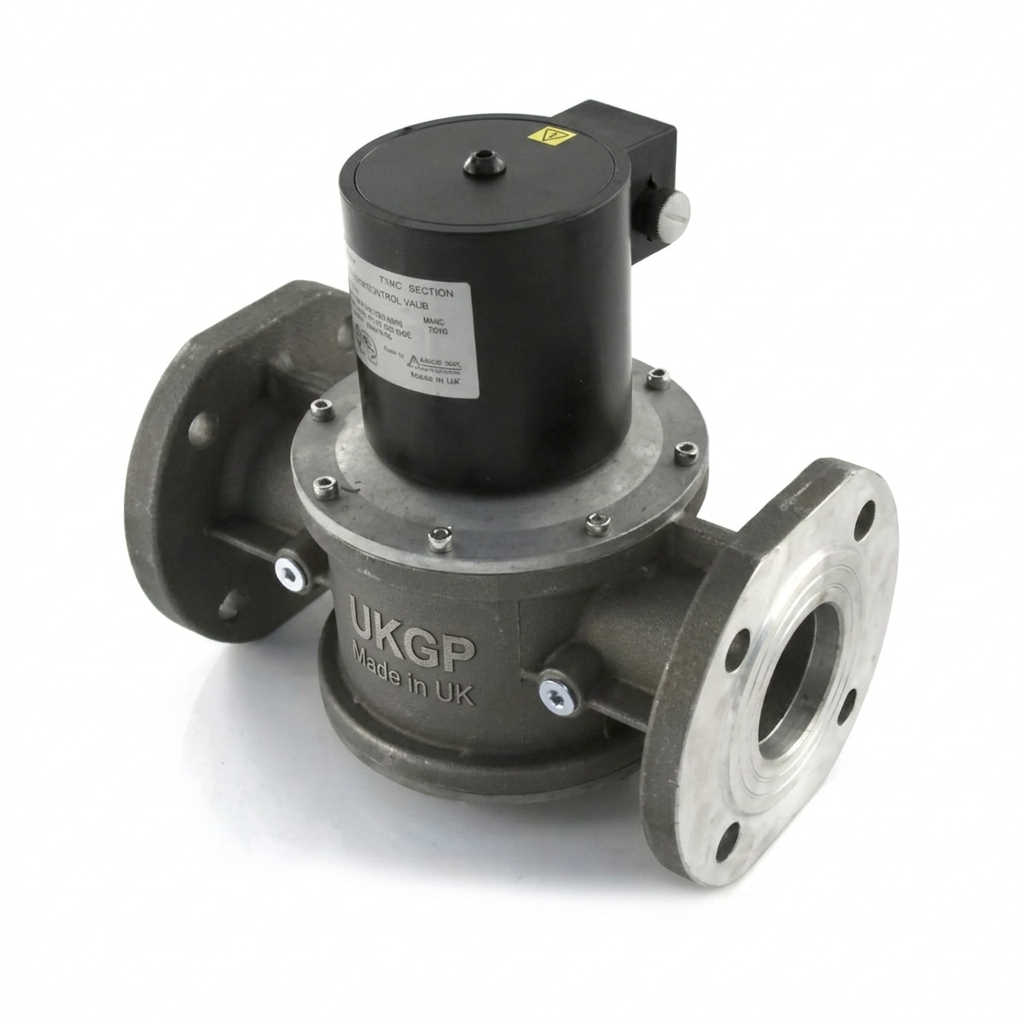
When specifying a gas solenoid valve, the engineer must ensure it meets 'Class A' requirements according to BS EN 161. Class A valves are designed to withstand higher operating pressures and exhibit lower leakage rates than lower-rated counterparts. For most commercial gas supplies in the UK (low pressure at 21 mbar or medium pressure up to 2 bar), a Class A valve is the industry standard for safety-critical shut-off. These valves are typically constructed from die-cast aluminium or brass, with NBR-based seals compatible with natural gas and LPG.
The 'normally closed' (NC) configuration is a non-negotiable requirement. In this state, the valve is held shut by a heavy-duty internal spring. Only when the solenoid coil is energised does the electromagnetic field lift the plunger (or armature) to allow gas flow. This ensures that if the building loses power, or if a fire alarm or emergency stop button is triggered, the gas supply is immediately isolated. The 'automatic reset' function refers to the valve's ability to re-open once power is restored, provided the external control system (the interlock panel) permits it.
Engineers must also consider the electrical rating of the solenoid coil. In the UK, 230V AC is standard, though 24V DC or 110V AC variants are common in industrial process applications. The coil's duty cycle should be 100% (ED 100%), meaning it is designed to remain energised for indefinite periods without overheating. However, it is vital to note that even high-quality coils become hot during operation; this is normal, but requires the valve to be located in a position with adequate air circulation to prevent thermal degradation over time.
Frequently asked questions
When is a gas interlock required by law?
- Under BS 6173:2020, an interlock is mandatory in any kitchen with mechanical ventilation (supply or extract) that is essential for the safe operation of the gas appliances and the comfort of the staff. This applies to virtually all modern commercial kitchens.
Can a gas solenoid valve be installed vertically?
- The valve must be installed on a horizontal run of pipe wherever possible. While some Class A valves permit vertical installation, the coil must never be positioned below the valve body to prevent moisture or debris accumulation in the armature. Flow direction must follow the arrow cast into the valve body.
What is the difference between a gas solenoid and a gas proving system?
- A gas proving system checks for downstream leaks before the solenoid valve is allowed to open. This is mandatory if any of the appliances are not fitted with Flame Supervision Devices (FSDs) or if the installation is in an educational establishment (IGEM/UP/11).
Should I use a normally open or normally closed valve for gas safety?
- In a commercial kitchen, the solenoid valve must be a 'normally closed' type. This ensures that in the event of a power failure, fire alarm activation, or ventilation failure, the valve automatically snaps shut, isolating the gas supply.
Why is my solenoid valve coil failing prematurely?
- The coil temperature can reach 80°C under normal operation. High ambient temperatures in plant rooms or near cooking ranges can cause premature coil failure. Ensure the valve is sited away from direct heat sources and has adequate ventilation.