The Significance of EN 161 Classification
European Standard EN 161 specifies the requirements for automatic shut-off valves for gas burners and gas appliances. In the UK context, specifically within commercial plant rooms and industrial laundry or kitchen environments, 'Class A' is the benchmark. This classification ensures that the valve can reliably withstand the operating pressures of the system while maintaining a bubble-tight seal when de-energised. Any valve installed as a safety shut-off device in a gas train must carry this certification to be compliant with UK law.
The standard categorises valves based on their ability to withstand internal pressure and their sealing efficiency. For natural gas and LPG applications, the valve must be 'Normally Closed' (NC), meaning it requires continuous electrical power to remain open. Upon loss of power—whether through a deliberate emergency stop, a fire alarm signal, or a power failure—the valve must return to its closed position via spring force. This fail-safe mechanism is what distinguishes a safety shut-off valve from a standard process control valve.
- Class A: High-security valves with leakage rates below 5cm³/h.
- Class B: Medium-security valves.
- Class C: Lower-security valves for specific process applications.
Operational Dynamics: Group 1 vs Group 2 Valves
Beyond the Class A rating, EN 161 further sub-divides valves into groups based on their closing time and frequency of operation. Group 1 valves are typically used for applications where the valve is required to operate frequently, whereas Group 2 valves may be used in less demanding cycle environments. However, for UK gas trains, the closing time is the most critical metric. A safety shut-off valve must close in less than one second to prevent gas accumulation in a flame-failure scenario.
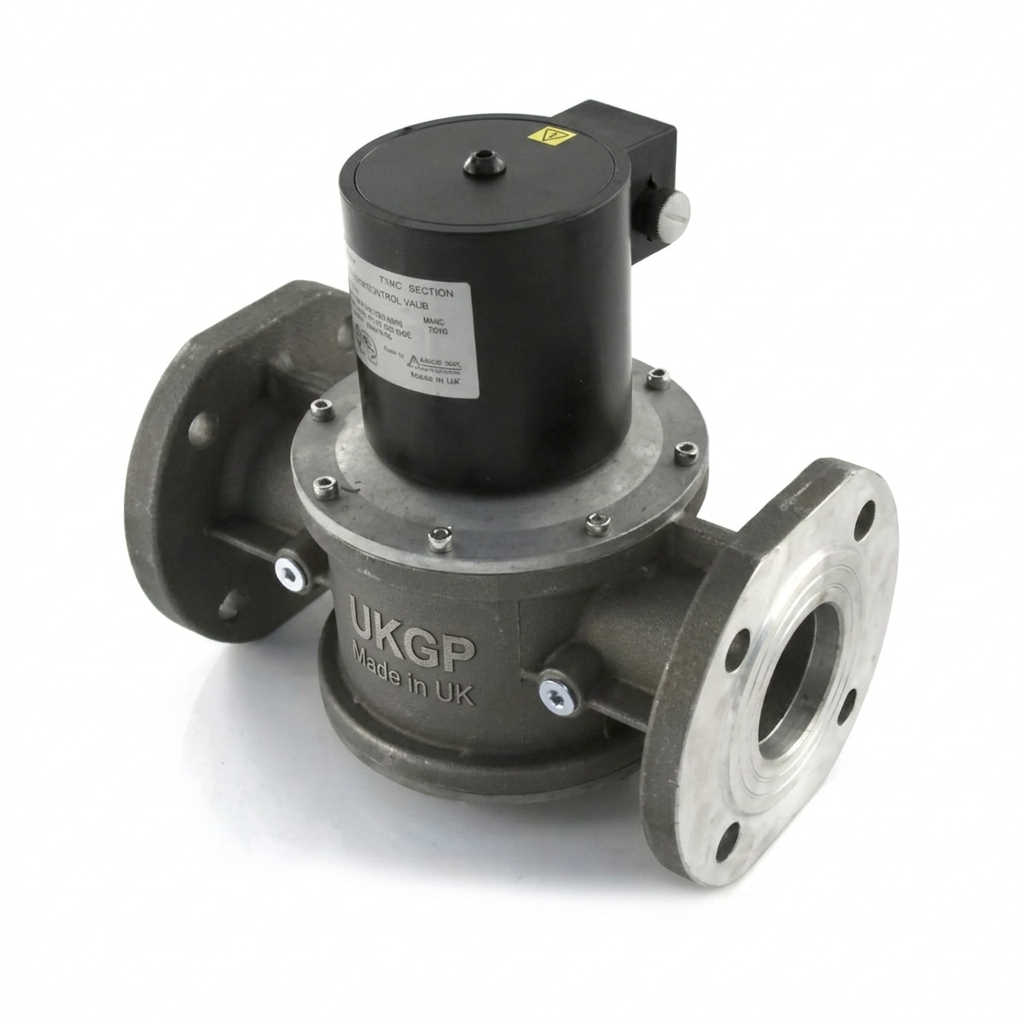
Selecting an automatic-reset valve over a manual-reset variant is common in modern plant rooms integrated with a BMS. An automatic-reset valve, such as those in the UKGP Industrial range, will re-open once power is restored to the solenoid coil. This is ideal for unmanned plant rooms where a brief power flicker shouldn't necessitate a site visit, provided the upstream safety interlocks (such as gas detection systems) remain satisfied.
Technical Specifications and Installation Requirements
When specifying a solenoid valve, engineers must account for the maximum operating pressure (MOP). Standard commercial valves are often rated for 200 mbar or 360 mbar, which is sufficient for most low-pressure nominal systems in the UK. For industrial applications or those downstream of a booster, 1 bar to 6 bar rated valves may be required. Over-specifying pressure can lead to unnecessary costs, while under-specifying is a critical safety breach.
Installation must strictly follow IGEM/UP/2 (Gas installation pipework, boosters and compressors on industrial and commercial premises). Valves should be installed in a horizontal or vertical run, but never with the solenoid coil facing downwards, as this allows debris and condensate to accumulate in the tube, potentially causing the valve to stick or the coil to burn out. A gas filter must always be installed upstream of the solenoid valve to protect the Viton or NBR seats from particulate damage.
BMS Interlocking and Gas Safety Regulations
The Gas Safety (Installation and Use) Regulations 1998 require that gas supplies to certain areas, such as commercial kitchens (BS 6173) or laboratories, must be interlocked with ventilation systems. The gas solenoid valve acts as the final element in this safety chain. If the extract fan fails or the CO2 sensors exceed threshold limits, the BMS or the gas interlock panel drops the 230V or 24V supply to the valve, instantly isolating the fuel supply.
Engineers must also consider the electrical inrush current of larger solenoid coils. On valves exceeding 2" (DN50) BSP or flanged equivalents, the holding current is significantly lower than the pull-in current. Correct fuse sizing in the control panel is essential to prevent nuisance tripping. Furthermore, many UKGP Industrial valves feature LED indicators or auxiliary switches (Closed Position Indication - CPI) to provide positive feedback to the BMS that the valve is physically closed.
Material Compatibility: Natural Gas, LPG, and Town Gas Fluids
Material selection is governed by the chemical composition of the gas. Standard EN 161 valves are typically constructed from die-cast aluminium or brass. While suitable for Natural Gas (Methane) and LPG (Propane/Butane), certain 'Town Gas' or manufactured gases with high hydrogen content may require specific seal materials to prevent embrittlement or leakage. Aluminium bodies are preferred for their strength-to-weight ratio and are generally the standard for flanged DN65 to DN150 installations.
The environmental conditions of the plant room also dictate the IP rating of the valve. Most UK commercial installations require IP54 or higher to protect against dust and moisture ingress. In external locations or wash-down areas, IP65 rated coils are mandatory. It is also worth noting that solenoid valves generate heat during operation; ensuring adequate ventilation around the valve head is a basic but often overlooked design requirement to prevent premature coil failure.
Summary of Selection Criteria for Building Services
Choosing the correct gas solenoid valve is a matter of matching the application’s safety integrity level with the valve’s laboratory-tested performance. For the majority of UK applications, a Class A, Group 1, normally-closed automatic-reset valve is the standard. This ensures compliance with IGEM/UP/2 and provides the necessary fail-safe protection for the building and its occupants.
By ensuring that all valves are EN 161 certified and correctly integrated into the building’s emergency shutdown system, engineers can mitigate the risks associated with gas leaks and flame failure. Regular maintenance and annual inspections, as recommended by CIBSE and BSRIA, remain the final pillar of a robust gas safety strategy.
- Compliance with EN 161 (Class A).
- Fast closing time (<1 second).
- Correct voltage (typically 230V AC for UK plant, but 24V DC for certain process controls).
- Pressure rating suitable for the gas governed supply.
- Presence of a CPI switch if remote monitoring is required.
Frequently asked questions
Why is Class A classification required for UK plant rooms?
- Class A valves must comply with the leakage rates and closing times defined in EN 161. In the UK, IGEM/UP/2 specifies Class A for the majority of industrial and commercial safety shut-off applications to ensure the highest level of protection.
What is the difference between automatic and manual reset valves?
- While both are safety devices, a manual reset valve requires a physical human intervention to reopen after a power cut or alarm, whereas an automatic reset valve (normally-closed) will reopen as soon as the control signal or power is restored. Automatic valves are standard for BMS-controlled plant.
Where should the shut-off valve be positioned in the gas train?
- The valve should be installed as close as possible to the point of entry to the building or the appliance train, typically after the primary isolation valve and filter, but before any flexible connections to burners.
Do gas solenoid valves require maintenance?
- No. While EN 161 valves are designed for durability, seating surfaces can degrade. BSRIA BG29 and BG50 highlight the importance of annual tightness testing and visual inspection for corrosion or solenoid coil overheating.