The Role of Normally-Closed Solenoid Valves
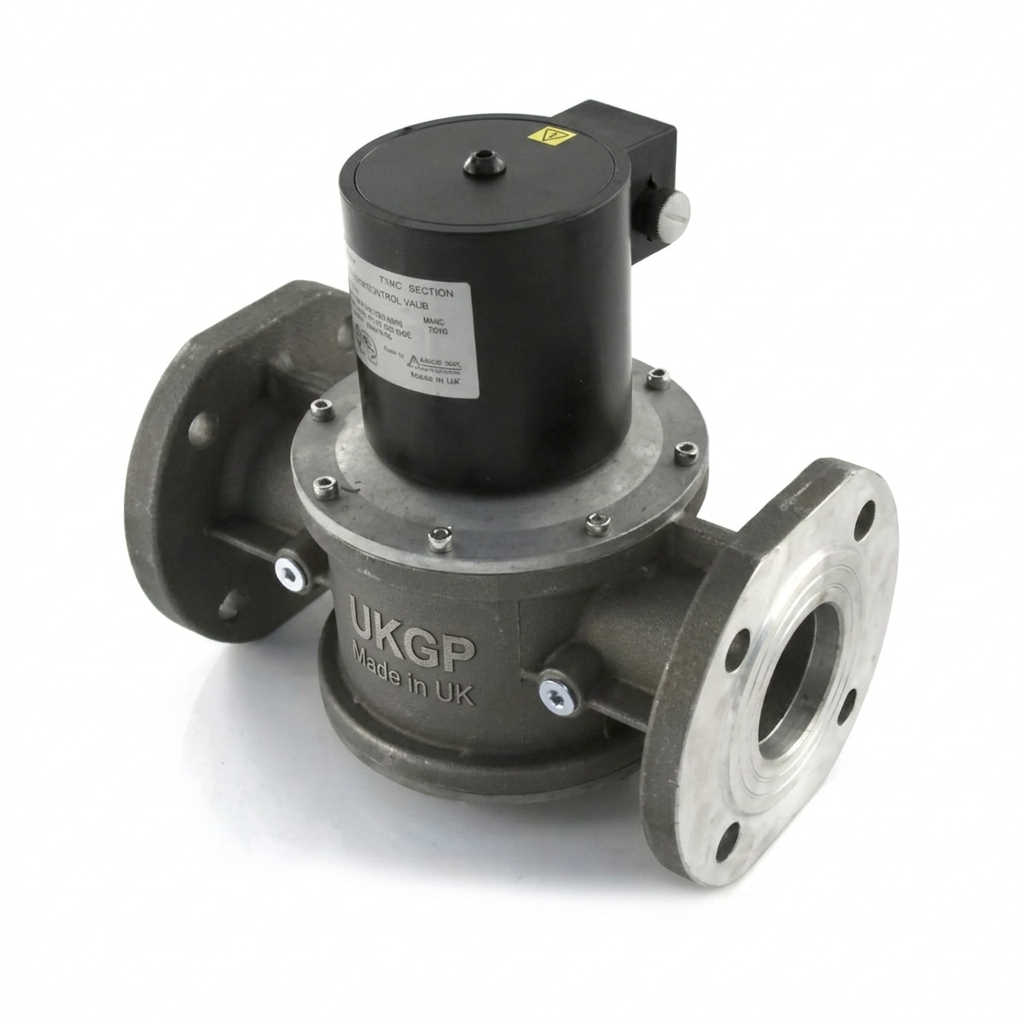
In commercial gas installations, the primary safety mechanism is the normally-closed (NC) solenoid valve. These devices are held open by an electromagnetic coil; when power is interrupted—whether by a deliberate manual emergency stop, a fire alarm trigger, or a failure in the ventilation system—the valve resets to its closed position via internal spring tension. This 'fail-safe' characteristic ensures that gas flow is immediately terminated in hazardous conditions, preventing the accumulation of unburnt gas.
For UK plant rooms and kitchens, the valves must be automatic-reset types. This doesn't mean the valve reopens on its own after a power cut—rather, it means the internal mechanism is designed to reset to the closed position automatically without manual intervention. For the valve to reopen, power must be restored to the coil, often through a control panel that requires a manual reset by the operator once the safety condition (such as airflow) is satisfied. Quality components, such as those within the UKGP Industrial range, are designed to withstand the high-cycle demands of commercial applications.
- Automatic closure in <1 second upon loss of signal.
- High-quality NBR based seals for leak-tight shut-off.
- Die-cast aluminium bodies to reduce weight while maintaining pressure ratings up to 360 mbar or 6 bar for industrial variants.
- Compliance with EN 161 standards for Class A Group 2 safety valves.
BS 6173 Compliance and Interlocking Requirements
BS 6173 is the 'Specification for installation and maintenance of gas-fired catering appliances'. One of its most critical mandates involves the interlocking of the gas supply with the mechanical ventilation system. If the extraction canopy or supply air fans fail, the gas supply must be automatically isolated to prevent the buildup of combustion products, particularly Carbon Monoxide (CO), which poses a lethal risk to staff.
The gas solenoid valve acts as the final element in this safety chain. It is typically wired to a gas interlock controller or a BMS. Engineers must ensure the valve selected is compatible with the voltage of the control system (usually 230V AC or 24V DC). Furthermore, BS 6173 highlights that where appliances do not have flame supervision devices (FSDs), a gas proving system is required to check for downstream leaks before the solenoid valve is allowed to open, adding another layer of complexity to the valve’s control logic.
- Fan power monitoring (detecting current draw).
- Air pressure differential switches (measuring actual airflow).
- Carbon Dioxide (CO2) sensors (monitoring room air quality).
- Emergency Stop (E-Stop) buttons.
Frequently asked questions
What is the difference between Class A and Class B gas solenoid valves?
- Class A valves, as defined by EN 161, are high-safety shut-off valves typically required for commercial boiler plant and kitchen interlock systems. They must be capable of closing in less than one second upon power loss.
Is a gas solenoid valve mandatory in all commercial kitchens?
- Yes, BS 6173 requires that where gas appliances do not have flame failure devices, or where mechanical ventilation is essential for safety, a gas proving system or interlock must be used to prevent gas flow if the fans are not operational.
Why are normally-closed valves specified over normally-open versions?
- Normally-closed valves require constant electrical power to remain open. In the event of a power cut, fire alarm activation, or E-stop trigger, the valve automatically closes via internal spring tension, ensuring a fail-safe condition.
How does IGEM/UP/2 relate to BS 6173 regarding valve installation?
- While BS 6173 focus on kitchens, IGEM/UP/2 (Edition 3) provides the broader framework for gas installations in industrial and commercial premises, covering pipework sizing, valve positioning, and testing.