The Fundamentals of Linear Expansion in Steam Pipework
The thermodynamic properties of steam necessitate a rigorous approach to pipework design. As steam enters a cold main, the rapid rise in temperature causes the steel to expand. If this movement is restrained without an expansion joint or loop, the resulting forces—calculated as the product of the cross-sectional area of the pipe and the Young’s modulus—can easily exceed the yield strength of the steel, leading to catastrophic failure of welds or supports.
Thermal expansion coefficients for carbon steel (typically 0.012mm/m/°C) mean that engineers must account for substantial displacement. For example, a 150mm ND steam main operating at 10 bar g (approx. 184°C) will expand roughly 2.1mm for every metre of pipe. In a 50-metre straight run, over 100mm of movement must be absorbed. While natural offsets and 'L' or 'U' bends are ideal, they are often impractical in dense UK plant rooms.
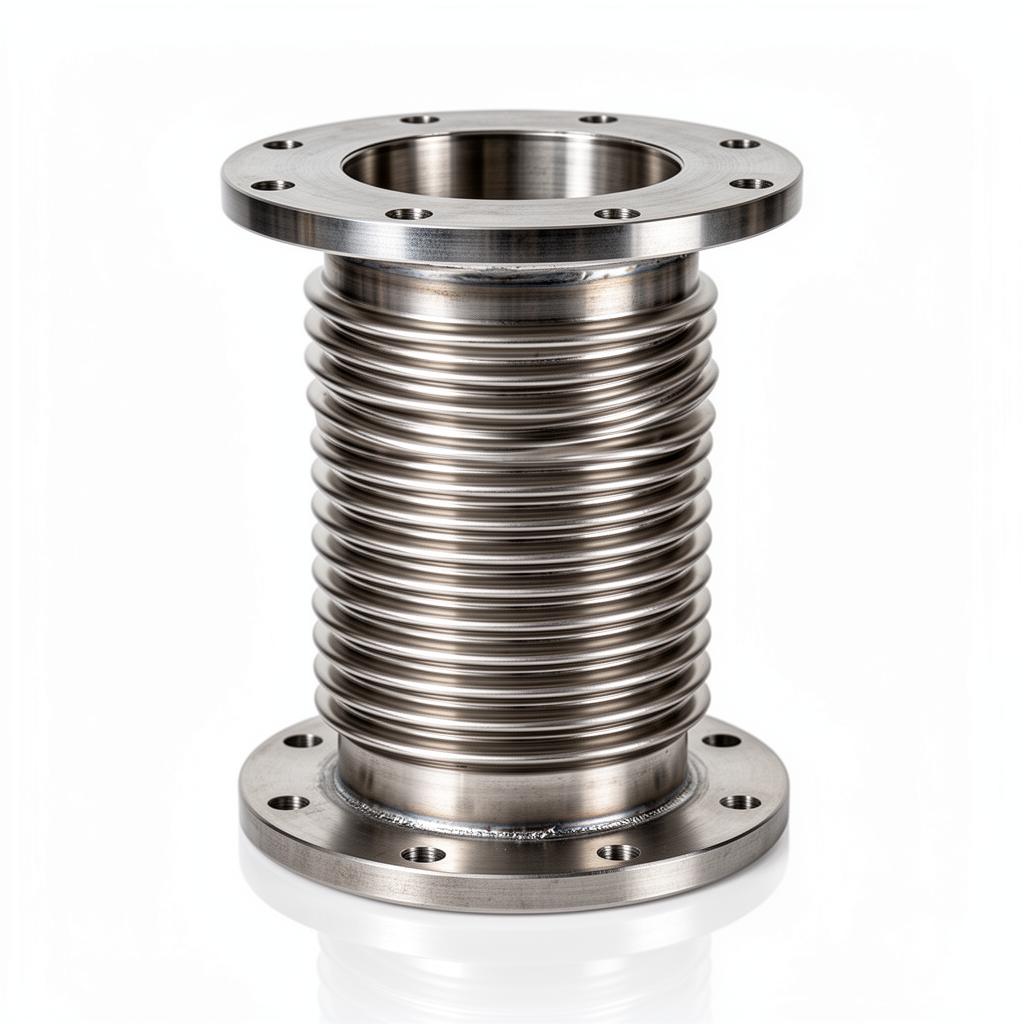
This is where expansion bellows become critical. Unlike rubber joints used in LPHW systems, steam bellows must be constructed from multi-ply stainless steel (typically Grade 316L or 321) to withstand the temperature-pressure relationship and the corrosive potential of the condensate. Understanding the difference between axial, lateral, and angular movement is the first step in a successful specification.
- Calculation of the total thermal expansion (expansion = L x ΔT x α).
- Steam pressure and temperature (maximum working and design conditions).
- The media velocity and its impact on erosion.
- The physical space available for the bellows and required anchors.
Classifying Bellows Types for Steam Applications
Selection depends entirely on the piping geometry. Axial expansion joints are the most common in long straight runs. They are compact and cost-effective but require extremely rigid anchoring. Because the bellows acts like a piston under pressure, it generates a 'pressure thrust' force that can exceed several tonnes. All axial installations must be Book-ended by main anchors capable of resisting this force.
Lateral expansion joints are often preferred in congested areas or where anchors cannot be sufficiently reinforced. By utilising tie rods, the pressure thrust is contained within the bellows unit itself, meaning the pipe anchors only need to deal with the relatively small force required to deflect the bellows. For steam mains, 'articulated' joints consisting of two bellows separated by a spool piece provide the highest degree of lateral movement.
Universal expansion joints consist of two bellows joined by a centre sleeve. These are capable of absorbing axial, lateral, and angular movements simultaneously. However, in steam service, these are more complex to support and often require custom engineering to ensure they do not 'squirm' or become unstable under high-pressure conditions. Referencing EJMA (Expansion Joint Manufacturers Association) guidelines is essential for calculating these stability limits.
- Axial Bellows: Designed to compress or extend along the longitudinal axis.
- Lateral Bellows: Designed to absorb movement perpendicular to the pipe axis, often using tie rods.
- Angular Bellows: Used in 'hinged' pairs to absorb expansion through rotation.
Material Selection and Compliance Standards
In the UK, all steam expansion bellows must comply with the Pressure Equipment Directive (PED) and be CE or UKCA marked where applicable. The bellows element itself is usually formed from 300-series stainless steel. Grade 321 is frequently specified for steam due to its titanium stabilisation, which prevents intergranular corrosion in the heat-affected zones of the welds. Grade 316L is also common for its superior resistance to chlorides which may be present in lower-quality feedwater.
The end connections must match the system's pressure rating. Most UK industrial steam systems utilize flanged connections to BS EN 1092-1 (typically PN16, PN25, or PN40). For high-pressure process steam or district heating, butt-weld ends are often preferred to reduce the number of potential leak paths. Internal sleeves (liners) are mandatory for steam applications to prevent the high-velocity flow from inducing resonance in the convolutions, which leads to fatigue failure.
External shrouds or 'can' covers are also a critical safety feature. Not only do they protect the delicate convolutions from external mechanical damage and debris, but in the event of a bellows failure, they provide a degree of containment for the escaping steam, protecting onsite personnel. Specification should always insist on a design life calculated in cycles—typically 1,000 to 2,000 full-stroke cycles for standard building services applications.
- BS EN 1092-1: Standard for circular flanges for pipes, valves, and fittings.
- EN 14917: European standard for metal bellows expansion joints.
- Pressure Equipment Directive (PED) 2014/68/EU.
The Critical Role of Anchoring and Guiding
The single most frequent cause of expansion bellows failure is not the bellows itself, but the lack of adequate guiding and anchoring. When a steam main is pressurised, the bellows tries to straighten out or 'blow apart'. This pressure thrust (Area x Pressure) must be absorbed by main anchors. If an anchor fails, the bellows will instantly over-extend and rupture.
Guiding is equally important. Axial bellows have no lateral stiffness. Without pipe guides, the pipework will bow or buckle, causing the bellows to distort laterally—a movement it was likely not designed to handle in an axial configuration. According to industry best practice, the first guide must be placed within 4 diameters (4D) of the bellows, and the second guide within 14 diameters (14D).
In steam systems, the weight of the pipe and the condensate must also be considered. Friction forces from pipe supports add to the load on the anchors. For M&E contractors, ensuring that the structural steel of the building can take the point loads generated by these anchors is a critical part of the pre-installation phase. Calculations should be verified by a structural engineer before the steam main is commissioned.
- Main Anchors: Must withstand pressure thrust plus friction.
- Intermediate Anchors: Used to divide long runs into smaller sections.
- Planar Guides: Used to keep the pipe in alignment with the bellows.
Installation Best Practices for M&E Contractors
Before installation, the bellows should be inspected for any dings or scratches on the convolutions. Even a minor scratch can act as a stress concentrator, leading to premature failure in a high-pressure steam environment. It is vital to ensure that the pipework is correctly aligned; expansion bellows should never be used to compensate for poor pipework fabrication or misalignment unless specifically designed as a 'settlement' joint.
Many steam bellows are supplied with 'cold draw' or 'pre-setting'. This involves stretching or compressing the bellows during manufacture so that at the midpoint of its operating temperature, it is in its relaxed state. Contractors must follow the manufacturer’s instructions regarding the removal of transit bars. Transit bars are painted a bright colour (often yellow or red) and must only be removed after the pipework is fully anchored and guided, but BEFORE the system is hydrostatically tested.
During the hydrostatic test, the pressure is typically 1.5 times the design pressure. This is the moment of greatest risk for the bellows. If the anchors are insufficient, the bellows will fail during the test. Once the system is live, the bellows should be monitored through its first thermal cycle. Look for smooth movement and ensure no 'squirm' (winding) of the convolutions is occurring. Quality UKGP Industrial bellows are designed to meet these rigorous commissioning phases without deformation.
- Check for shipping bolts/tags (must be removed after installation).
- Verify flow direction (internal liners are directional).
- Inspect for 'cold draw' requirements.
Condensate Management and Water Hammer Prevention
Water hammer is the primary 'killer' of steam expansion bellows. When steam travels over a pool of condensate, it can pick up the liquid and propel it at high velocities (up to 30m/s). When this 'slug' of water hits the convolutions of a bellows, it causes an instantaneous pressure spike and mechanical impact that the thin-walled stainless steel cannot withstand. One major event can deform the bellows beyond repair.
To protect the bellows, efficient steam trapping is non-negotiable. A steam trap station should be installed immediately before the expansion joint to ensure that the bellows remains dry during both 'warm-up' and 'running' conditions. Drip legs should be sized adequately to collect condensate during the start-up phase when condensation rates are at their highest.
Furthermore, the internal liner of the bellows helps by providing a smooth bore for the steam, but it does not protect against the physical impact of a water slug. Engineers must ensure the entire system gradient (fall) is correct and that the bellows is not installed at a low point in the system where condensate could pool during shutdown periods. Environmental factors and insulation (lagging) also play a role in reducing the volume of condensate formed.
- Removal of condensate prevents water hammer.
- Traps should be placed immediately upstream of any bellows.
- Properly sized dirt pockets prevent debris from entering convolutions.
Maintenance and Long-term Integrity
While expansion bellows are technically 'service-free' components, they require regular visual inspection as part of a robust Facilities Management (FM) regime. Over time, the constant cycling of the bellows can lead to fatigue cracking. Inspections should look for signs of 'panting' or any deformation in the convolution profile. If the bellows is covered by insulation, it is good practice to use removable 'thermal jackets' that allow for easy inspection of the flanges and bellows element.
Corrosion is another concern, particularly in UK areas with hard water or where boiler water treatment is inconsistent. Stress Corrosion Cracking (SCC) can occur if chlorides are allowed to concentrate in the convolutions. BSRIA BG50 provides specific guidance on maintaining water quality to prevent such issues. Any sign of 'weeping' from the bellows is an emergency; steam leaks under pressure can erode the adjacent metallurgy rapidly through 'wire-drawing'.
Finally, the external environment must be considered. In plant rooms where chemical cleaning occurs or in coastal environments, the stainless steel can be susceptible to external pitting. If the bellows is located in a harsh environment, specifying a protective shroud or a higher grade of stainless steel (such as 316) for all wetted and non-wetted parts is a prudent engineering decision. Most units should be replaced after their calculated cycle life is reached to avoid unmanaged failure.
- BSRIA BG50 guidelines for steam system chemistry.
- Visual inspection for 'tea-staining' or pitting.
- Checking for 'bottoming out' of convolutions.
Advanced Solutions: Pressure Balanced Joints
In some complex steam installations, the pressure thrust is so high that constructing a traditional main anchor is physically impossible or prohibitively expensive—for example, on a roof-mounted main or a bridge crossing. In these scenarios, a 'Pressure Balanced Expansion Joint' is the solution. This design uses an additional bellows and a system of tie rods to create an opposing force that cancels out the pressure thrust.
The result is a joint that only transmits the spring rate of the bellows to the pipework, drastically reducing the structural requirements for anchors. While more expensive and larger than a standard axial bellows, the savings in structural steel and the increased safety often justify the investment in industrial and district heating applications.
Whether specifying a standard flanged axial bellows or a complex pressure-balanced system, the focus must remain on the interaction between the bellows and the piping system as a whole. Expansion bellows are not 'fit and forget' components; they are highly engineered pressure vessels that require precise integration into the steam distribution network to ensure a safe and long service life.
- Steam-jacketed bellows for high-viscosity media.
- Externally pressurised bellows for high-axial movement.
- Pressure-balanced joints to eliminate anchor loads.
Frequently asked questions
Can I use rubber expansion joints on a low-pressure steam line?
- No. Rubber bellows have maximum temperature limits (typically 90-110°C) and cannot withstand the pressures or the erosive nature of steam. Stainless steel is the industry standard.
What is the purpose of an internal liner in a steam bellows?
- The internal sleeve (liner) protects the bellows convolutions from high-velocity steam erosion and prevents turbulent flow. It is essential for steam velocities exceeding 20m/s.
Are tie rods always required for steam bellows?
- Tie rods are used to restrain the pressure thrust of the system. While common in lateral and angular offsets, they must be used carefully; if used on an axial bellows, they prevent it from doing its job unless specific 'limit rod' configurations are employed.
Which BSRIA guides are relevant to steam bellows installation?
- BSRIA BG29/21 and BG50 provide guidance on water treatment and system cleanliness, which is vital to prevent stress corrosion cracking (SCC) in stainless steel bellows.
How does poor condensate management affect bellows lifespan?
- Untrapped condensate results in water hammer—slugs of water travelling at high speed. This can cause instantaneous mechanical failure of the bellows convolutions, even if the bellows is rated for the system pressure.