The Necessity of Chemical Dosing in Closed Loops
Closed-loop heating and cooling systems are rarely 'closed' in the absolute sense. Micro-leaks, gland seepage, and maintenance activities introduce fresh, oxygenated water into the circuit. This replenishment introduces dissolved oxygen and minerals, which serve as the primary drivers for oxidative corrosion and scale formation. Without technical intervention, the metallic components—ranging from carbon steel pipework to aluminium heat exchanger blocks—will undergo rapid degradation.
Corrosion in these systems typically manifests as magnetite (black iron oxide). This heavy, abrasive sludge settles in areas of low flow, such as underfloor heating manifolds and terminal units, significantly reducing heat emission. In cooling systems, the lower temperatures promote the growth of biofilm and sulphate-reducing bacteria (SRB). These biological agents not only impede flow but can cause localised 'under-deposit' corrosion, which is more aggressive and harder to detect than general surface corrosion.
Chemical dosing is the primary preventative measure prescribed by BS 8552 and BSRIA BG50. By introducing specific formulations—including anodic and cathodic inhibitors, pH buffers, and biocides—engineers can create a passive layer on internal surfaces. This layer effectively 'insulates' the metal from the electrolyte, halting the electrochemical process of corrosion before it compromises the structural integrity of the plant.
- Internal corrosion leading to pinhole leaks in heat exchangers.
- Magnetite (sludge) accumulation causing valve seizures and reduced pump efficiency.
- Microbiological growth (SRB/NRB) in low-temperature systems like LTHW or CHW.
- Reduced thermal transfer efficiency resulting in higher energy consumption.
Anatomy and Mechanics of the Dosing Pot
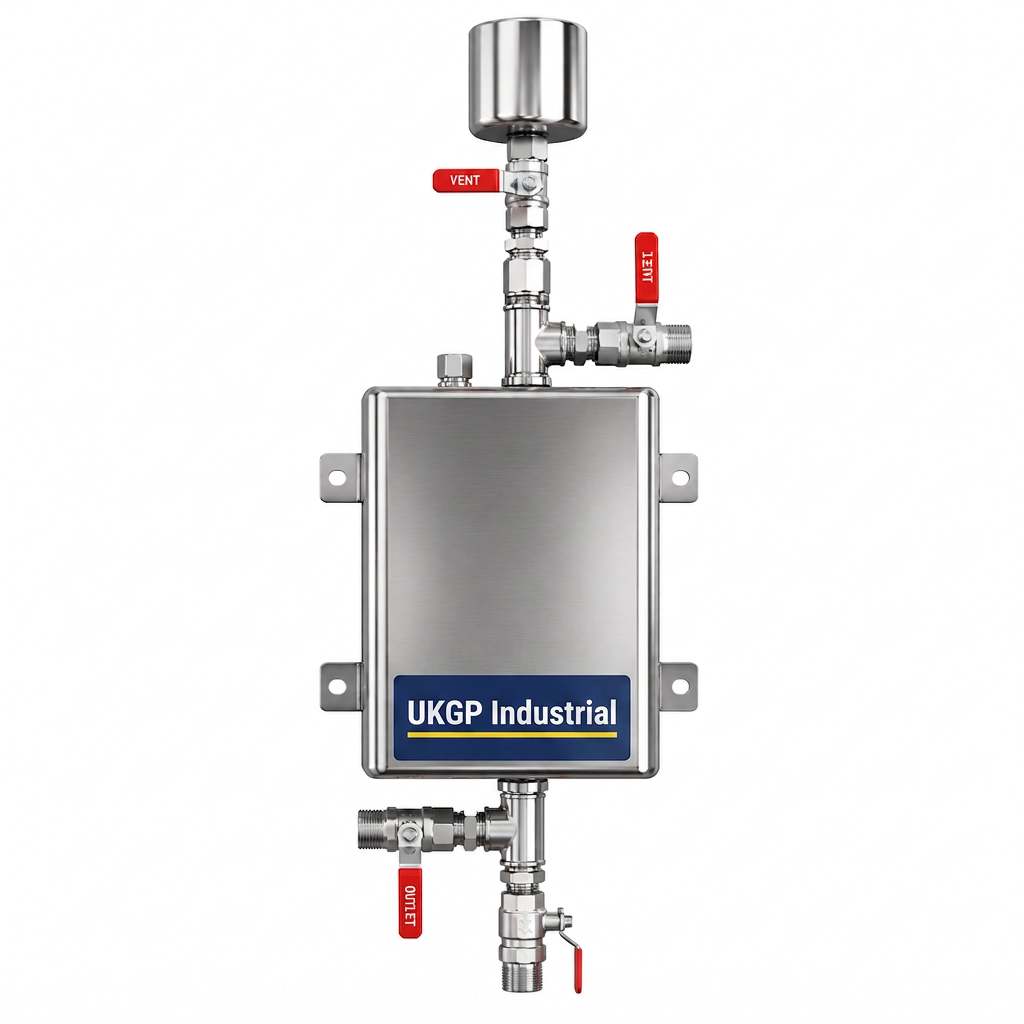
The chemical dosing pot is a pressure-vessel bypass feeder designed to introduce liquid chemicals into a circulating system without the need to de-pressurise the loop. It operates on the principle of differential pressure. By connecting the pot across a pump or a control valve, a flow path is created that forces the chemical charge from the pot into the main return header. Standard units are manufactured from mild steel or stainless steel, with the latter being preferred for longevity and resistance to aggressive biocides.
A standard installation involves a vessel with a top-mounted filling funnel, an air vent, and two isolation valves connecting to the system. Most UK-specified units, such as those from UKGP Industrial, feature a five-valve configuration: two for system isolation, one for the fill funnel, one for the air vent, and a bottom drain-off. This layout ensures that the operator can safely isolate the vessel, drain a portion of the system water, fill it with the required chemical, and then slowly bleed it back into the circuit.
Sizing is a critical yet often overlooked factor. While common pot sizes range from 3.5 litres to 25 litres, the selection should be based on the total system volume and the required dosage concentration. If a system requires 50 litres of inhibitor, using a 3.5-litre pot requires over 14 individual filling cycles. This is not only labour-intensive but increases the risk of chemical spills and air ingress. For commercial applications, a 10-litre or 15-litre pot is generally considered the industry standard for efficiency.
- Inlet and outlet valve configurations (standard five-valve arrangement).
- Material of construction (typically stainless steel or epoxy-coated carbon steel).
- Pressure rating requirements (PN10, PN16, or higher for high-rise plant).
- Tundish and drain-off arrangements for safe chemical handling.
Frequently asked questions
How frequently should inhibitor levels be checked in a commercial heating system?
- In line with BSRIA BG50, closed systems should be checked weekly for inhibitor levels during the first three months of operation, moving to monthly or quarterly once stable. A full analytical laboratory report should be commissioned annually.
Can a dosing pot be used for initial glycol filling?
- While technically possible, it is not recommended for large volumes. Dosing pots are designed for slug-dosing. For significant glycol volumes, a dedicated pressurisation unit with a glycol break tank is required to maintain the correct concentration and system pressure.
What pressure rating is required for a dosing pot?
- Dosing pots are generally rated to PN10 or PN16. In high-rise applications or high-pressure process loops, ensure the pot's shell and valve rating exceeds the system's safety valve set point. UKGP Industrial offers high-pressure variants for these specific needs.
Is a dosing pot compatible with an Air and Dirt Separator (ASD)?
- They are compatible, but the presence of an ASD does not replace the need for chemical treatment. Deaeration removes the corrosive gas (oxygen), while inhibitors provide the secondary defence against electrolyte-driven corrosion.