Regulatory Framework and Compliance Standards
The installation of chemical dosing pots in the UK is governed by several key technical standards. Foremost is BSRIA BG50, which provides explicit guidance on how to prevent corrosion, scale, and microbiological fouling in closed-loop systems. A dosing pot is not an optional extra; it is the recognised professional method for maintaining chemical concentrations without breeching the sealed nature of a pressurised system. Improperly treated water leads to premature failure of heat exchangers, circulators, and control valves, often voiding manufacturer warranties on boilers and chillers.
Mechanical and Electrical (M&E) contractors must also adhere to BG29/21 during the commissioning phase. The dosing pot is frequently used to introduce cleaning agents and biocides during the initial flush and passivating stages. Failure to install the pot correctly or in the right location can lead to 'dead legs' or insufficient chemical distribution, leaving the system vulnerable to Microbiologically Influenced Corrosion (MIC) from the outset.
Furthermore, all dosing pots must be manufactured in accordance with the Pressure Equipment Directive (PED) or the UKCA equivalent. Since these vessels are pressurised during operation, they must be hydrostatically tested and clearly labelled with their maximum working pressure (MWP) and temperature ratings. For most commercial UK installations, this typically involves a 10 bar or 14 bar rating, though high-rise developments may require higher specifications.
- BSRIA BG50: Water treatment for closed heating and cooling systems.
- BSRIA BG29: Pre-commission cleaning of pipework systems.
- BS 8552: Sampling and monitoring of water from building services circuits.
- Pressure Equipment Directive (PED) 2014/68/EU (UKCA equivalent).
System Design and Positioning Requirements
The effectiveness of a chemical dosing pot depends entirely on the pressure differential (ΔP) across its connections. To function correctly, the pot must be piped as a bypass loop between two points of different pressure. Typically, this is achieved by connecting the inlet of the pot to the discharge side (flow) of the main system pump/circulator and the outlet of the pot to the suction side (return) or a lower-pressure return header. This ΔP naturally drives the fluid through the vessel, displacing the chemicals into the main system flow.
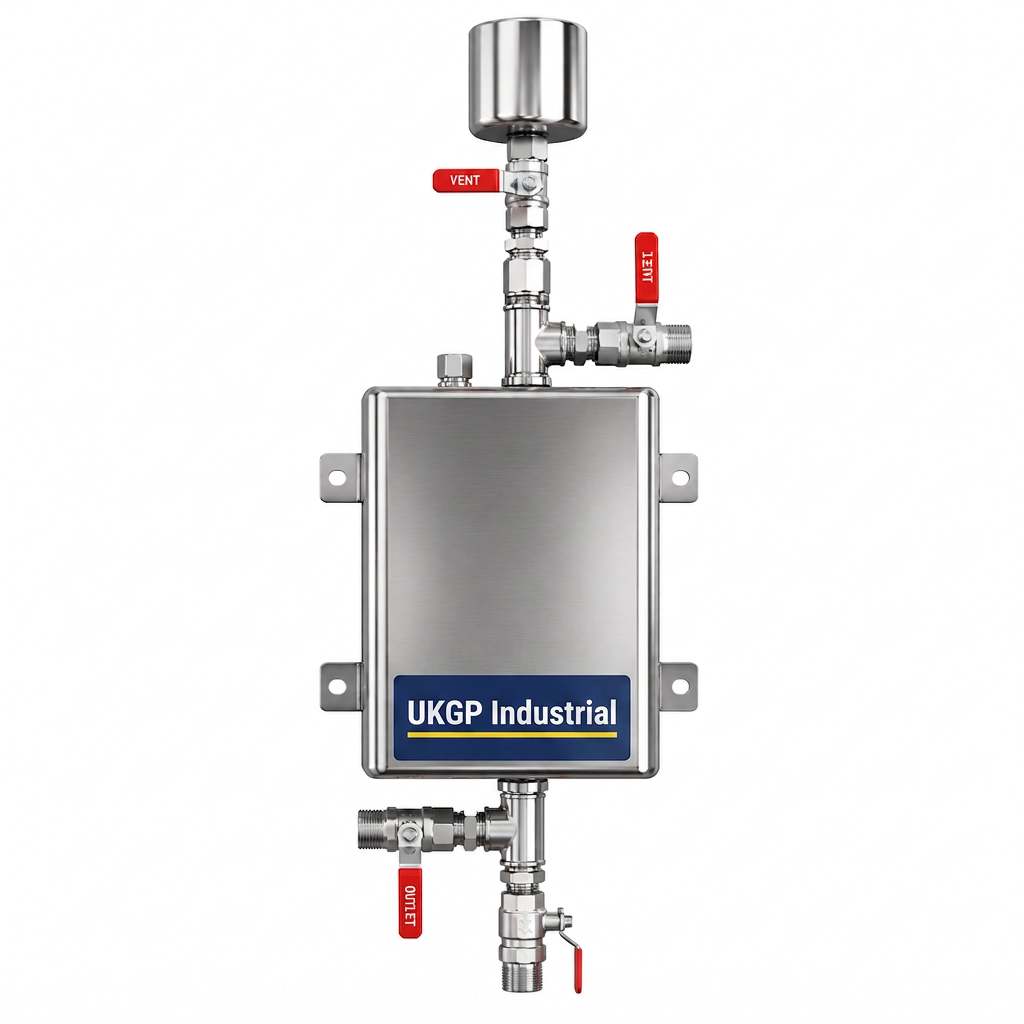
Positioning is equally critical for operational safety. Engineers should avoid installing dosing pots in cramped or overhead locations. Given that concentrated inhibitors and biocides are often heavy (20-25 litre drums), the pot must be installed at an ergonomic height. There must be sufficient clearance above the filling funnel to allow for a clean pour and around the vessel for valve operation. UKGP Industrial dosing pots are designed with integral floor stands or wall-mounting brackets to facilitate this.
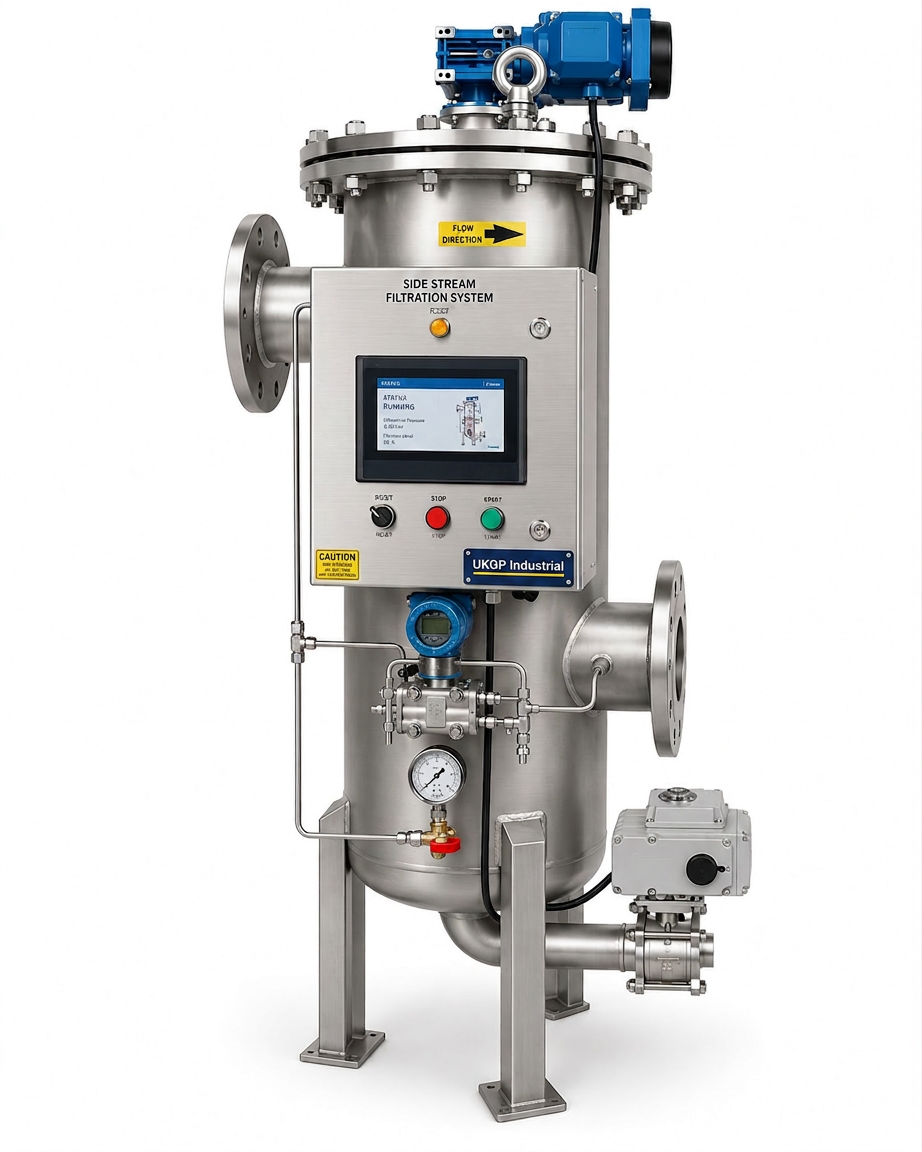
When designing the layout, ensure the dosing pot is located upstream of any fine filtration or side-stream separators if the intent is to coat the entire system. However, in many modern specifications, the dosing pot is integrated into a side-stream filtration skid to ensure that any suspended solids introduced during the chemical pouring process are immediately captured before circulating through the plant.
- Flow configuration: Installed across the flow and return headers to utilise differential pressure.
- Accessibility: Positioned at chest height (approx. 1.2m to 1.5m) for safe manual handling.
- Proximity: Located in the plant room near the main circulating pumps for maximum turbulence and mixing.
Sizing and Material Selection
Dosing pots are generally sized by volume, with standard commercial capacities ranging from 3.5 litres to 25 litres. Sizing is not strictly proportional to system volume; rather, it is based on the volume of chemical being added in a single 'shot.' Larger systems (e.g., >50,000 litres) may benefit from a 25-litre pot to reduce the number of repeated filling cycles required to reach the target parts-per-million (ppm) concentration of inhibitor.
While carbon steel pots are available, stainless steel is the preferred specification for UK building services. This is due to the aggressive nature of certain concentrated chemicals, particularly undiluted biocides and some glycol formulations, which can cause internal pitting in carbon steel vessels. A stainless steel vessel ensures that the dosing pot itself does not become a source of corrosion or debris within the plant room.
Valve selection is another critical factor. High-quality quarter-turn ball valves are standard, providing clear visual indication of whether the pot is 'on-line' or isolated. It is essential that the filling funnel is fitted with a secondary isolation valve to prevent accidental discharge if the primary seal fails. Dosing pots from UKGP Industrial feature secure, leak-proof designs that prioritise the safety of the plant room operative.
- Stainless steel construction for longevity and chemical resistance.
- Non-return valves (NRV) on the inlet to prevent backflow during filling.
- Pressure gauge to monitor vessel internal pressure.
- Safety relief valve (optional but recommended in high-pressure circuits).
Step-by-Step Installation Methodology
Begin by identifying the high-pressure (inlet) and low-pressure (outlet) connection points on the main system headers. The pipework connecting the system to the dosing pot should be kept as short as possible to minimise pressure drops. Use 15mm or 22mm pipework depending on the pot size; smaller pots typically use 15mm connections, while 15L and 25L versions often utilise 22mm for faster turnover.
Mount the vessel securely using the provided brackets. Ensure the pot is perfectly vertical to prevent air pockets during the filling process. If wall-mounting, ensure the fixings are rated for the 'wet' weight of the unit. Once mounted, install the valved bypass arrangement: the inlet valve connects to the top of the vessel (or the side inlet port), and the outlet valve connects to the bottom. A drain valve must be installed at the lowest point of the pot to allow the vessel to be emptied before each dose.
Crucially, the filling funnel (tundish) must be located at the highest point of the assembly. A safety air-release valve or vent should be incorporated to allow air to escape as the pot is filled with chemicals and then later as it is re-pressurised with system water. All joints should be tested for leaks at the system's static pressure before the pumps are activated.
- Check the wall or floor can support the weight of the vessel when full of liquid.
- Install the inlet and outlet pipework (typically 15mm or 22mm copper or steel).
- Fit isolation valves at the system connection points to allow for future maintenance.
- Ensure the tundish or drain-off point is piped to a safe, visible discharge area.
Hydraulic Integration and Side-Stream Synergy
A dosing pot does not operate in isolation; its performance is linked to the overall cleanliness of the hydronic circuit. BSRIA BG50 emphasises the importance of side-stream filtration alongside chemical treatment. If a system is heavily fouled with magnetite or sludge, adding inhibitor via a dosing pot will be largely ineffective, as the chemical will be 'consumed' reacting with existing debris rather than protecting metal surfaces. Integrating a side-stream filter ensures that the water remains clear, allowing the chemicals to maintain their peak concentration.
When installing the dosing pot, engineers should consider the bypass flow rate. If the flow through the dosing pot is too fast, it can lead to air entrainment. If it is too slow, the chemicals may take hours to disperse. A balance is required, often achieved by partially closing the return valve on the dosing pot to control the flow rate once the initial 'flush' of chemicals into the system has occurred.
In modern 'intelligent' buildings, the dosing pot may be complemented by an automated chemical dosing system or a pressurisation unit with a glycol recovery or top-up function. However, the manual dosing pot remains the ultimate fail-safe and the standard requirement for the initial 'slug' dosing of corrosion inhibitors (like Molybdates or Nitrites) and biocides used to control pseudomonas and other bacteria in chilled water systems.
- Check system health before chemical addition; high turbidity inhibits chemical efficacy.
- Monitor differential pressure: ensure flow is moving from the high-pressure side to the low-pressure side.
- Verify that the air vent is fully closed before opening the pot to the system.
The Dosing Procedure: Best Practice for Engineers
Executing a dose requires a disciplined approach to prevent air ingress and system depressurisation. Start by ensuring the dosing pot is isolated from the system. Open the drain valve at the bottom and the air vent at the top to clear the pot of existing system water. Once empty, close the drain valve. The chemical—whether it is a concentrated inhibitor or a biocide—should then be poured into the tundish. Take care to follow the manufacturer's Safety Data Sheets (SDS) for the chemicals being handled, including the use of appropriate PPE (gloves and goggles).
After the chemical is in the pot, close the filling valve and the air vent. The next step is critical: slowly open the inlet valve to allow pressurized system water to enter the pot. Once the pot is equalised with the system pressure, open the outlet valve. The differential pressure across the system will now force water through the pot, carrying the concentrated chemical into the main circuit. Typical dispersion time for a 15-litre pot is approximately 10 to 20 minutes, depending on the ΔP.
Once the dosing is complete, the valves can be left in the open position to allow continuous flow through the pot (acting as a small bypass), or isolated until the next dosing cycle. According to BS 8552, water samples should be taken from the system (not the dosing pot) after 24 hours of circulation to verify that the target chemical concentrations have been achieved and uniform distribution has occurred. Check-valves should be inspected regularly to ensure no backflow occurs into the funnel during this process.
- 1. Isolate the pot from the system by closing the inlet and outlet valves.
- 2. Open the drain valve and the vent valve to empty the vessel of water.
- 3. Close the drain valve. Proceed to pour the chemical into the funnel.
- 4. Close the filling valve and the vent valve. Slowly open the inlet and outlet valves to re-circulate.
Maintenance and Long-Term Operation
Ongoing maintenance of the dosing pot is straightforward but essential. The most common point of failure is the seat of the ball valves. Because dosing pots are often used to introduce chemicals that can be slightly abrasive or prone to crystallization (like certain glycols), the valve seats can degrade over time. Annual inspection involves cycling the valves and checking for any sign of leakage at the stems. If a valve becomes difficult to operate, it should be serviced or replaced immediately to prevent a safety hazard during chemical handling.
The internal vessel of a stainless steel UKGP Industrial dosing pot requires very little maintenance, but it is good practice to flush the pot with clean water if it is to be left isolated for long periods. This prevents the concentration of stagnant chemicals which could, over many years, lead to localised corrosion or the formation of 'slugs' of thickened chemical that might block small-bore air vents or gauges.
In cooling systems where biocides are frequently used, it is vital to check the dosing pot's air vent. Biocidal chemicals can sometimes produce small amounts of gas when reacting with system contaminants; ensuring the vent is clear prevents pressure build-up within the isolated vessel. Finally, always maintain a logbook next to the dosing pot, as per BSRIA BG50 recommendations, recording the date, type of chemical added, and the operative responsible. This provides a clear audit trail for water treatment compliance.
- Check valves for 'weeping' or gland leaks.
- Inspect the funnel/tundish for chemical crusting or blockages.
- Verify the pressure gauge is zeroing correctly when isolated.
- Ensure all labels and safety warnings remain legible for future operatives.
Special Considerations for Glycol and Biocides
When using a dosing pot for glycol top-ups, engineers must account for the higher viscosity of certain glycol blends. Standard 15mm connections may be insufficient if large volumes of high-concentration glycol are being introduced regularly. In such cases, 22mm connections and a larger 25-litre vessel are highly recommended to prevent the dosing process from becoming overly time-consuming for the site staff. Always ensure the glycol is pre-diluted to the required concentration if possible, or introduced slowly to ensure thorough mixing in the main header.
Biocide dosing in chilled water systems presents a different challenge. Biocides are often added as a 'shock dose' to kill off microbial colonies. Because these chemicals are highly reactive, the dosing pot must be thoroughly flushed after a biocide cycle before any other chemicals, such as corrosion inhibitors, are added. Some inhibitors and biocides are chemically incompatible and can form precipitates if mixed in their concentrated forms within the dosing pot vessel.
Lastly, for systems with a high turnover of water—perhaps due to a persistent leak—countless dosing cycles will be required to maintain chemical levels. In these scenarios, the dosing pot serves as a temporary solution. The primary objective should always be to fix the system leak. Over-reliance on a dosing pot to compensate for water loss leads to excessive chemical costs and an increased risk of scaling due to the constant introduction of fresh, oxygenated, and mineral-heavy 'make-up' water.
- Glycol requires higher volumes; consider a dedicated mixing tank if system volume is >10,000L.
- Never mix different types of inhibitor or biocide within the pot at the same time.
- Ensure the system's pressurisation unit is active to compensate for the small volume lost during draining.
- Label the dosing pot with the specific circuit name (e.g., 'LTHW' or 'CHW').
Frequently asked questions
How often should chemicals be added via the dosing pot?
- BSRIA BG50:2021 recommends monthly checks of inhibitor levels as a minimum frequency. However, during the first six months of a new system's operation, weekly or fortnightly checks are advisable to ensure the protective film has stabilised on all internal metallic surfaces.
Can I use a dosing pot for initial glycol charging of a large chiller circuit?
- While technically possible via the dosing pot, it is highly inefficient for large systems. Glycol should ideally be introduced via a dedicated pressurisation unit with a glycol mixing tank. Dosing pots are better suited for top-ups of less than 25 litres.
Can a dosing pot affect system hydraulic balance?
- If a dosing pot is installed without a flow-limiting device or if the bypass valves are left fully open indefinitely, it can create a short-circuit path. This reduces the pressure differential required to drive flow through the furthest parts of the building, potentially leading to 'cold spots' in the circuit.
What pressure rating is required for a commercial dosing pot?
- A dosing pot should be rated to the same maximum working pressure as the rest of the system components. Standard UKGP Industrial pots are typically rated to 10 bar or 14 bar, but high-rise applications may require bespoke vessels rated to 25 bar or higher.