Failure of Chemical Distribution and Circulation
The most common issue reported by site engineers is the failure of the chemical to leave the pot and enter the system. This is almost exclusively a result of insufficient differential pressure (DP) across the dosing pot connections. For a dosing pot to function effectively, it must be installed as a bypass across a point of high pressure and a point of lower pressure, typically across the main system pump or a control valve.
If the pot remains full of the concentrated chemical after the valves are opened, the first step is to verify the connection points. If both the inlet and outlet are connected to the same header without a sufficient DP-producing component between them, there will be no motive force to drive the fluid through the vessel. Engineers should aim for a minimum pressure drop of 0.2 to 0.5 bar across the pot to ensure rapid mixing.
- Check that the flow pipe (top) is connected to the high-pressure side (pump discharge).
- Check that the return pipe (bottom) is connected to the low-pressure side (pump suction).
- Ensure the differential pressure across the circuit is sufficient to overcome the resistance of the pot.
Air Ingress and System Pressurisation Issues
A dosing pot is a potential source of air ingress into a closed-loop system. When the pot is drained to facilitate the addition of chemicals, it fills with air. If the commissioning engineer does not follow a strict venting procedure during the refill process, that air is pushed directly into the system once the isolation valves are opened. This leads to air-locks in terminal units and accelerated localised corrosion.
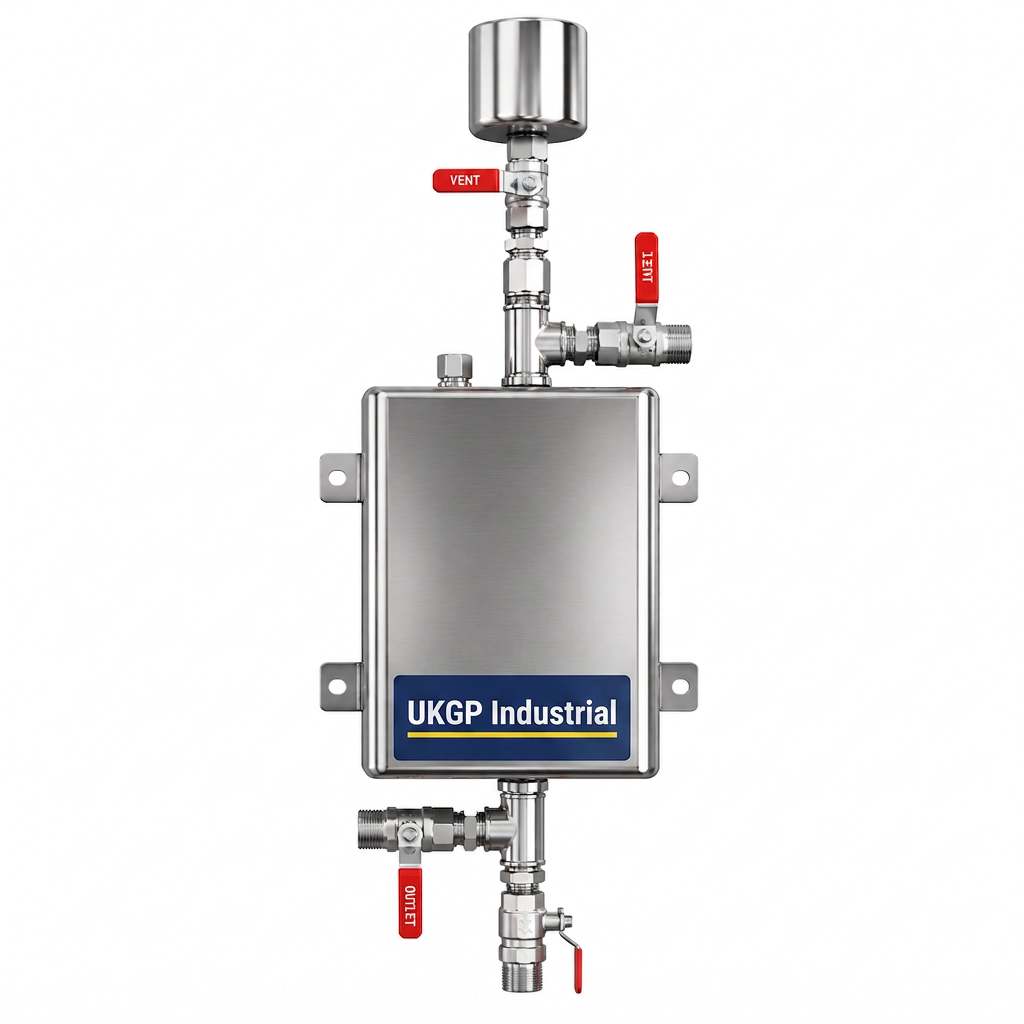
Standard UKGP Industrial dosing pots are equipped with an air vent valve at the highest point. To troubleshoot air ingress, ensure the filling procedure involves closing the outlet valve, filling the pot until water emerges from the air vent, and only then opening the isolation valves to the system. If the system pressure drops significantly when opening the pot, it may indicate that the pot was not fully pressurised to system levels before connection.
- Install the dosing pot at a height that allows for gravity filling but remains accessible.
- Use a tundish for safe chemical introduction and to provide a visual break.
- Ensure the vessel is independently supported and not hanging off small-bore pipework.
Valve Sequence Errors and Physical Blockages
Chemical dosing pots are simple vessels, but operational errors can lead to safety hazards. If the bottom drain valve and the top filling valve are opened simultaneously while the system isolation valves are even slightly cracked, high-pressure hot water can erupt from the fill point. This is a common failure in plant rooms where the operational sequence has not been clearly labelled on the vessel.
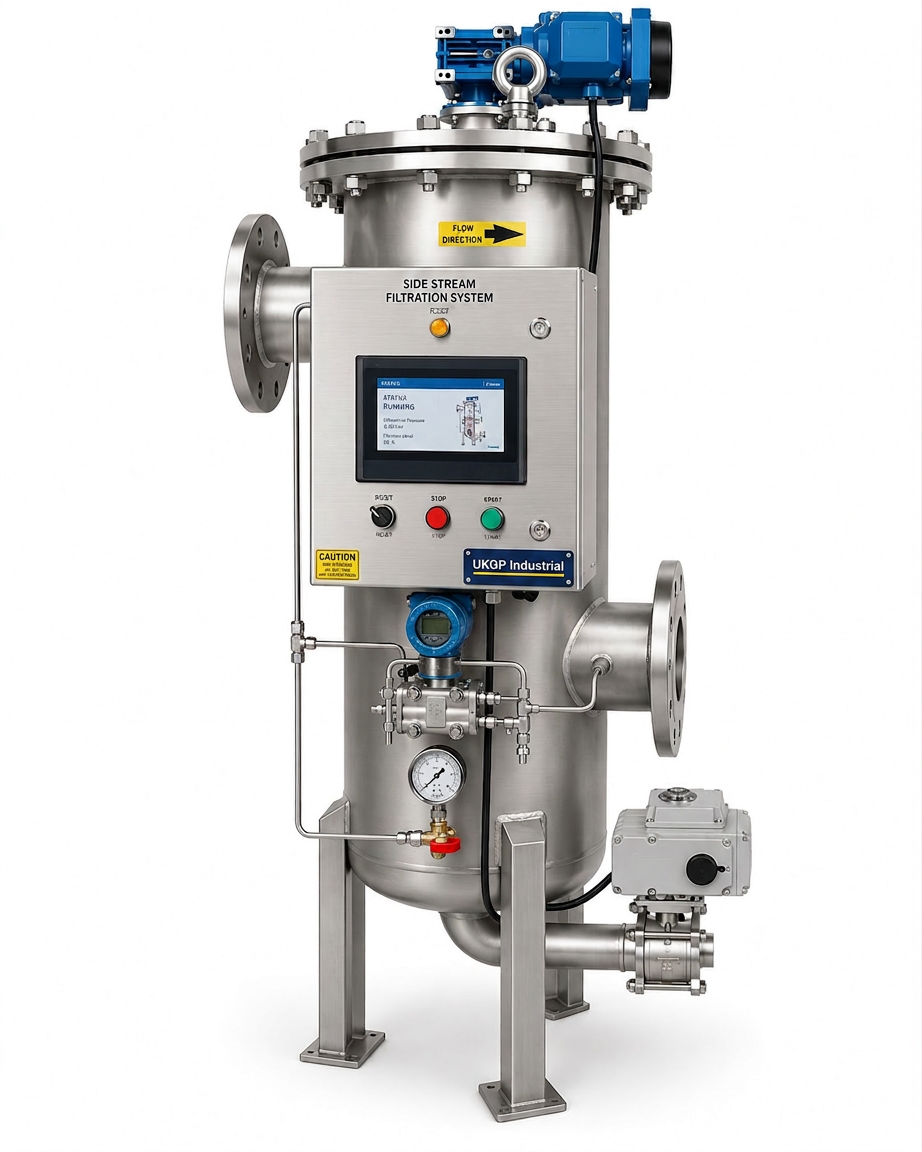
Manual blockages often occur if the system has high levels of suspended solids. While the dosing pot is not a filter, its design—often involving a stagnant base—allows it to act as a settlement zone for magnetite. If the pot fails to drain, the drain valve should be inspected for debris. This is a clear indicator that the system requires side-stream filtration to comply with BSRIA BG29/21 guidelines.
- Incorrect valve sequence leading to backflow through the tundish.
- Deterioration of EPDM seals on the top cap due to aggressive chemical concentrates.
- Blockage of the drain valve by sludge or debris from a poorly flushed system.
Optimising Dosing for Biocides and Inhibitors
In chilled water systems, the introduction of biocides via a dosing pot is critical for controlling Pseudomonas and other MIC-inducing (Microbiologically Influenced Corrosion) bacteria. A common troubleshooting scenario involves 'shot-dosing' where the chemical is introduced too quickly or in too high a concentration, leading to localized spikes in conductivity that can trigger false alarms on building management systems (BMS).
To ensure even distribution, the dosing pot should be used to introduce the chemical gradually. If monitoring shows that inhibitor levels (such as Molybdate or Nitrite) are inconsistent across the circuit, it suggests that the dosing pot is located in a 'dead zone' of the plant room or that the system circulation is not reaching all branches. In these instances, engineers must verify that the dosing pot is connected to the main flow headers. Coordinating dosing with side-stream filtration ensures that once the chemicals loosen existing biofilm or scale, the resulting debris is captured rather than redistributed.
Safety Compliance and Pressure Vessel Integrity
As units that are frequently subjected to system pressure and thermal cycling, dosing pots must be treated as pressure vessels. Leakage from the top seal is a common complaint, often caused by over-tightening the T-handle bolt, which deforms the O-ring. If a leak persists, the seal should be replaced with a compatible material, typically EPDM or Viton depending on the chemical being handled.
Finally, engineers must ensure the dosing pot is compliant with the Pressure Equipment Directive (PED). Using an undersized or uncertified vessel in a high-pressure commercial plant room is a significant liability. UKGP Industrial dosing pots are manufactured to withstand the rigours of industrial environments, but regular inspection of the internal sacrificial anode (if present) and external coatings is necessary to prevent long-term vessel failure.
- Verify the PN rating of the dosing pot against the PRV (Pressure Reducing Valve) setting of the pressurisation unit.
- Inspect the weld integrity and mounting brackets annually for signs of stress or weeping.
- Check the integrity of the non-return valve (if fitted) on the fill line to prevent system bypass.
Frequently asked questions
How do I ensure the dosing pot is rated for my system pressure?
- The dosing pot must be rated for a higher pressure than the system's maximum operating pressure. Standard pots are often PN10 or PN16 rated. Always verify the plant room pressure at the point of connection, particularly in high-rise applications.
How often should I dose a closed-loop system?
- BSRIA BG50 recommends that water quality be checked at least quarterly for settled systems. If you find inhibitor levels are dropping without a known leak, the dosing pot frequency should increase accordingly.
Can dosing pots be used for shock-dosing biocides?
- While dosing pots can introduce biocide, they are slow-release. For high-contamination scenarios, professional high-volume pumping may be required. However, for maintenance dosing of biocide in chilled water systems, a standard UKGP Industrial dosing pot is perfectly sufficient.
Should I leave the dosing pot valves open after use?
- If the pot is installed such that it creates a natural bypass, it can be left permanently online, though it is best practice to isolate it once the chemical is fully dispersed to prevent it becoming a stagnant dead-leg.
Is it acceptable to use a dosing pot for glycol top-ups?
- Yes, but it is inefficient for high-volume requirements. For large systems, a dedicated glycol break tank and pressurisation unit with a glycol mixing facility is preferred to maintain the correct concentration automatically.