Design and Specification Standards for Dosing Pots
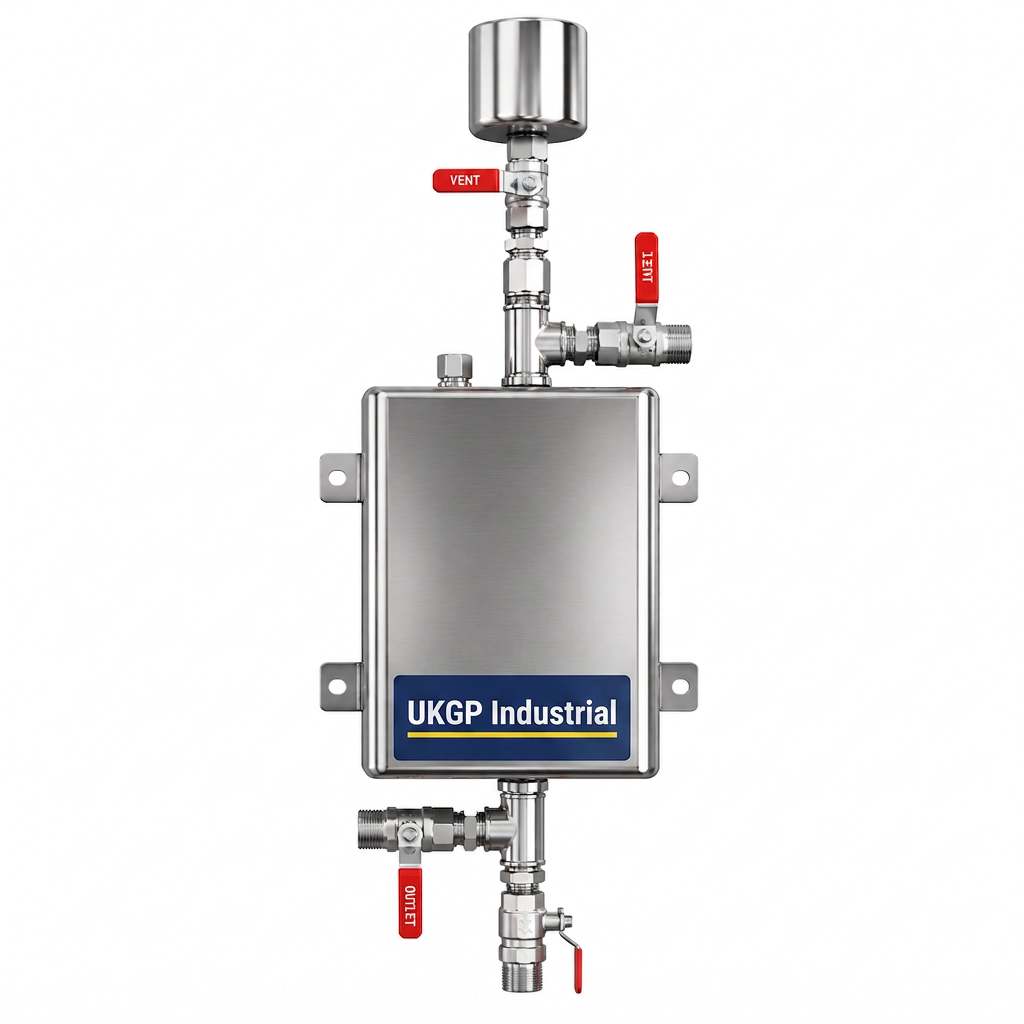
The primary function of a chemical dosing pot is to facilitate the introduction of water treatment chemicals into a closed-loop system without the need to de-pressurise or drain down the circuit. In the UK, these vessels are typically manufactured from stainless steel or carbon steel and must be compliant with the Pressure Equipment Directive (PED). For chilled water applications, stainless steel is often preferred due to its resistance to external condensation-induced corrosion, particularly in unconditioned plant room environments.
UKGP Industrial dosing pots are typically rated to PN10 or PN16, ensuring compatibility with standard commercial pump heads. When specifying a unit, the volume—ranging from 3.5 litres to 35 litres—must be chosen based on the total system volume and the concentration requirements of the chemical being introduced. A common error in plant design is undersizing the pot, which necessitates multiple 'shots' to reach the desired ppm (parts per million) concentration, increasing the risk of air ingress during the refilling process.
Hydraulic Integration and Differential Pressure
For a dosing pot to function effectively, it must be installed as a bypass loop across a point of high differential pressure, typically across the main system pumps. The inlet of the dosing pot is connected to the high-pressure side (discharge), and the outlet is connected to the low-pressure side (suction). This pressure gradient drives the flow through the vessel, ensuring that the chemical charge is swept into the main circulation.
Standard installation requires the inclusion of non-return valves and isolating ball valves to prevent backflow and allow for safe filling. Modern specifications often demand the inclusion of a secondary tundish and a drain valve at the base of the pot to facilitate clean charging. It is essential that all pipework connecting the pot to the main headers is kept to a minimum length to reduce dead-legs, which are a known risk factor for bacterial proliferation in chilled systems.
Frequently asked questions
How often should a chilled water system be dosed via the pot?
- In accordance with BSRIA BG50/2021, chemical levels and water quality should be tested at least quarterly, though high-risk or large-scale chilled water systems may require monthly monitoring.
Can I use a dosing pot for continuous glycol feed?
- No. Dosing pots are designed for shot-dosing or occasional top-ups. If a system requires constant glycol injection due to high water loss, a sustained pressurisation unit with a glycol mixing tank is required to maintain the correct concentration and system pressure.
Where is the optimum location for a dosing pot in a CHW circuit?
- The dosing pot must be installed across the flow and return headers (parallel to the pump) to utilise the differential pressure. It should be located in the plant room, ideally after the air/dirt separator but before any fine side-stream filtration units.
What are the pressure rating requirements for CHW dosing pots?
- The pot must be rated to at least the same PN (Pressure Nominal) rating as the rest of the system, typically PN10 or PN16. Crucially, the vessel must be compliant with the Pressure Equipment Directive (PED) 2014/68/EU.