The Role of Dosing Pots in Closed-Loop Systems
In any closed-circuit HVAC system, maintaining water chemistry is the primary defence against premature asset failure. According to BSRIA BG50/2021 (Water Treatment for Closed Heating and Cooling Systems), the controlled introduction of chemicals is essential to manage dissolved oxygen, pH levels, and microbial growth. The dosing pot provides a safe, controlled bypass loop to introduce these chemicals without depressurising the main system.
Rather than relying on complex pumping stations for every circuit, a chemical dosing pot allows for 'batch' or 'slug' dosing. This is particularly effective for inhibitors that remain stable over long periods or for periodic biocide shocks in chilled water systems where anaerobic bacteria or pseudomonads may be a risk.
Beyond chemical delivery, the dosing pot serves as a diagnostic window. While secondary to a dedicated sampling point, the fluid extracted from the pot during the dosing process can provide an initial indication of system water clarity and the presence of suspended solids or magnetite.
- Manual slug-dosing of corrosion inhibitors and scale preventatives.
- Introduction of biocides in chilled water or low-temperature systems.
- Initial system 'charging' with glycol or antifreeze.
- Facilitating water sampling (though dedicated sampling points are preferred).
Regulatory Compliance and Industry Standards
Compliance is not optional when dealing with pressurised vessels. Any dosing pot installed in a UK plant room must be designed and manufactured in accordance with the Pressure Equipment Directive (PED) or the equivalent UK Pressure Equipment (Safety) Regulations. This ensures that the vessel can withstand the design pressure and temperature of the system without risk of catastrophic failure.
BSRIA BG50 is the definitive guidance for facilities managers and consultants. It specifies that water treatment programmes must be supported by appropriate hardware. A dosing pot that is difficult to access or incorrectly sized can lead to non-compliance with BG50, as it may prevent the maintenance team from reaching the required chemical residuals stipulated in the water treatment regime.
Furthermore, the material of construction must be compatible with the fluids being handled. While mild steel is standard for LTHW systems, stainless steel variants may be required for specific process environments or where aggressive demineralised water is used, to prevent the pot itself from becoming a source of corrosion.
- BS EN 12828: Heating systems in buildings.
- BSRIA BG29/21: Pre-commission cleaning of pipework systems.
- BSRIA BG50/21: Water treatment for closed heating and cooling systems.
- Pressure Equipment Directive (PED) 2014/68/EU and UKCA marking.
Technical Specifications and Sizing Criteria
Selecting the correct size of a dosing pot is a balance between convenience and system volume. A 3.5-litre pot is often sufficient for small commercial units or sub-circuits, but for large-scale district heating or multi-storey chilled water circuits, a 15-litre or 25-litre vessel is more practical. A larger capacity reduces the number of 'cycles' required to introduce the initial charge of inhibitor, saving labour costs during commissioning.
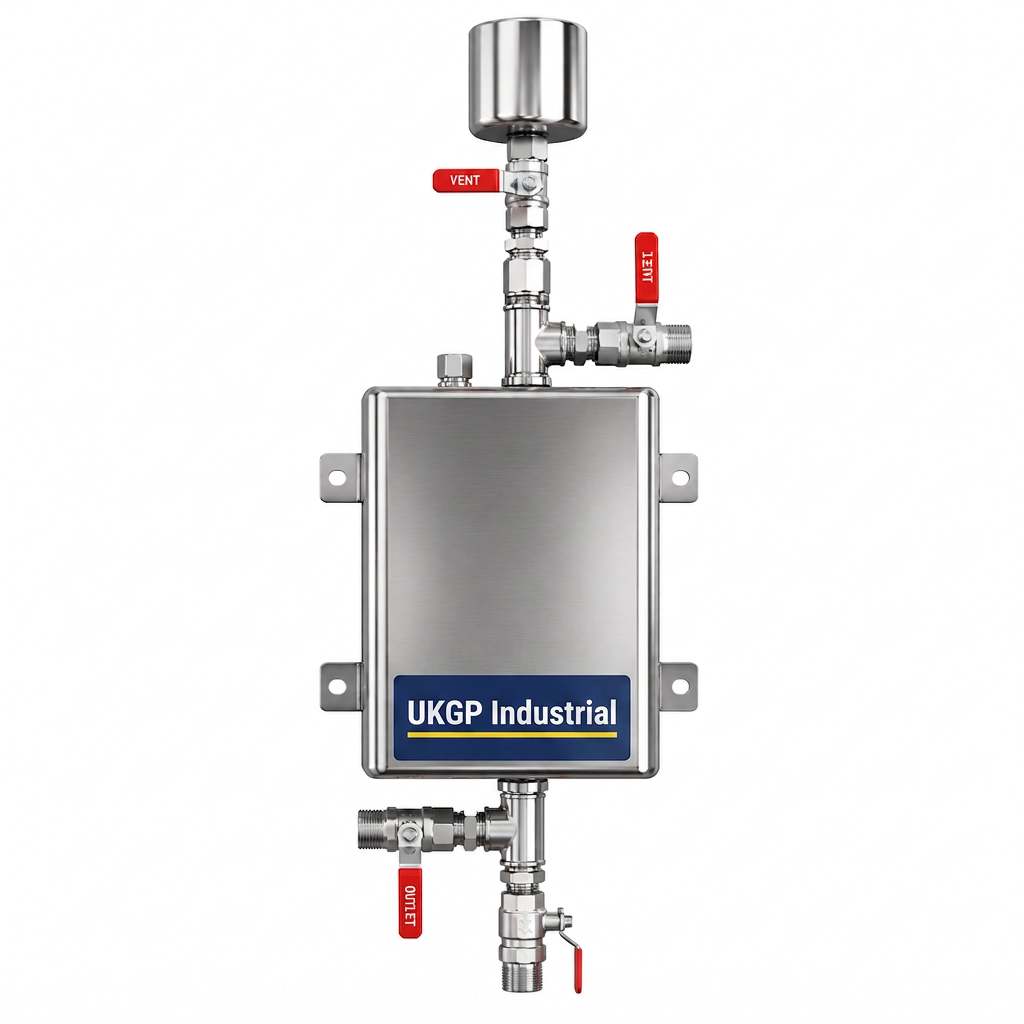
The orientation and layout of the pot are equally critical. A standard UKGP Industrial dosing pot features a stainless steel or carbon steel body with five primary ports: flow inlet, return outlet, fill point (top), drain point (bottom), and an air vent. The fill point should be fitted with a wide-bore funnel to prevent chemical spillages, which can be hazardous to operators and damaging to plant room floors.
Pressure ratings must exceed the system's safety valve set point. It is common practice to specify a vessel rated to at least 10 bar for standard commercial buildings, though high-rise applications may require 16 bar or 25 bar units. Engineers must verify that the vessel has been hydrostatically tested to 1.5 times its rated working pressure.
- Standard sizes: 3.5, 6, 10, 15, 20, and 25 litres.
- Inlet/Outlet bore sizes (typically 15mm or 25mm).
- Pressure ratings (PN10, PN14, PN16, PN25).
- Material: Stainless steel vs Carbon steel.
Installation Best Practices for M&E Contractors
The dosing pot must be installed as a side-stream bypass, typically across the main flow and return headers or across the secondary pumps. The movement of fluid through the pot is driven by the differential pressure (∆P) between the two connection points. Without a sufficient pressure gradient, the chemical will remain stagnant within the vessel rather than circulating into the system.
Isolation valves are mandatory on the inlet and outlet legs. These allow the pot to be isolated from the high-pressure system during the filling process. We recommend the use of high-quality ballroom or gate valves that provide a bubble-tight shut-off. If the pot is installed in a location with high vibration, such as near large centrifugal pumps, robust bracketry is essential to prevent fatigue at the weld points.
Safety is paramount. The air vent on top of the dosing pot must be piped to a safe, visible discharge point. When the system pressure is reintroduced to the pot, air must be purged. This air can be highly compressed and contains atomised chemical traces; therefore, it should never be vented directly towards the operator's face.
- Side-stream installation across headers.
- Differential pressure requirements.
- Valve sequencing for safety.
- Wall-mounting and floor-standing logistics.
Operational Safety and Maintenance.
Operating a dosing pot requires a strict sequence of valve operations to avoid 'thermal shock' or 'pressure surge'. The typical sequence involves closing the inlet and outlet valves, opening the drain and vent to empty the vessel, adding the chemical via the funnel, and then slowly reopening the valves to integrate the chemical into the flow. Failure to follow this sequence can lead to hot system water spraying from the funnel.
Maintenance of the dosing pot is often overlooked. Over time, the internal surfaces can accumulate sludge, especially if the pot is located in a 'dead-leg' portion of the system. Regular flushing of the pot during water treatment visits is recommended. The seals on the fill cap and valves should be inspected annually for signs of degradation caused by chemical exposure.
For systems where biocides or toxic glycols are used, we recommend installing a tundish below the drain valve. This provides a visible air gap and ensures that any overflow or drainage can be managed safely according to local water authority regulations regarding trade effluent.
- Non-return valves on the inlet.
- Tundish requirements for the drain.
- Clear labelling of chemical types.
- Bunded areas for chemical storage.
Integration with Side-Stream Filtration
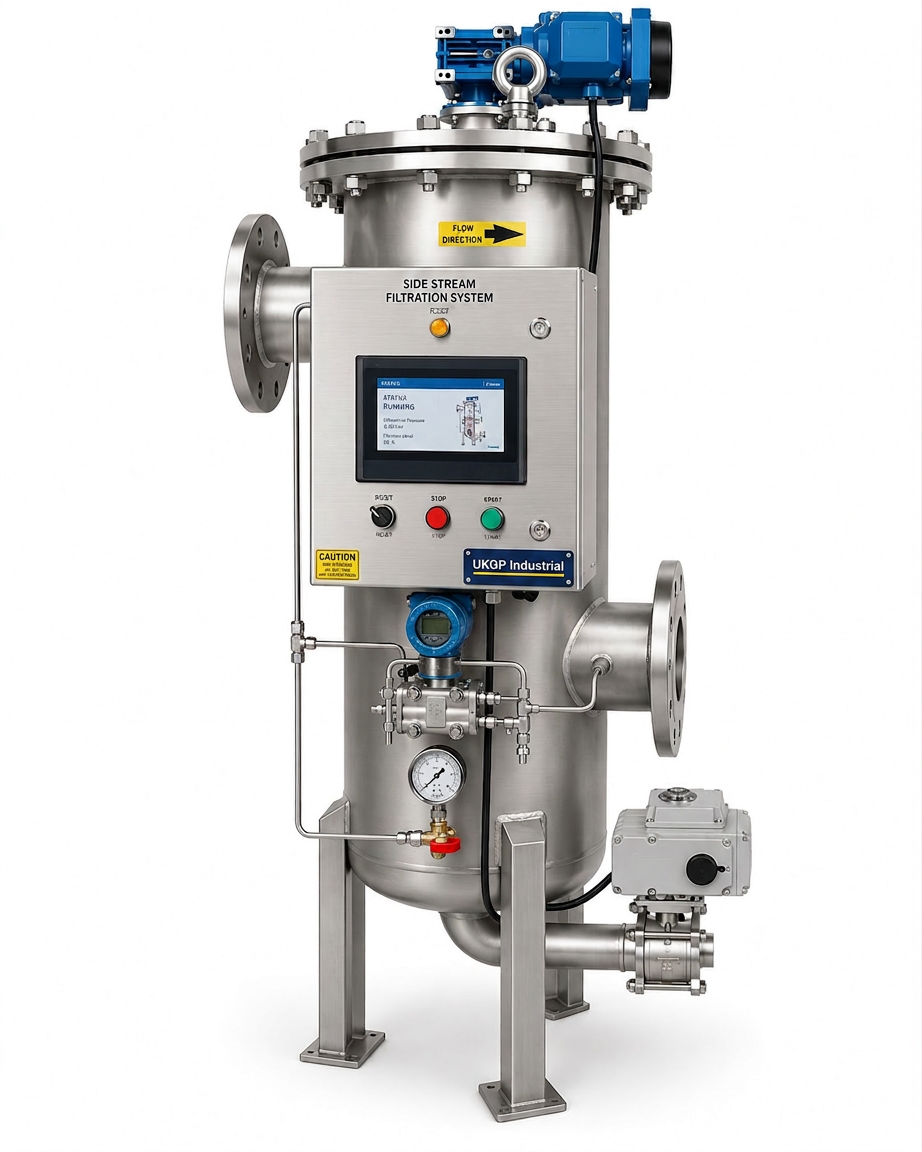
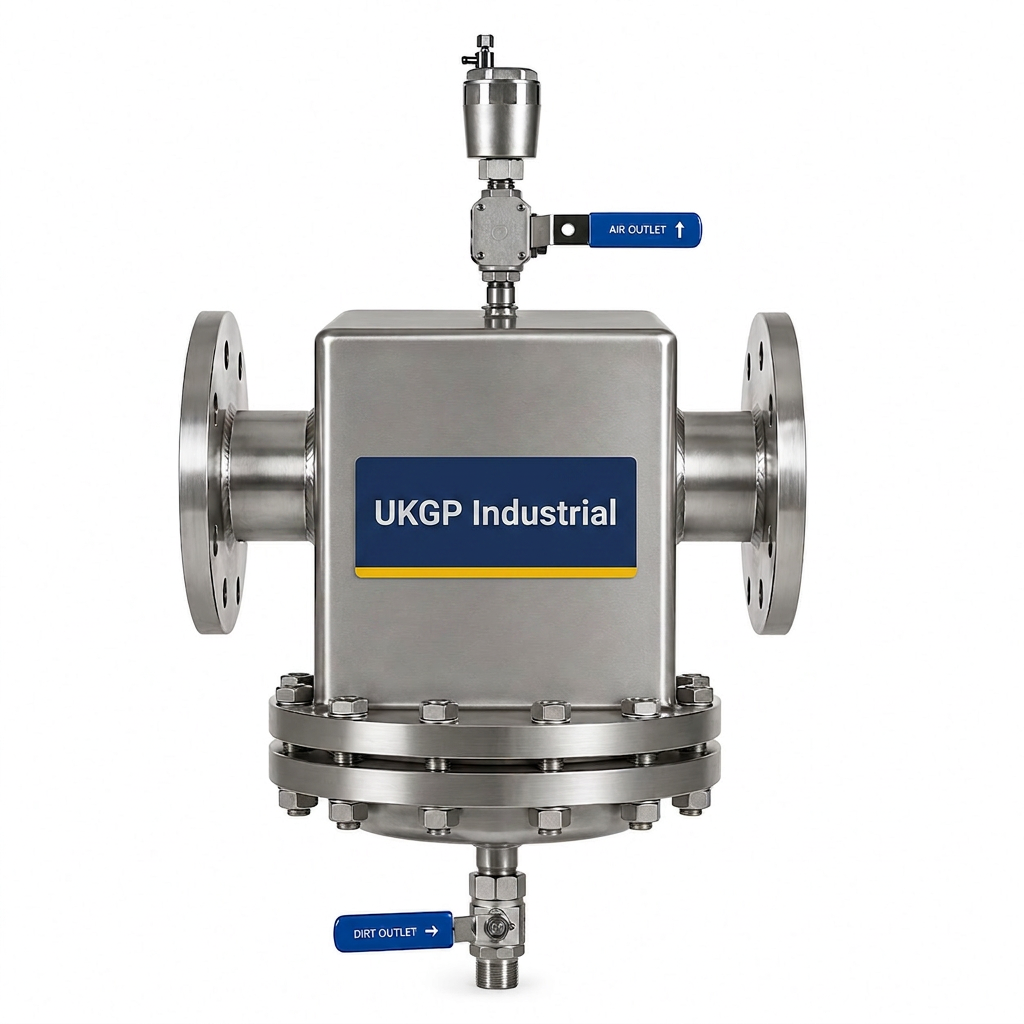
While a dosing pot introduces chemicals to control corrosion, it does not remove the physical contaminants already present in the system. To achieve full compliance with BSRIA BG50, dosing pots should be used in conjunction with side-stream filtration. Side-stream filters, such as those provided by UKGP Industrial, continuously remove suspended solids and magnetite that can interfere with the efficacy of chemical inhibitors.
The relationship between dosing and filtration is symbiotic. A clean system with low turbidity allows corrosion inhibitors to form a more effective protective film on the internal pipework. Conversely, if a system is heavily contaminated with 'black sludge' (magnetite), the chemical inhibitor will be consumed faster as it attempts to react with the vast surface area of the suspended particles.
When specifying a plant room layout, placing the side-stream filter and the dosing pot in the same bypass loop (or in parallel) simplifies maintenance. This ensures that the water treatment specialist can manage both the chemical levels and the physical filtration media during a single service visit, providing a holistic approach to water quality.
- Capturing magnetite and haematite.
- Protecting heat exchangers and VSD pumps.
- Reducing the frequency of chemical dosing.
- Synergy with dosing pots for system health.
Glycol and Antifreeze Considerations
In UK chilled water systems and air-source heat pump (ASHP) circuits, glycol is essential for frost protection. A dosing pot is often used for top-up purposes when the system volume has slightly decreased due to air venting or minor leaks. However, it is vital to ensure that the glycol is pre-mixed with water before being added to the dosing pot funnel.
Introducing neat glycol into a dosing pot can lead to 'slugs' of high-viscosity fluid entering the system, which can cause temporary flow imbalances or issues with pump sensors. Furthermore, glycol requires a specific concentration (typically 20% to 30% by volume) to provide both freeze protection and bacterial inhibition. A dosing pot allows for precise Incremental adjustments to these levels.
Engineers must be aware that glycol is susceptible to thermal degradation. If a system is not properly inhibited, the glycol can break down into organic acids, lowering the pH and accelerating corrosion. Therefore, the dosing pot should be used to regularly 'sweeten' the system with fresh inhibited glycol as indicated by annual laboratory analysis.
- Ethylene Glycol vs. Propylene Glycol.
- Calculating the 'fill' volume.
- Maintaining the correct freeze protection level.
- Mixing requirements before dosing.
Material Selection: Stainless Steel vs Carbon Steel
The majority of industrial dosing pots are manufactured from carbon steel and finished with a powder coating. This is perfectly acceptable for LTHW systems where the internal water is treated with inhibitors and oxygen is excluded. The powder coating protects the external surface from the humid conditions often found in plant rooms.
However, for chilled water systems (CHW), there is a significant risk of external 'sweating' and corrosion if the vessel is not correctly insulated. In these applications, or where the system water is particularly aggressive (e.g., in some process cooling applications), 304 or 316-grade stainless steel dosing pots are the preferred choice. Stainless steel offers superior longevity and does not require external painting to maintain its integrity.
From a specification standpoint, stainless steel dosing pots should also be considered for 'clean' environments, such as pharmaceutical or food processing facilities, where the presence of flaking paint or external rust is unacceptable. While the initial capital cost is higher, the total cost of ownership is reduced through the elimination of corrosion-related replacements.
- Superior corrosion resistance in aggressive environments.
- Longer service life in high-humidity plant rooms.
- Reduced risk of iron contamination in ultra-pure circuits.
- Aesthetic and professional finish for high-spec projects.
Summary Checklist for Specification
When finalising the specification for a chemical dosing pot, engineers should verify that the product meets the specific demands of the project. Start by confirming the maximum working pressure and temperature. A vessel intended for a 5-bar LTHW circuit is unsuitable for a 12-bar secondary circuit in a high-rise tower. Check the PED/UKCA certification to ensure the vessel is legally compliant for use in the UK.
Consider the ease of use for the facilities management team. A dosing pot with clear labelling, a wide-mouthed funnel, and accessible valves will be used more effectively than one squeezed into a corner with poor access. Ensure the sizing is appropriate for the total system volume; a 10L pot is the 'gold standard' for most medium-sized commercial plant rooms, providing a good balance between size and dosing speed.
Finally, consider the manufacturer's reputation and technical support. UKGP Industrial dosing pots are designed with the contractor in mind, providing robust construction and clear installation instructions. By selecting a high-quality, compliant vessel and following the guidance in BSRIA BG50, engineers can ensure the long-term health and efficiency of the building's hydronic systems.
- Vessel material and pressure rating.
- Valve types and sizes.
- Funnel and air vent configuration.
- Supporting documentation (PED/UKCA).
Frequently asked questions
Where should a dosing pot be installed in a heating circuit?
- BSRIA BG50 recommends that chemical dosing pots are installed across the main flow and return headers, or across the pump, to ensure a sufficient pressure differential (typically minimum 0.2 to 0.5 bar) to drive the fluid through the pot.
What size dosing pot do I need for a 50,000-litre system?
- Capacity is generally determined by the total system volume. For large commercial systems, a 10L or 15L pot is common to minimize the number of 'charges' required to reach the target inhibitor concentration. For smaller sub-circuits, a 3.5L or 6L pot may suffice.
Can a dosing pot be used for automatic glycol top-up?
- While both introduce chemicals, a dosing pot is a manual, batch-process vessel. An automatic dosing station or glycol make-up unit uses a pump and sensors to maintain concentration automatically, which is preferred for systems with high leak risks or precise concentration requirements.
What are the typical pressure ratings for commercial dosing pots?
- Standard dosing pots are typically rated to 10 bar or 14 bar. For high-rise developments or high-pressure process circuits, specifies must ensure the vessel carries a PN16 or PN25 rating and is CE/UKCA marked under the Pressure Equipment Directive (PED).