TECHNICAL ENGINEERING GUIDE

Brazed Plate Heat Exchanger Failure Modes

Brazed Plate Heat Exchangers (BPHEs) are the workhorses of modern UK plant rooms, valued for their compact footprint and high thermal efficiency in district heating, DHW generation, and heat pump applications. Unlike their gasketed counterparts, BPHEs are vacuum-brazed—typically with copper—creating a rigid, hermetically sealed unit. While this eliminates gasket leak paths, it introduces specific failure modes related to thermal stress, chemistry, and mechanical fatigue. Understanding these mechanisms is critical for M&E contractors and FM teams to ensure system longevity and prevent catastrophic primary-to-secondary cross-contamination.

10 June 2026 6 min readPlate heat exchangers
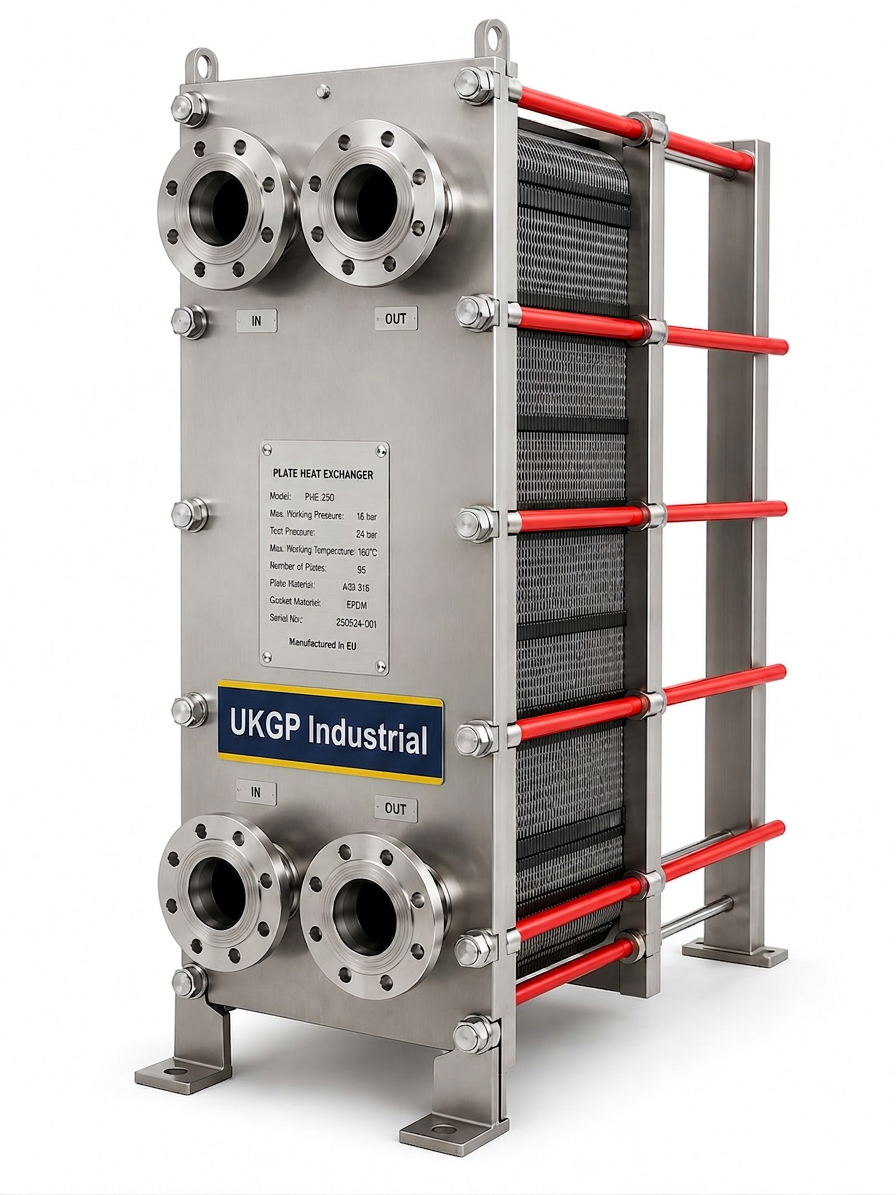
Brazed Plate Heat Exchanger Failure Modes — UKGP gasketed plate heat exchanger for commercial plant rooms
UKGP gasketed plate heat exchanger for commercial plant rooms

Corrosion and Chemical Degradation

Chemical compatibility is the primary determinant of BPHE lifespan. In the UK, varying water hardness and chloride levels pose a significant risk to the copper brazing material. While the 316L stainless steel plates are highly resistant, the copper filler used to bond them is vulnerable to galvanically induced corrosion, particularly in open-looped cooling towers or poorly managed secondary DHW loops. When chlorides exceed recommended levels, the copper braze can pit and eventually fail, leading to internal leakage.

Dezincification and ammonia-induced stress corrosion cracking are also prevalent in specific industrial contexts. For systems utilising aggressive fluids or treated water with high conductivity, engineers should consider nickel-brazed or 100% stainless steel units. It is essential to conduct a water analysis before specification to ensure the brazing material is compatible with the system’s chemical profile, as per BSRIA BG50 guidelines for water treatment.

  • Copper-brazed units are highly susceptible to corrosion if chlorides exceed 200-300 mg/l at elevated temperatures.
  • High flow velocities (>5 m/s) can strip the protective oxide layer from the plates.
  • Aggressive soft water or high-CO2 content can leach copper, leading to pinhole leaks between circuits.

Frequently asked questions

Can a brazed plate heat exchanger be cleaned if it becomes fouled? Lord?

Unlike gasketed PHEs, BPHEs cannot be opened for manual scrubbing. Cleaning requires a high-flow CIP (Clean-In-Place) pump using inhibited acidic or alkaline solutions, depending on the scale type, followed by thorough neutralisation and flushing.

What is the design life of a copper-brazed plate heat exchanger?

A typical BPHE should last 10–15 years in a well-managed closed-loop system. However, in aggressive domestic hot water (DHW) applications or systems with poor water chemistry, failure can occur in under 24 months.

Are BPHEs suitable for systems containing ammonia?

Standard copper-brazed units are highly susceptible to corrosion if ammonia concentrations exceed 2mg/l. In such cases, stainless steel or nickel-brazed units must be specified.

What causes fatigue failure in DHW plate heat exchangers?

Thermal shock is common in DHW systems where cold mains water (10°C) is suddenly introduced to a unit plate surface at 80°C. This causes differential expansion between the core and the outer casing, leading to fatigue cracks.
Keep reading

Related articles

Plate heat exchangers

How does a plate heat exchanger work?

Plate heat exchangers (PHEs) have become the definitive solution for heat transfer in modern UK building services, largely replacing traditional shell-and-tube calorifiers. Whether utilised for hydraulic separation in high-rise district heating, domestic hot water (DHW) generation, or as interface units for low-carbon heat pump arrays, the PHE offers unparalleled thermal efficiency within a compact footprint. This guide examines the fluid dynamics, mechanical construction, and specification criteria essential for M&E consultants and plant-room engineers.

Read
Plate heat exchangers

Engineering Plate Heat Exchangers for Efficiency

For the modern building services engineer, the plate heat exchanger (PHE) is the cornerstone of efficient thermal energy transfer. Whether decoupling a high-pressure district heating network from a tertiary building circuit or providing instantaneous domestic hot water (DHW) in a commercial plant room, the PHE offers unparalleled thermal efficiency within a compact footprint. This guide examines the mechanical configurations, material specifications, and operational maintenance requirements for gasketed, brazed, and welded plate heat exchangers in line with current UK standards and engineering best practices.

Read
Plate heat exchangers

Gasketed vs Brazed vs Welded Plate Heat Exchangers

Selecting the correct plate heat exchanger (PHE) architecture is critical for the long-term efficiency and maintainability of UK district heating schemes, commercial HVAC systems, and industrial processes. While all three types—gasketed, brazed, and welded—operate on the principle of thin-gauge plate heat transfer, their mechanical limits, serviceability, and lifecycle costs vary significantly. This article provides a technical breakdown of these technologies to assist engineers in specifying the optimal solution for specific plant-room applications.

Read
Request Quote