The Fundamental Role of Hydraulic Separation
In an idealised heating system, the flow produced by the generation side would perfectly match the demand of the distribution side. In reality, modern commercial systems—incorporating multi-boiler cascades from manufacturers like Vaillant, Worcester, or Viessmann—operate with variable flow rates dictated by weather compensation and BMS-controlled modulating valves. Without a low loss header, the primary boiler pumps and secondary distribution pumps would fight for control, leading to turbulent flow and inefficient heat transfer.
A low loss header acts as a buffer zone of neutral pressure. By providing a low-resistance path between the flow and return headers, it allows the primary circuit to maintain the minimum required flow rate through the boilers regardless of what is happening in the secondary circuits. This is particularly vital for aluminium-silicon or stainless steel heat exchangers found in modern condensing boilers, which are sensitive to flow rate fluctuations.
Furthermore, the LLH facilitates the settlement of suspended solids and the release of micro-bubbles. As water enters the larger volume of the header, its velocity drops significantly. This deceleration allows heavier magnetite particles to fall to the bottom for blowdown and air to rise to the top for venting, aligning with the best practices outlined in BSRIA BG29/21 for water quality management.
- Decoupling of primary and secondary circuits to prevent pump interference.
- Maintenance of constant flow rates across heat exchangers (essential for condensing boilers).
- Provision of a 'null point' for debris settlement and air de-aeration.
- Protection against thermal shock by allowing bypass during low-load conditions.
Flow Dynamics and Temperature Mixing
The performance of a multi-boiler system is heavily dependent on the mixing dynamics within the low loss header. Consultants must consider three primary scenarios. In the first, where primary flow exceeds secondary flow, some of the heated water bypasses the load and returns directly to the boilers. While this protects the boilers from low-temperature return, it can raise the return temperature above the dew point (approx. 54°C), preventing the boilers from operating in condensing mode.
Conversely, if the secondary pumps demand more water than the primary pumps are providing, cool return water is sucked up into the flow pipe. This results in a blended flow temperature that is lower than the boiler setpoint. In a hospital or large office block, this may lead to complaints of 'lukewarm' radiators or DHW cylinders failing to reach pasteurisation temperatures. To mitigate this, primary pumps are usually sized to provide roughly 10% more flow than the peak secondary demand.
Strategic sensor placement is the only way to manage these dynamics. A common mistake is placing the header sensor too high or in a pocket that is susceptible to stagnation. The sensor should be located in the upper third of the header for heating applications to ensure the BMS is reading the actual mixed flow temperature being delivered to the secondary circuits.
- Primary Flow > Secondary Flow: Resulting in increased return temperatures (less efficient for condensing).
- Primary Flow < Secondary Flow: Resulting in reduced flow temperatures to the building (insufficient heat).
- Primary Flow = Secondary Flow: The theoretical ideal, rarely achieved in variable load systems.
Sizing Criteria and the 3-v Rule
Sizing a low loss header solely based on the pipe connection size of the boilers is a frequent but costly error. The internal diameter of the header must be calculated based on the maximum possible flow rate of the entire system (primary or secondary, whichever is greater). The '3-v rule' is a standard industry benchmark, suggesting that the velocity within the header body should be one-third of the velocity in the connecting pipework, typically not exceeding 0.2 m/s.
To calculate the required volume, engineers must first determine the mass flow rate (m) in kg/s or m³/h using the total peak load (kW) and the design temperature differential (ΔT). For modern condensing systems, a ΔT of 20K is often targeted to maximise efficiency, whereas older systems may operate on 11K. A larger ΔT reduces the required flow rate, allowing for smaller header diameters, but the LLH must be sized for the 'worst-case' highest flow scenario.
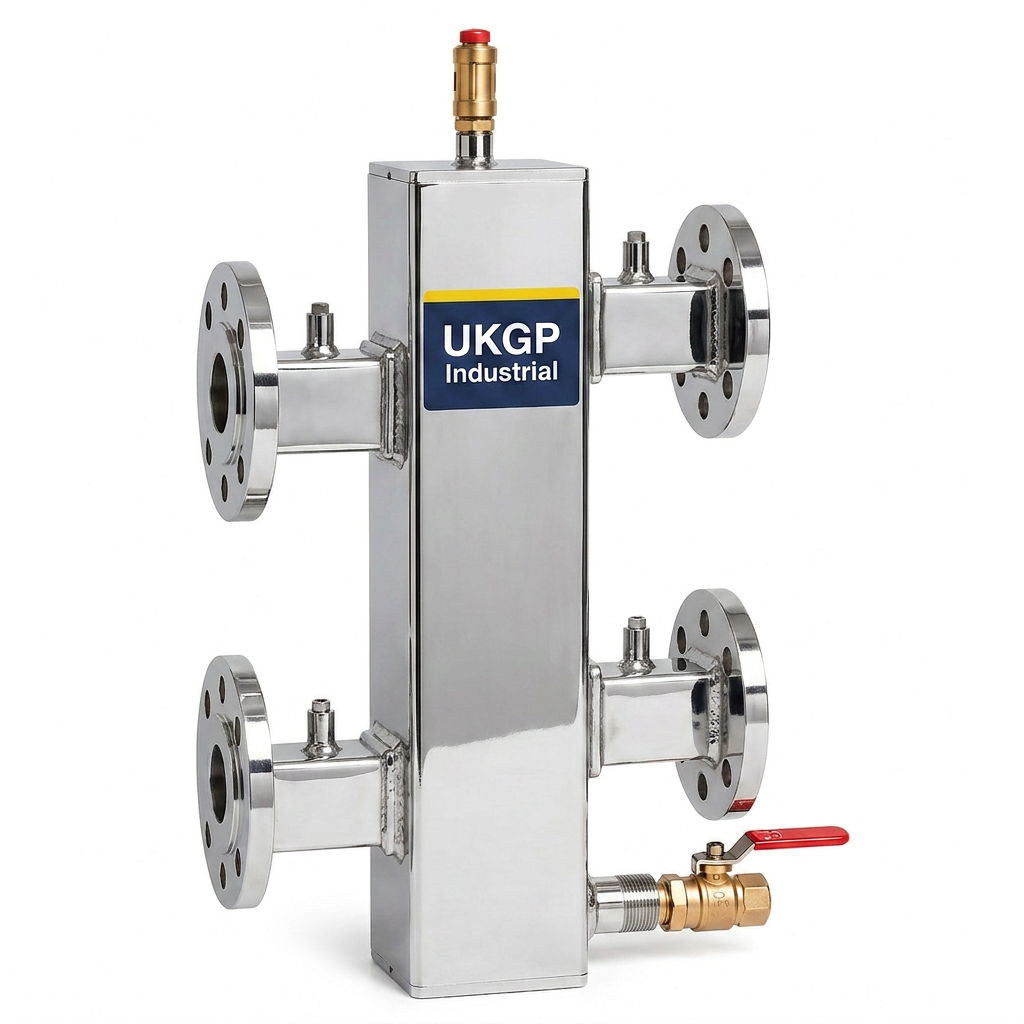
UKGP Industrial low loss headers are engineered to provide this low-velocity environment. When a header is undersized, the water moves too quickly through the vessel, creating 'carry-over' where the hydraulic decoupling fails, and dirt/air separation is negated. Ensuring a generous vertical height also aids in thermal stratification, which can improve the responsiveness of the boiler cascade control.
- Formula: Q = m \u00d7 Cp \u00d7 \u0394T.
- Velocity limit: 0.1 m/s to 0.2 m/s within the header body.
- Nozzle sizing: Match the primary and secondary pipe diameters based on velocity limits (usually <1.5 m/s).
Integration with Air and Dirt Separation
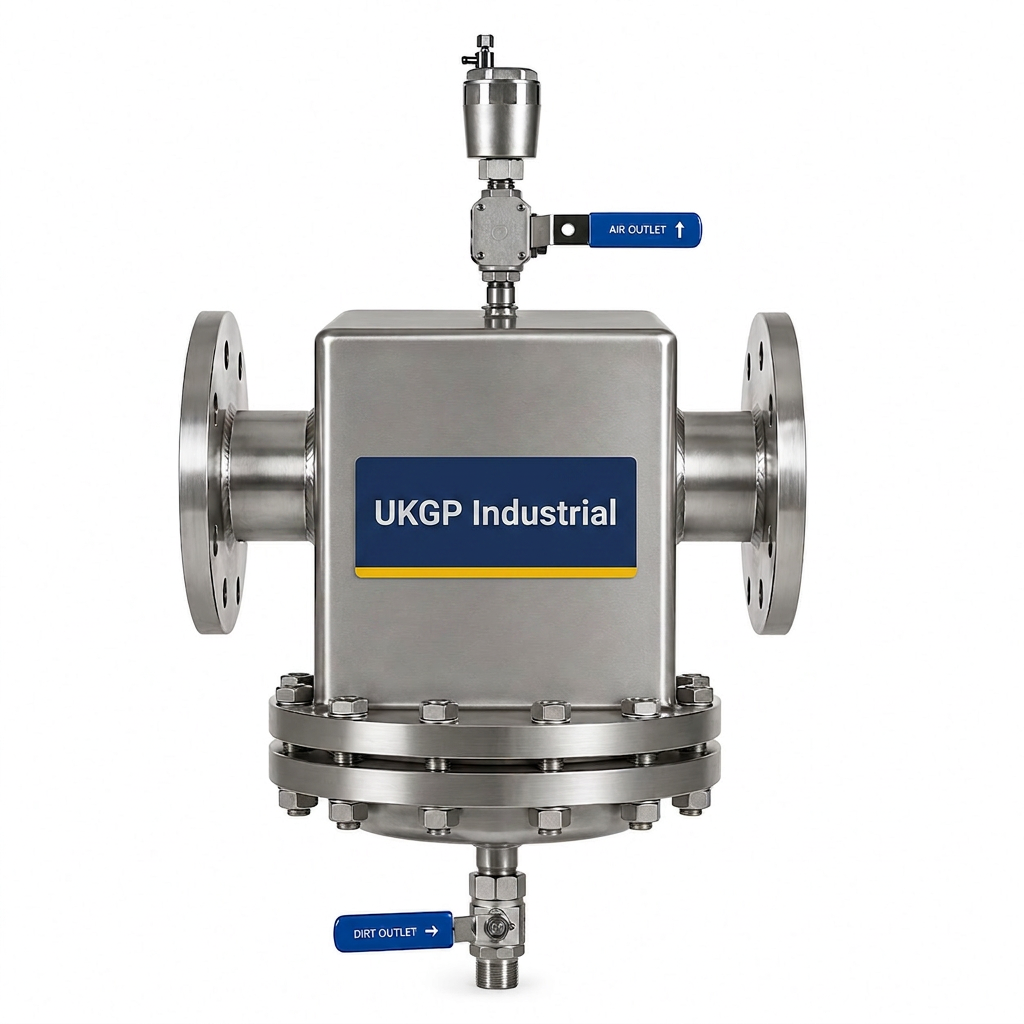
While a standard low loss header provides fundamental separation, the increasing complexity of commercial systems often necessitates enhanced filtration. In systems with high volumes of recirculated water or older iron pipework, the LLH serves as the primary collection point for magnetite. However, relyling solely on the LLH for debris management can be risky if flow rates are high enough to keep particles in suspension.
Modern specifications frequently call for the inclusion of internal baffles or magnetic inserts within the header. These internal components force the water to change direction multiple times, facilitating the 'dropout' of smaller particles. For systems and FM teams following BSRIA BG50 guidelines, the LLH acts as the first line of defence in a comprehensive water treatment strategy.
It is also vital to consider the location of the LLH relative to the rest of the plant. It should ideally be at the lowest point of the primary circuit to facilitate sludge collection, but must also have adequate clearance at the top for air venting. If the system has significant vertical rises, additional de-aeration may be required elsewhere, but the LLH remains the central point for hydraulic stability.
- Mandatory high-point automatic air vent (AAV).
- Full-bore drain valve for sediment removal.
- Thermometer pockets for manual verification of BMS data.
- Removable insulation jackets to prevent plant room overheating.
Multi-Boiler Cascade Strategies
In a multi-boiler configuration, the low loss header is the 'brain' of the hydraulic system. Boiler modularity allows for high turndown ratios, meaning the plant can provide 20kW of heat on a mild spring day even if the total capacity is 500kW. The LLH allows individual boilers to fire and circulating pumps to ramp up or down without affecting the pressure differential of the building’s radiators, underfloor heating, or AHUs.
Control logic usually involves a common flow sensor located in the LLH. When the temperature in the header drops below a certain threshold, the master controller calls for the next boiler in the sequence. This prevents 'short-cycling,' where a boiler fires and shuts down rapidly because it cannot dissipate its heat. By having the LLH as a buffer, the heat is effectively absorbed and then distributed as needed.
For M&E contractors, the commissioning phase is critical. It is necessary to balance the primary flow (boiler loops) to ensure that even the furthest boiler in the cascade can deliver its full output to the header. This often requires the use of differential pressure sensors or fixed-orifice commissioning valves on each boiler limb to ensure uniform distribution.
- Single boiler system: Simple decoupling.
- Multi-boiler cascade: Staged ignition based on header temperature.
- Hybrid systems: Managing different flow temperatures from heat pumps and boilers.
Installation Best Practices for Contractors
Proper installation of a low loss header begins with structural considerations. Larger commercial headers can be exceptionally heavy when filled with water; therefore, floor-standing units or robust wall brackets must be specified. Pipework should be supported independently of the header to prevent stress on the nozzles. It is also recommended to install isolation valves on all ports to allow for maintenance without draining the entire system.
During the pre-commissioning phase, following BSRIA BG29/21, the system must be flushed. A common error is bypassing the LLH during flushing, which allows debris to collect in the header once the system is live. The LLH’s drain valve should be used frequently during the first few weeks of operation to clear out 'construction dirt' such as flux, tape, and metal filings.
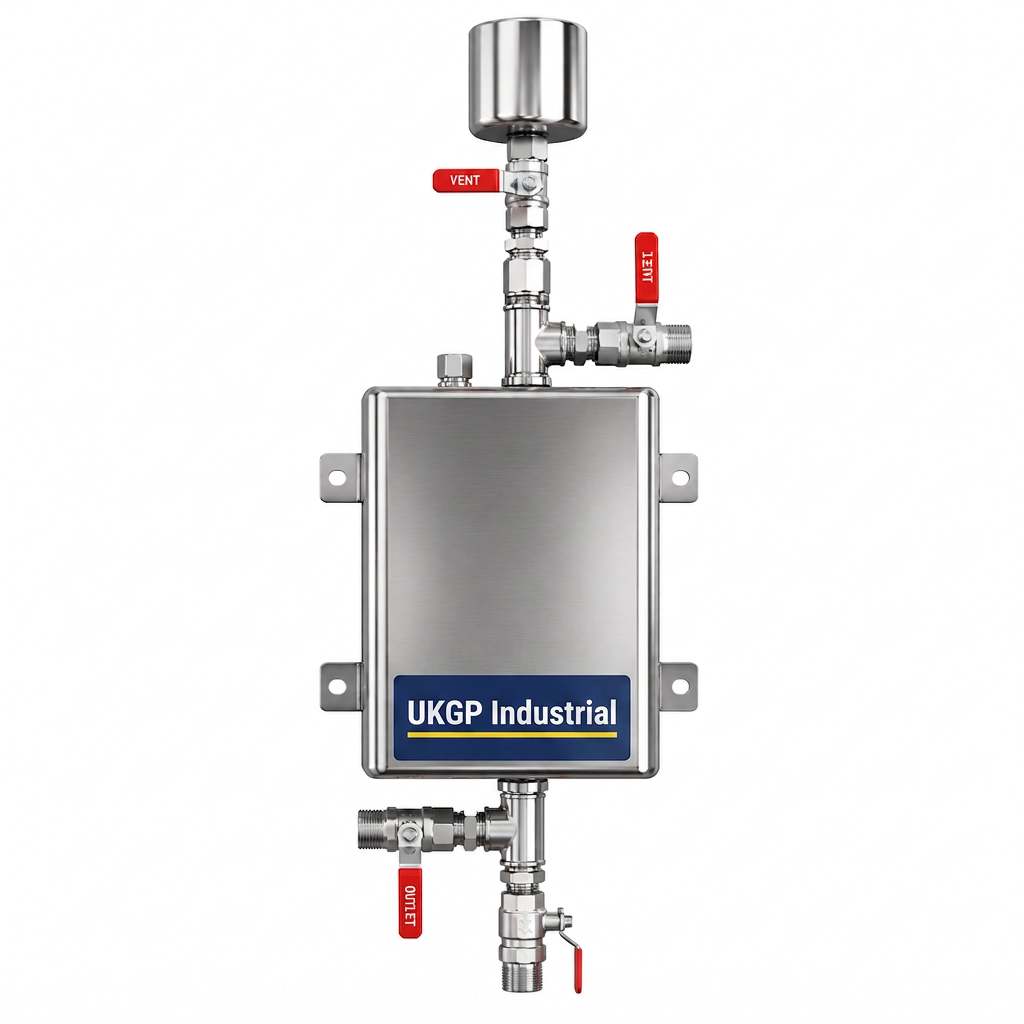
Chemical treatment is the final pillar of a successful installation. Once the system is cleaned and the LLH is purged of air, the system should be dosed with a high-quality inhibitor. Using a UKGP Industrial chemical dosing pot allows for the controlled introduction of these chemicals, ensuring they are distributed evenly throughout the primary and secondary loops via the hydraulic bridge provided by the low loss header.
- Pressure testing to 1.5x working pressure (per PED/PE(S)R).
- Correct orientation of flow and return nozzles.
- Flushing and chemical cleaning prior to handover.
Long-term Maintenance and Compliance
For Facilities Managers, the low loss header is a low-maintenance but high-impact component. Annual maintenance should include a full blowdown of the header to remove accumulated sludge. If the header is equipped with a magnetic separator, this should be cleaned according to the manufacturer’s instructions. A spike in the temperature differential across the primary side of the header can be a sign of scaling or fouling within the boiler heat exchangers.
Compliance with the Pressure Equipment (Safety) Regulations (PE(S)R) is mandatory for vessels operating above 0.5 bar. Most commercial headers fall under 'Sound Engineering Practice' (SEP) or Category I/II depending on the volume and pressure. Engineers must ensure the header is CE or UKCA marked where applicable and that the test certificates are included in the O&M manuals.
Regular water analysis is also essential. Since the LLH is the mixing point, it is the best place to take water samples for testing pH, conductivity, and inhibitor levels. Maintaining these parameters protects the significant investment in header-based systems and ensures the manufacturer warranties for the boilers remain valid.
- Reduced pump wear due to lower operating pressures.
- Extending boiler heat exchanger lifespan.
- Lower energy bills through sustained condensing operation.
Conclusion: Optimising the Plant Room
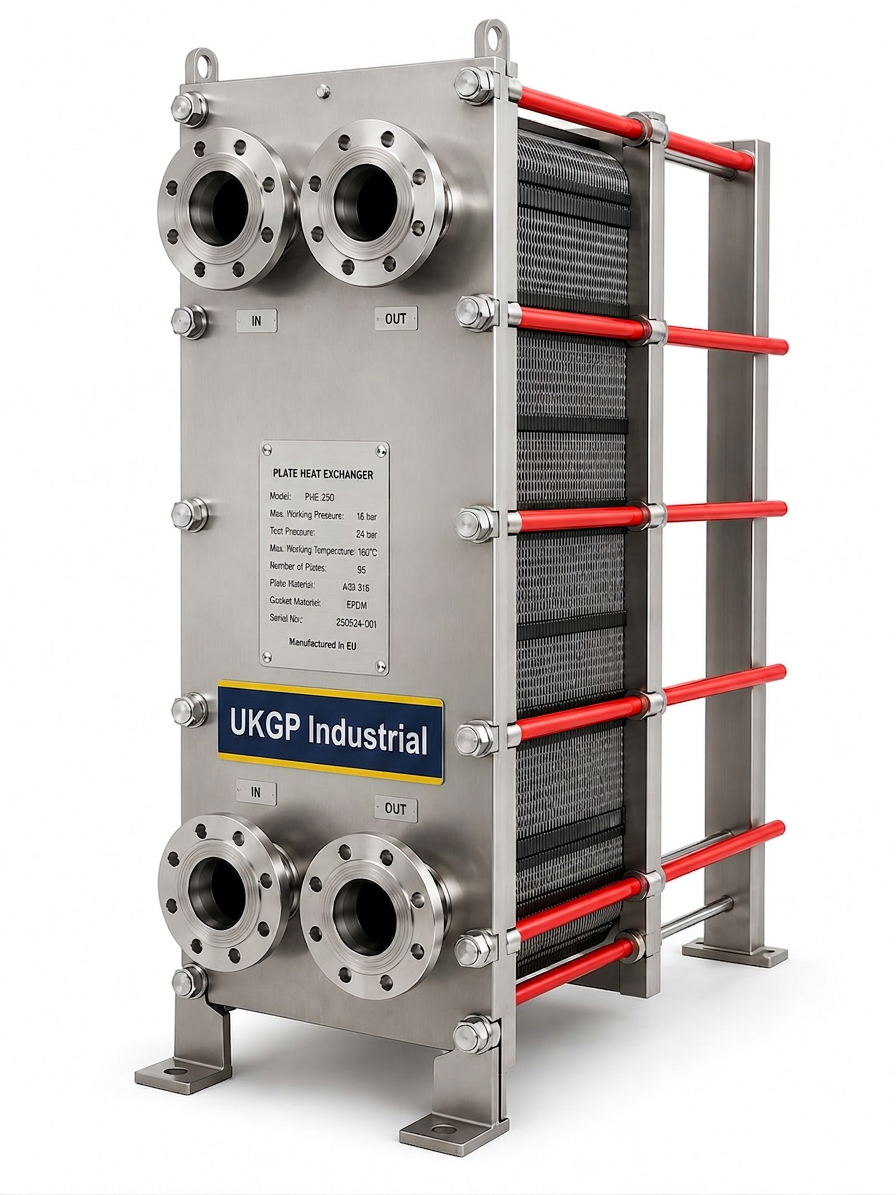
The low loss header remains the most reliable method for achieving hydraulic independence in multi-boiler systems. While alternatives like plate heat exchangers offer separation, the LLH provides a unique combination of pressure management, air separation, and debris collection that simplifies both design and operation. By adhering to the 3-v rule and ensuring strategic sensor placement, engineers can deliver systems that are efficient, quiet, and durable.
For consultants and contractors, the choice of a high-quality, correctly sized header is an investment in the system's future. It eliminates the most common causes of plant room failure—pump conflict and boiler cycling—and provides a stable platform for the integration of modern, high-efficiency heating technologies. Accurate sizing, combined with robust water treatment and air removal, ensures that 'condensing' boilers actually condense, delivering the carbon savings they were designed for.
As we move towards lower-carbon heating solutions, including hybrid systems with heat pumps, the role of the hydraulic separator will only become more critical. It serves as the bridge between generation and distribution, ensuring that regardless of the heat source, the building receives the warmth it requires with minimal energy waste.
- Avoid undersized headers which cause high velocity and noise.
- Ensure consistent insulation to prevent heat loss.
- Check for 'thermal short-circuits' in the bypass.
Frequently asked questions
Why is a low loss header necessary in multi-boiler systems?
- A low loss header creates a neutral pressure zone, allowing the primary (boiler) circuit and secondary (load) circuit to operate at different flow rates. This prevents pump conflict and protects modern high-efficiency heat exchangers from thermal shock or insufficient flow.
What is the '3-v rule' in LLH sizing?
- The 3-v rule states that the vertical velocity within the header should not exceed 0.1 to 0.2 m/s. This allows for effective hydraulic decoupling and helps with the settlement of debris and the rise of air bubbles.
Can I use a Plate Heat Exchanger instead of a Low Loss Header?
- While both decouple circuits, a plate heat exchanger provides physical separation of the primary and secondary fluids. A low loss header is an open hydraulic connection where fluids may mix. Use a PHE if there are concerns about system pressure or fluid contamination.
Does a low loss header act as an air and dirt separator?
- Yes, many modern LLHs are designed with internal baffles to facilitate air and dirt removal. However, in heavily contaminated systems or high-flow commercial plants, dedicated UKGP Industrial air and dirt separators are often recommended upstream.
Is there a limit to how many boilers can be connected to a single header?
- Provided the primary and secondary pipework are correctly sized and the LLH is sized for the maximum cumulative flow, there is no strict limit. However, for systems exceeding 1MW, header diameters can become significant to maintain low velocities.