The Criticality of Vertical Orientation and Tappings
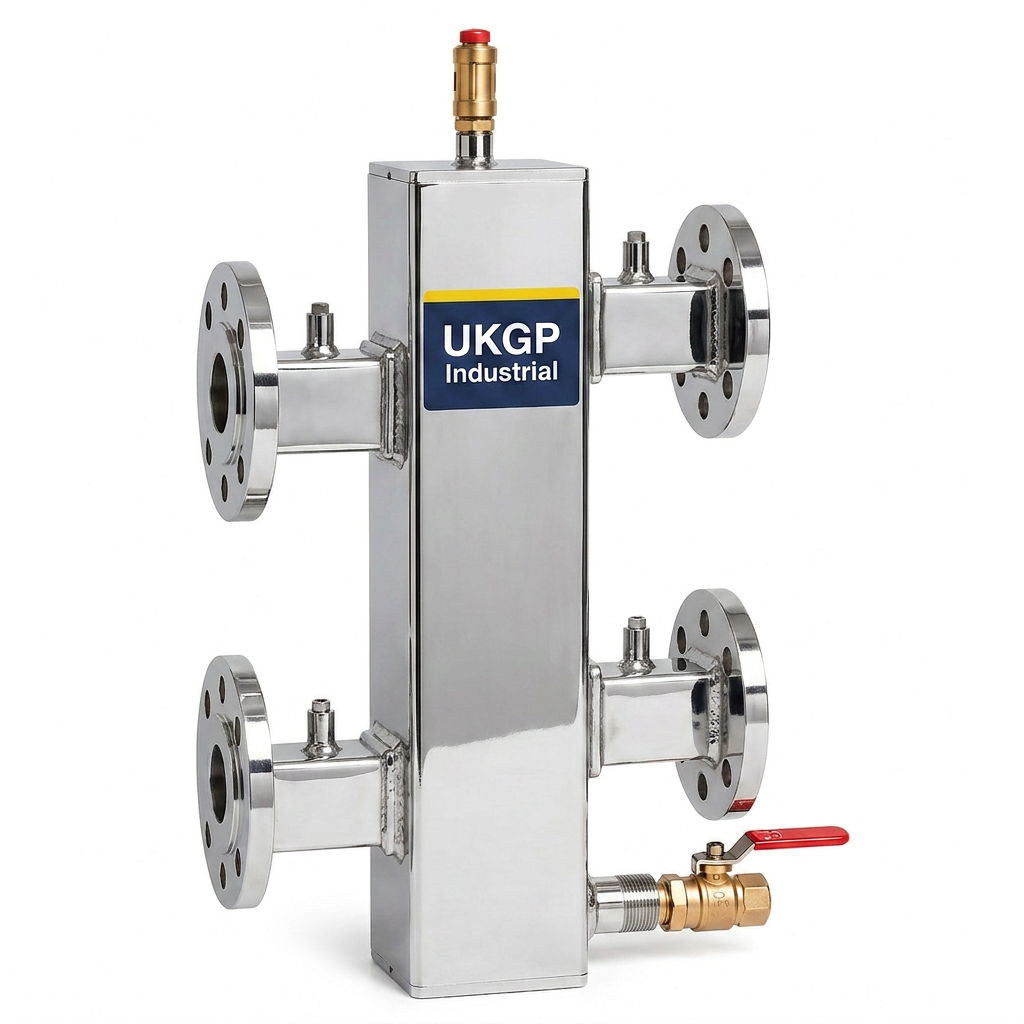
The physical orientation of a low loss header is fundamental to its ability to manage air and debris. In a vertical LLH, the reduction in fluid velocity—typically designed to fall between 0.1 m/s and 0.3 m/s—allows entrained air to rise to the top and suspended solids to settle at the base. Without dedicated tappings for these functions, the LLH becomes a trap for contaminants that eventually migrate into the heat exchangers of high-efficiency boilers such as those from Vaillant or Viessmann.
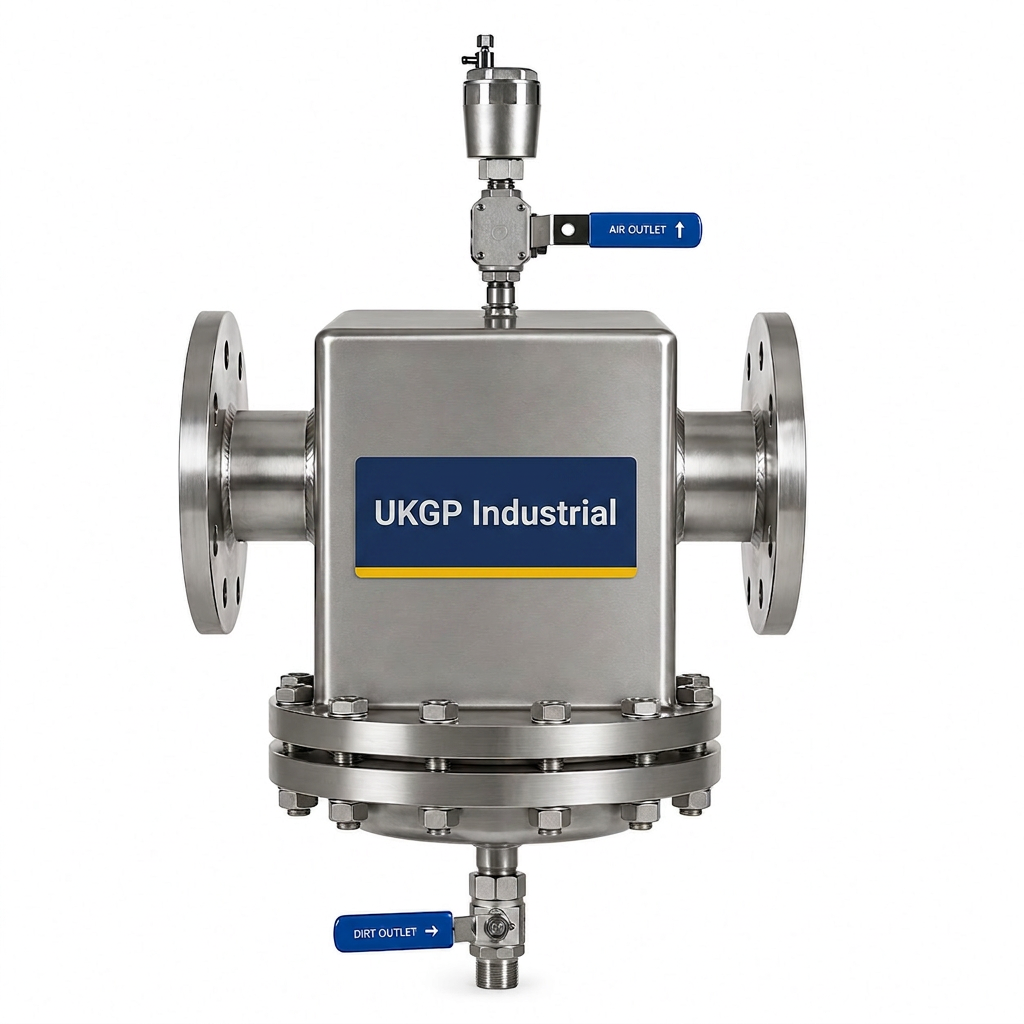
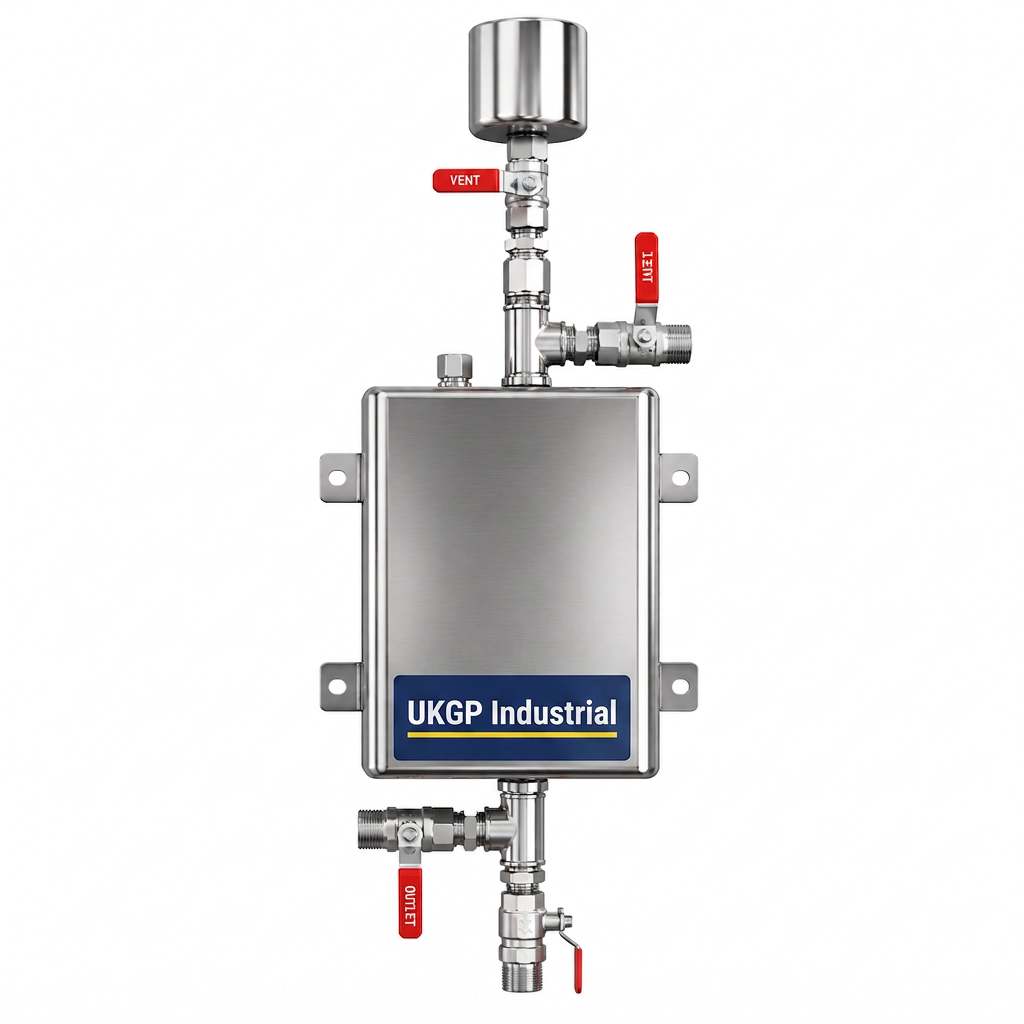
Standard UK commercial practice dictates that the header must feature at least four auxiliary tappings beyond the primary and secondary flow/return connections. The top tapping must be positioned at the highest point of the chamber to avoid 'dead zones' where air pockets can form. Similarly, the bottom tapping requires a full-bore valve to ensure that heavier magnetite and debris can be flushed effectively during maintenance intervals as specified in BSRIA BG29/21.
- Automatic Air Vent (AAV) for continuous venting.
- Manual vent or 'petcock' for commissioning.
- Pressure gauge tapping for differential monitoring.
- Drain valve (Full-bore) for sludge removal.
Automated Air Removal Strategies
Micro-bubbles and entrained air are the primary causes of noise and premature component failure in commercial HVAC systems. On a low loss header, the automatic air vent (AAV) should be installed at the top-most point. However, a common error is the direct installation of a small-orifice AAV without an isolation valve. For industrial applications, a 1/2" or 3/4" BSP connection is standard, allowing for a high-capacity vent that can handle the initial system fill as well as ongoing degassing.
Engineers must ensure that the AAV is compatible with the system's chemical treatment. High-output commercial boilers, such as Worcester or Viessmann cascades, often operate at higher delta-Ts, making the degassing function at the header even more vital. If the LLH is situated in a high-level plant room, the vent discharge should be piped to a safe, visible location to prevent damage to electrical components in the event of a vent failure.
- Use of an isolation valve (lockshield or ball valve) prior to the AAV.
- Ensuring the AAV rated temperature exceeds the system peak.
- Installation of a 'tundish' for visible discharge in plant rooms.
Drainage and Sludge Management
The base of the low loss header acts as a natural collection point for magnetite and circuit debris. While a standard drain cock may suffice for domestic settings, commercial systems require a full-bore lever ball valve, typically 1" BSP or larger. This allows for 'high-velocity' flushing of the header base. During the commissioning phase, the header drain point is often the most effective location to monitor the clarity of the system water.
Furthermore, the drain point provides a vital connection for the injection of cleaning chemicals or inhibitors via a dosing pot. In systems where the LLH is the lowest point of the primary plant, it may also serve as the primary drain-down point for the boiler shunt pumps and the boilers themselves. Without a sufficiently sized drain, removal of the 'sludge' layer becomes impossible, leading to a gradual reduction in the cross-sectional area of the header and increased pressure drops.
- Magnetite collection and removal.
- System flushing point for BSRIA BG29 compliance.
- Safe isolation for component replacement.
Instrumentation and Ancillary Connections
Advanced header design incorporates more than just air and drain points. For a building services engineer, the ability to monitor the delta-P across the header is invaluable for commissioning. Tappings for pressure gauges allow the installer to verify that the primary pump (boiler side) and secondary pumps (system side) are not interfering with one another, which is the core purpose of a low loss header.
Additionally, temperature sensor pockets (thermowells) should be installed in the upper third of the header. This allows the Building Management System (BMS) to monitor the flow temperature actually being delivered to the secondary circuits, which may differ from the boiler flow temperature if the mixing ratio within the header is high. These peripheral points, combined with high-quality venting, transform a simple pipe-in-pipe header into a sophisticated hydraulic management tool.
- Manual bleed valves (1/2" BSP) for rapid air release.
- Pressure gauge assemblies to monitor primary/secondary balance.
- Temperature pockets for BMS integration.
Best Practice for Maintenance and Commissioning
Maintenance of LLH vent and drain points should be integrated into the facility's SFG20 schedule. Air vents are prone to clogging, particularly in systems with poor water chemistry or those suffering from oxygen ingress. If an AAV stops venting, the resulting air lock can lead to pump dry-running and 'kettling' inside the boiler heat exchangers. Engineers should always check for the presence of water at the vent during routine inspections.
When commissioning a new system, the LLH drain point should be used to samples the water for TSS (Total Suspended Solids) and iron content. This ensures that the pre-commission cleaning required by BSRIA BG29/21 has been successful. A low loss header that is regularly 'purged' via its drain valve will significantly extend the life of the secondary pumps and control valves by preventing the circulation of abrasive particulates.
- Annual inspection of AAV orifices for scaling.
- Quarterly flushing of the base drain valve to clear sediment.
- Verification of the system's 'neutral point' pressure.
Frequently asked questions
Can I rely on the internal air vents in commercial boilers instead of venting the header?
- Ideally, no. A low loss header should have its own dedicated automatic air vent and drain valve. Relying on boiler-internal vents can lead to air pockets within the header body, reducing separation efficiency.
What size drain valve should be used on a commercial low loss header?
- A 25mm (1 inch) full-bore lever ball valve is the minimum recommended size for commercial headers up to 100kW. For larger industrial headers, 40mm or 50mm valves are preferred to facilitate the removal of heavy sludge.
Is an air vent on an LLH a substitute for a dedicated air and dirt separator?
- No. While similar in construction, a dedicated air and dirt separator is designed with internal pall rings or mesh to force coalescence. A standard LLH relies on low velocity (0.1 to 0.3 m/s) and requires properly positioned vents to achieve similar results.
How often should LLH air vents be serviced?
- Vents should be checked during annual maintenance. If an AAV is leaking or 'weeping', the internal float mechanism is likely fouled by magnetite and should be replaced alongside a system water quality analysis per BSRIA BG50.