The Role of the Low Loss Header in Modern Plant Rooms
The transition to high-efficiency condensing boilers, such as those from manufacturers like Vaillant or Viessmann, has necessitated the use of low loss headers to maintain minimum flow rates regardless of secondary demand. By creating a zone of negligible pressure drop, the LLH ensures that the primary boiler pump and secondary distribution pumps do not interfere with one another's hydraulic characteristics. This is particularly vital in variable volume systems where TRVs and 2-port valves can significantly alter system resistance.
Beyond hydraulic separation, the LLH often acts as the 'neutral point' of the system. According to CIBSE AM14, the positioning of the expansion vessel in relation to this point is critical for maintaining positive pressure throughout the circuit. UKGP Industrial headers are designed to facilitate this stability, providing a robust junction for systems ranging from light commercial 50kW installations to multi-megawatt district heating hubs.
- Hydraulic decoupling of primary and secondary pumps.
- Acting as a point of low pressure drop (ΔP ≈ 0).
- Air and dirt separation (when internal baffles are present).
- Temperature mixing to protect heat exchangers from thermal shock.
Threaded Connections: Applications and Limitations
Threaded low loss headers are generally specified for domestic-to-commercial crossover projects or small commercial plant rooms where the peak load does not exceed approximately 70kW to 100kW (depending on the designed ΔT). These units usually feature BSP (British Standard Pipe) parallel or tapered threads. While cost-effective and fast to install for a solo operative, they are physically limited by the mechanical strength of the joint.
In a commercial context, the primary drawback of threaded connections is the permanent nature of the join. Should a header require removal for chemical cleaning or replacement, the surrounding pipework often needs to be cut or dismantled back to a union. For engineers following BSRIA BG29/21 guidelines for pre-commission cleaning, the inability to easily isolate and remove components can lead to complications during the flushing process.
- Limited to smaller pipe diameters, typically up to 50mm (2") BSP.
- Lower physical footprint, ideal for space-constrained plant rooms.
- Susceptible to 'weeping' if not correctly sealed with high-quality compound or PTFE.
- Higher risk of seizing over decades of service, complicating future kit replacement.
Flanged Headers: The Commercial Standard
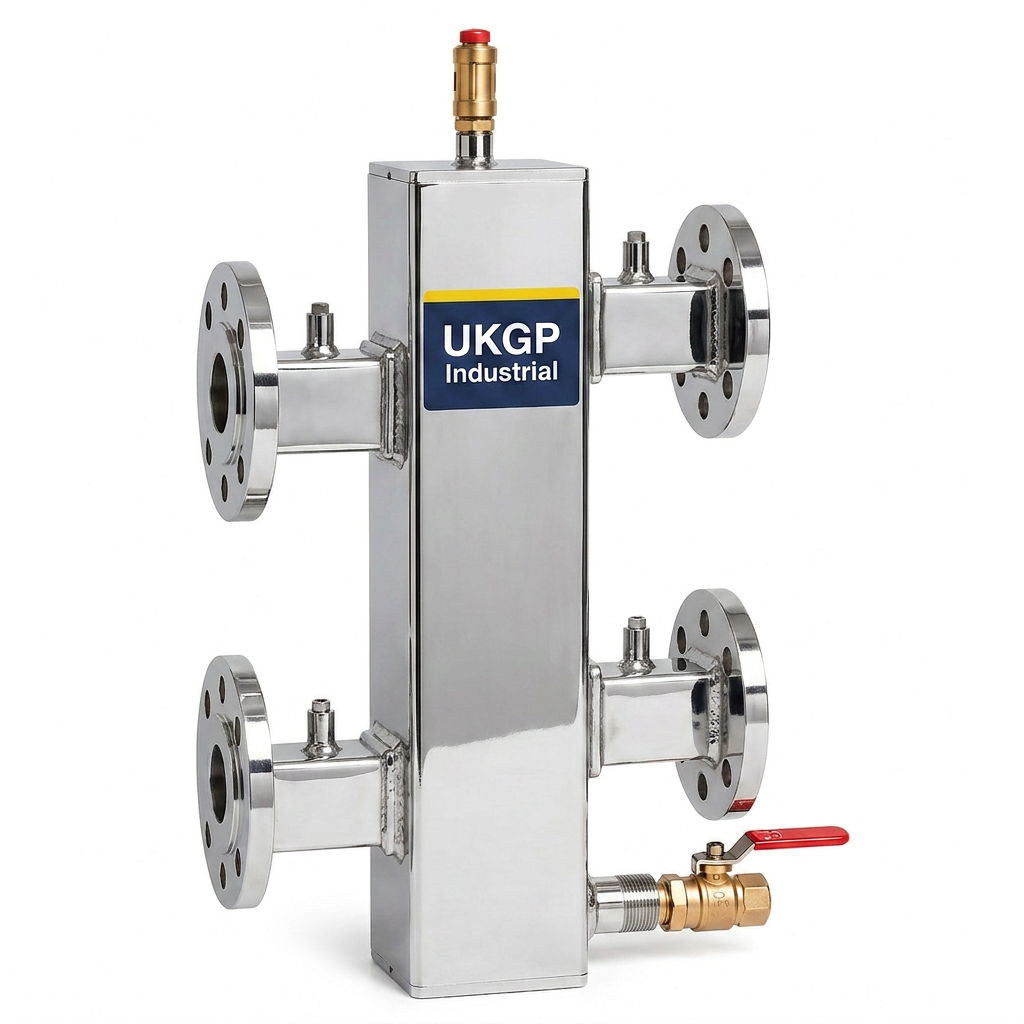
For systems exceeding 50mm nominal bore, flanged connections—typically to BS EN 1092-1 PN16—are the industry standard. These headers offer significantly higher structural integrity and are capable of withstanding the mechanical stresses associated with large-scale thermal expansion. In plant rooms serving hospitals, schools, or high-rise residential blocks, flanged headers provide the reliability required for critical infrastructure.
The primary advantage of a flanged UKGP Industrial low loss header is serviceability. By utilizando a flanged arrangement, the component can be 'dropped out' of the circuit for inspection, internal cleaning, or modification without disturbing the integrity of the fixed pipework. This aligns with BSRIA BG50 recommendations for life-cycle maintenance, ensuring that the heart of the hydraulic system remains accessible throughout the building's operational life.
Technical Comparison: Flow Rates and Velocity
Velocity control is the technical heart of LLH design. To achieve effective hydraulic separation, the vertical velocity within the header should generally be maintained between 0.1 m/s and 0.2 m/s. Threaded headers, being smaller in diameter, are often pushed to their limits in 'borderline' 100kW systems, which can lead to turbulence and poor air separation. In contrast, flanged headers are typically manufactured with larger body diameters, allowing for the slow, laminar flow required for efficient operation.
When calculating flow rates for a 20°C ΔT, a 2" threaded header may suffice for approximately 3500 l/h. However, if the design involves a heat pump or low-temperature system with a smaller ΔT (e.g., 5°C or 7°C), the required flow rate increases significantly. In these scenarios, moving to a DN80 or DN100 flanged header is often mandatory to prevent excessive pressure drops and noise within the plant room.
- Standardisation: Ensure flanges match existing valves and pumps (usually PN6 or PN16).
- Weight: Flanged units are substantially heavier; ensure wall brackets or floor plinths are rated for the wet weight.
- Gasket Selection: Always specify EPDM or premium fibre gaskets to suit the system temperature and chemical additives.
- Bolt Torquing: Unlike threaded joints, flanged connections require even, cross-pattern tightening to prevent flange deformation.
Integration with Air and Dirt Separation
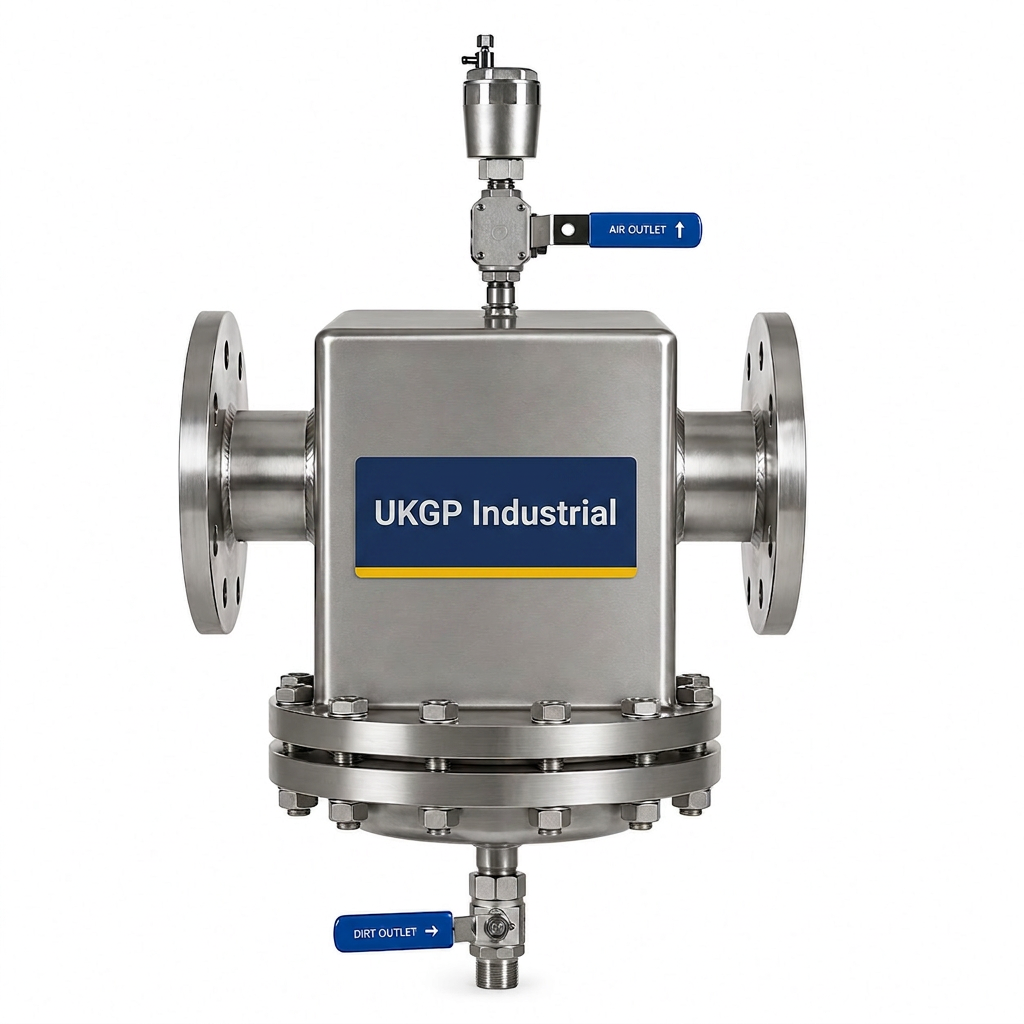
Modern building services design increasingly favours multi-function headers. A flanged low loss header can be equipped with internal perforated baffles or magnetic inserts to combine hydraulic separation with air and dirt removal. This reduces the number of components in the plant room, lowering both the total pressure drop and the installation footprint. Because flanged units are larger, they provide the necessary volume for micro-bubble coalescence and the settling of magnetite.
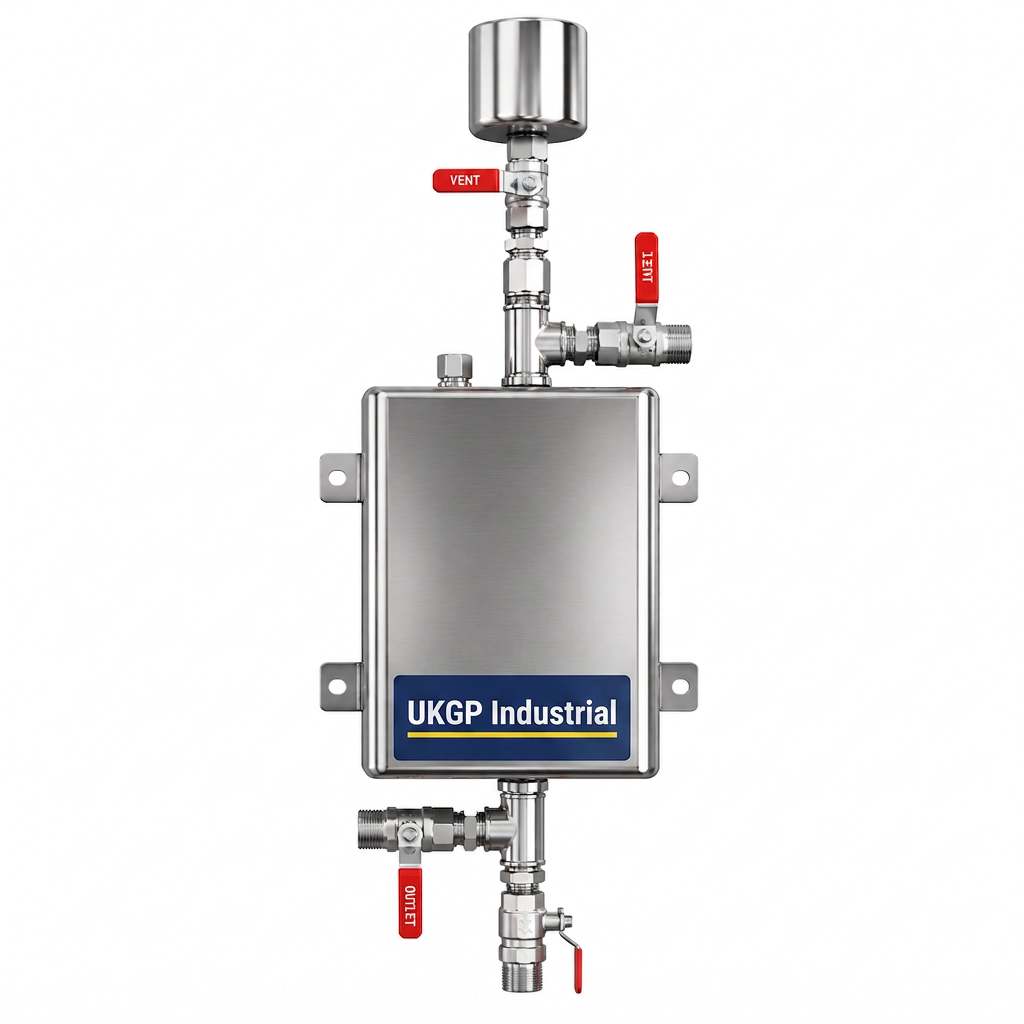
Integrating a separate air and dirt separator alongside a flanged header is considered best practice in high-value installations. While a threaded header might include a simple bleed valve, a flanged UKGP Industrial unit allows for a high-capacity automatic air vent (AAV) and a large-bore drain valve for sludge removal. This is a critical factor in meeting the water quality standards set out in BS 7593 and the manufacturer requirements of modern boiler warranties.
Cost Analysis and Long-Term Value
From a pure Capex perspective, threaded low loss headers are cheaper to procure and require fewer accessories (no gaskets or bolt sets). However, for M&E contractors, the Opex and risk profile must be considered. The labour cost of repairing a failed 2" threaded joint in a live plant room often eclipses the initial saving. Flanged headers, although requiring a higher initial investment, offer a 'fit and forget' level of security that is preferred by facilities managers.
Ultimately, the decision should be guided by the project’s design life and the specific requirements of the heat source. For industrial applications or systems utilising multiple boiler cascades, the PN16 flanged header remains the only viable professional choice. It provides the necessary robustness to handle the high-pressure and high-flow environments characteristic of modern British building services engineering.
- Threaded: Small commercial, low-budget, space-restricted, <70kW.
- Flanged: Medium to large commercial, district heating, high-reliability, >100kW or DN50+.
Frequently asked questions
At what kW rating should I switch from threaded to flanged headers?
- While there is no strict regulation, industry best practice (and most consultant specifications) dictates that connections above 50mm (2") should be flanged to ensure structural integrity and ease of maintenance.
Does the choice of connection affect installation time?
- Threaded headers are generally quicker to install on small scales but carry a higher risk of leaks over time due to thermal expansion. Flanged headers require more upfront labour for bolting and gaskets but offer superior long-term reliability.
Are flanged headers more compliant with CIBSE AM14?
- Yes. CIBSE AM14 emphasizes the importance of hydraulic separation. While the connection type doesn't change the physics of the 'neutral point', flanged headers are better suited for the higher flow rates (m³/h) typically required in CIBSE-compliant commercial designs.
What gasket material is recommended for flanged low loss headers?
- Standard EPDM gaskets are common for LTHW systems. However, for high-temperature or glycol-enriched systems, reinforced graphite or Spec gaskets may be required to prevent degradation.