The plant-room problem it solves
In a multi-boiler plant room each boiler has its own integral pump, and each heating zone has its own circulator. Without separation those pumps fight each other — high-resistance zones starve, low-resistance zones over-circulate, and boilers see erratic return temperatures that trigger lockouts and short cycling.
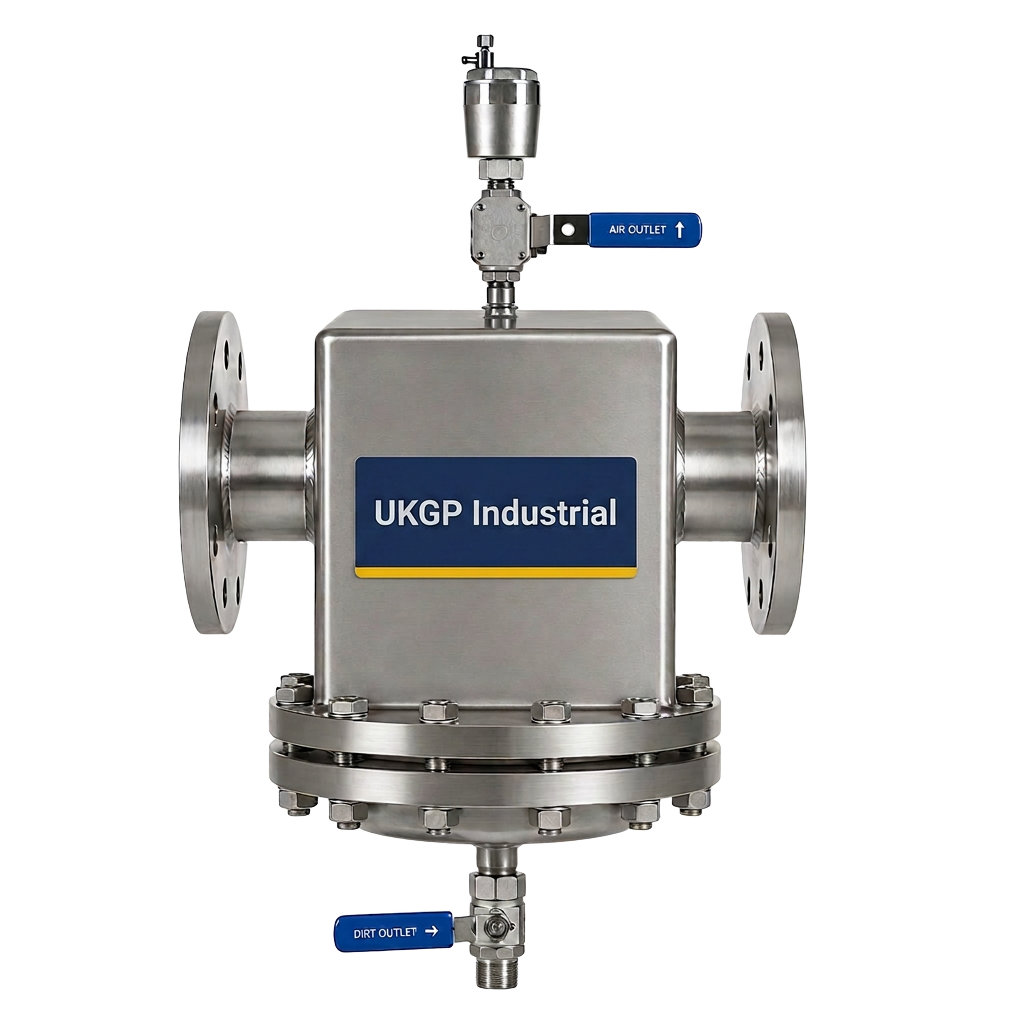
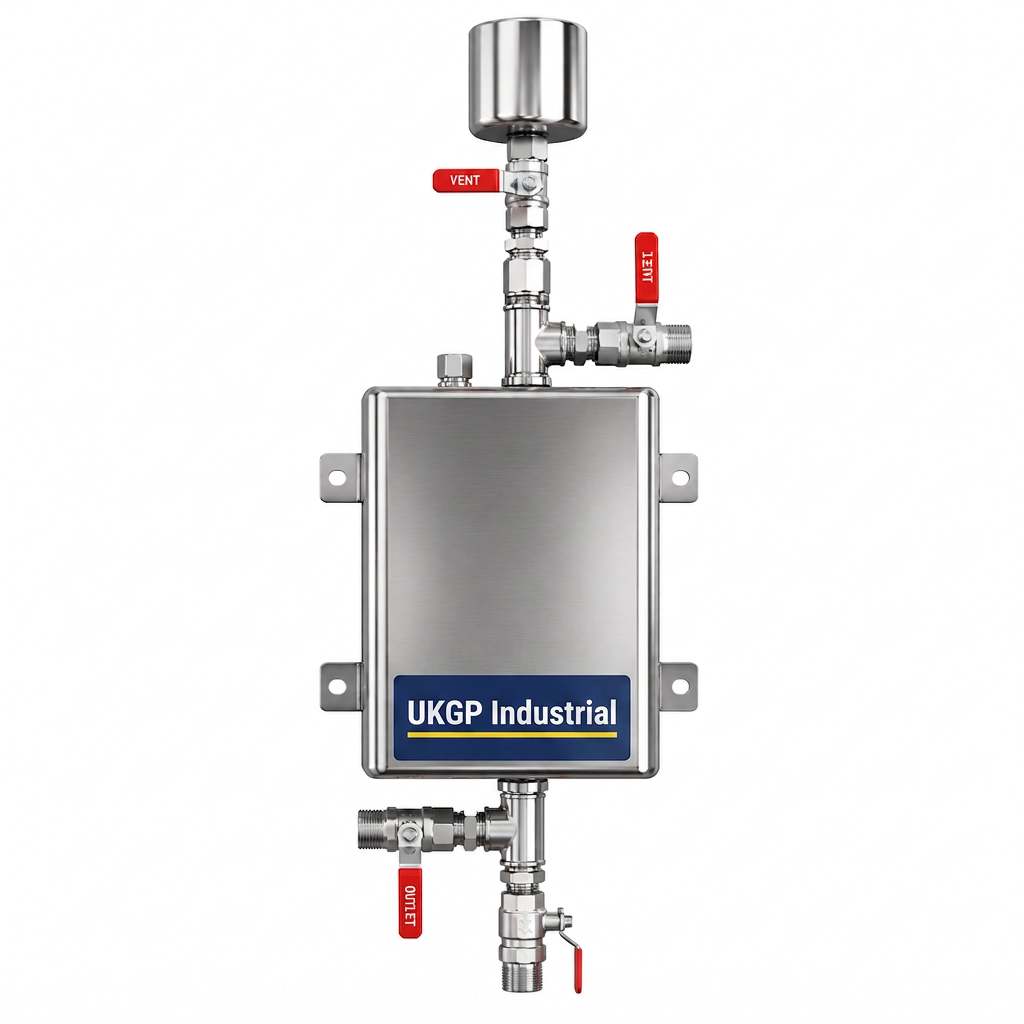
A low loss header sits between the two sides of the system as a vertical (or sometimes horizontal) vessel. Both the primary and the secondary pipework terminate in it. Because the header's cross-sectional area is much larger than the connecting pipes, the internal fluid velocity drops to around 0.1 m/s — the path of least resistance is straight across, so each circuit's pump is effectively decoupled from the others.
How a low loss header works
With velocity that low, three things happen:
- Hydraulic separation. Primary and secondary pumps can be sized independently. Add or remove a zone and the boilers don't notice.
- Air release. Microbubbles rise to the auto-air-vent at the top of the header.
- Dirt collection. Magnetite and debris settle to the dirt pocket at the bottom for periodic flushing — pair with an air and dirt separator on the flow side for system-wide protection.
Sizing a low loss header — the 3× rule
The standard rule of thumb across major UK commercial boiler cascade documentation is:
- Header diameter = 3 × the connection DN.
- Vertical pitch between primary flow/return and secondary flow/return tappings ≥ 3 × DN.
- Internal velocity ≤ 0.1 m/s at maximum primary flow.
So a system with DN65 connections needs a roughly 200 mm diameter header, with 200 mm of clear vertical run between each tapping. Our low loss header product page has a free online sizing calculator that does the maths from your boiler kW and ΔT.
Where it sits on the system diagram
Boilers and primary pumps on the left of the header, secondary distribution pumps and zone manifolds on the right. The air vent goes at the top, the dirt drain at the bottom. A chemical dosing pot on the secondary return makes it easy to add inhibitor without depressurising the system.
Low loss header vs buffer vessel
They're not the same thing. A header is sized for flow — its job is hydraulic separation. A buffer vessel is sized for volume — its job is to stop a modulating boiler from short-cycling under light load. Many modern plant rooms now use a combined buffer/header to do both jobs in one vessel, but if you only have one or the other, make sure it's specified for the duty it's actually doing.
Commissioning checklist
- Header mounted vertically with the dirt pocket fully clear.
- Auto-air-vent isolated by a service valve.
- Primary and secondary flow temperatures within 5 °C of each other at steady state — large divergence usually indicates pump under-sizing.
- Flush the dirt drain at first commissioning and after 30 days.
Need a header sized for your project? Send the boiler kW, design ΔT and connection size to sales@ukgpindustrial.co.uk or call +44 20 8935 5572 — our engineers will quote inside one working day.