The Role of the Traditional Y-Strainer
The Y-strainer is a mechanical filtration device designed to capture large particles within a fluid stream using a perforated or wire mesh screen. In industrial applications, they are essential during the initial commissioning phase to prevent 'construction debris'—such as solder, metal swarf, and PTFE tape—from damaging sensitive components like pump impellers or plate heat exchangers. Their operation is purely interceptive; if a particle is larger than the mesh aperture, it is trapped.
However, strainers have significant limitations in modern closed-loop systems. They are effectively 'passive' and only protect the pipework downstream of their location. Furthermore, they offer no solution for dissolved gases or micro-bubbles, which are major drivers of internal corrosion. As the screen fills with debris, the pressure drop (Δp) across the unit increases significantly, which can lead to pump cavitation or a reduction in the system's total flow rate if not cleaned regularly.
- Passive filtration via a fixed mesh or perforated screen.
- Primary role: Protecting specific components (pumps, control valves) from large-bore debris.
- Requirement for system shutdown and manual basket cleaning.
- High pressure drop potential as the mesh blinds over time.
Advancements in Combined Air and Dirt Separation
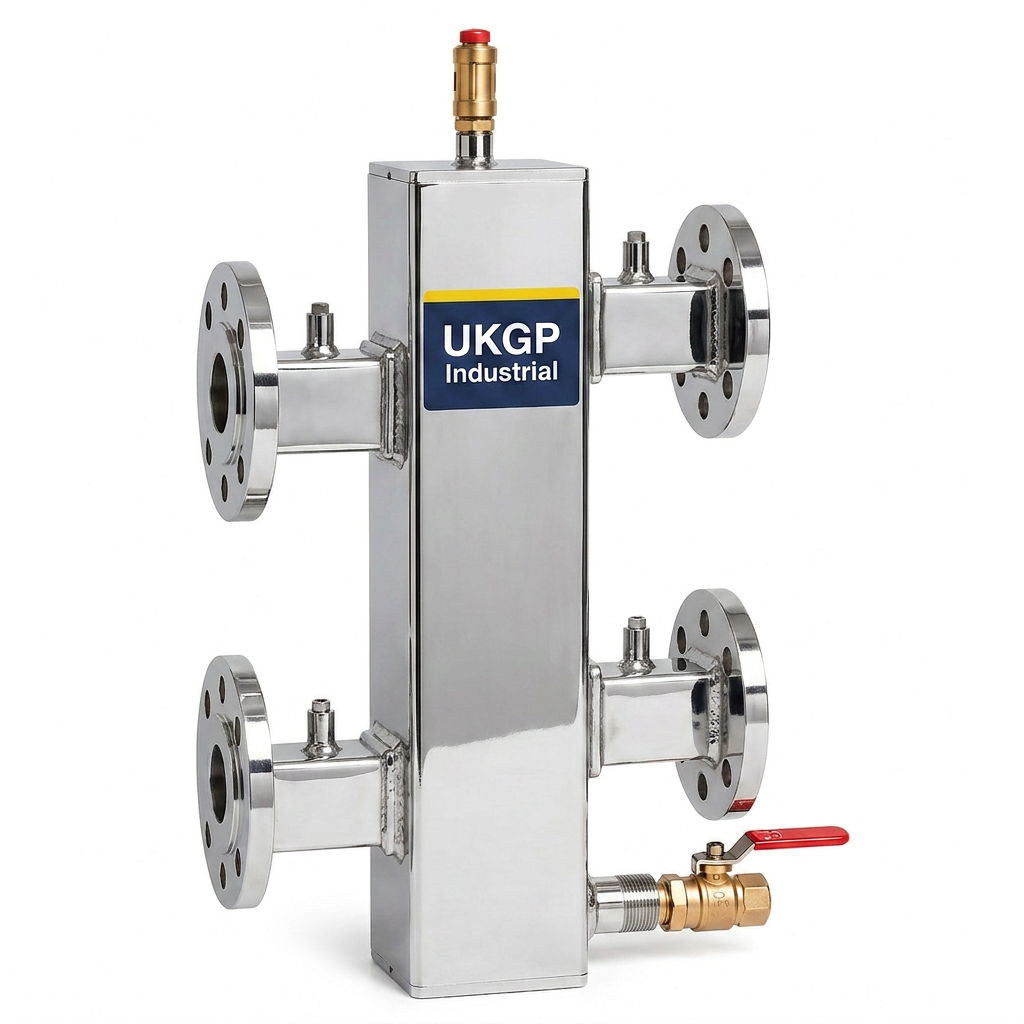
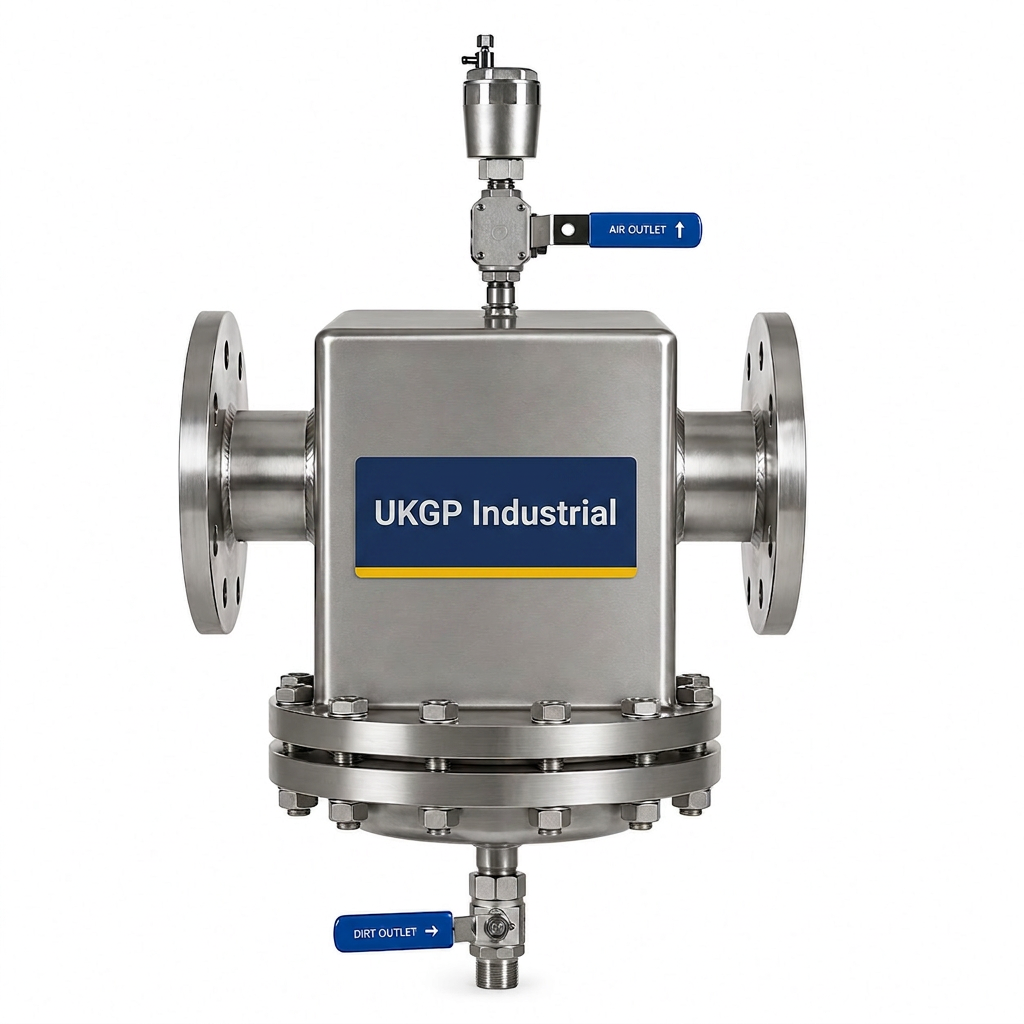
Combined air and dirt separators, such as those in the UKGP Industrial range, utilise fluid dynamics rather than simple mechanical straining. These units typically employ a coalescing medium or a series of internal baffles to create a 'quiet zone'. In this zone, fluid velocity is reduced, allowing micro-bubbles to rise and be purged via an automatic air vent, while dirt particles—including heavy magnetite sludge—settle into a collection chamber at the base of the unit.
Unlike strainers, these separators are designed to remove microscopic particles that would pass straight through a standard 20 or 40-mesh strainer. In a modern plant room, fine magnetite is often more damaging than large debris, as it settles in low-velocity areas like underfloor heating manifolds or the heat exchangers of condensing boilers. A combined separator provides a continuous cleaning action, maintaining the hydronic integrity of the system without requiring frequent shutdowns for screen cleaning.
- Centrifugal or coalescing media to remove micro-bubbles and fine sludge.
- Non-stop operation: Debris can be flushed while the system is live.
- Low, constant pressure drop compared to a fixed mesh.
- Captures magnetite and fine particulates down to 5 microns when fitted with magnetic inserts.
Compliance with BSRIA BG29/21 and BG50 Guidance
UK building services engineers must adhere to BSRIA guidance to ensure system warranties remain valid. BSRIA BG29/21 emphasizes the importance of removing suspended solids during the flushing and commissioning phase. While strainers are used during the temporary flushing bypass, the permanent installation of a dirt separator is now considered best practice for managing the 'residual' solids that inevitably remain after the initial clean.
BSRIA BG50 further highlights that oxygen is the primary cause of corrosion in LTHW systems. A standard strainer does nothing to address the presence of air. A deaerator or combined separator actively removes both entrained air and micro-bubbles. By maintaining low dissolved oxygen levels, the rate of magnetite formation is significantly reduced. Relying solely on a strainer is often viewed as a failure to meet the 'proactive' maintenance requirements outlined in these standards.
- BSRIA BG29/21: Pre-commission cleaning of pipework systems.
- BSRIA BG50: Water treatment for closed heating and cooling systems.
- Emphasis on 'continuous' water quality management over 'point-of-entry' straining.
Comparative Analysis: Pressure Drop and Maintenance
From an O&M perspective, the difference in maintenance requirements is stark. Cleaning a Y-strainer is a manual, messy process that requires the section of pipework to be isolated and drained. This often results in the introduction of fresh, oxygenated water—and therefore fresh corrosion potential—into the system during the refilling process. Conversely, a dirt separator features a blow-down valve at the base, allowing the FM team to discharge collected sludge in seconds while the system remains pressurized and operational.
The hydraulic impact on the system also differs. A clean Y-strainer has a relatively low Kvs, but as it collects debris, its resistance increases exponentially. A separator is designed with a larger internal volume; its pressure drop remains low and remarkably constant even as the collection chamber fills. For systems designed with high-efficiency, variable-speed pumps, this stability in system resistance is vital for maintaining the intended pump curve and reducing energy consumption.
- Aperture Size: Strainers typically capture >100 microns; separators can capture <10 microns.
- Maintenance: Strainers require isolation; separators use blow-down valves.
- Air Management: Strainers provide zero air removal.
Integration with Other Protection Devices
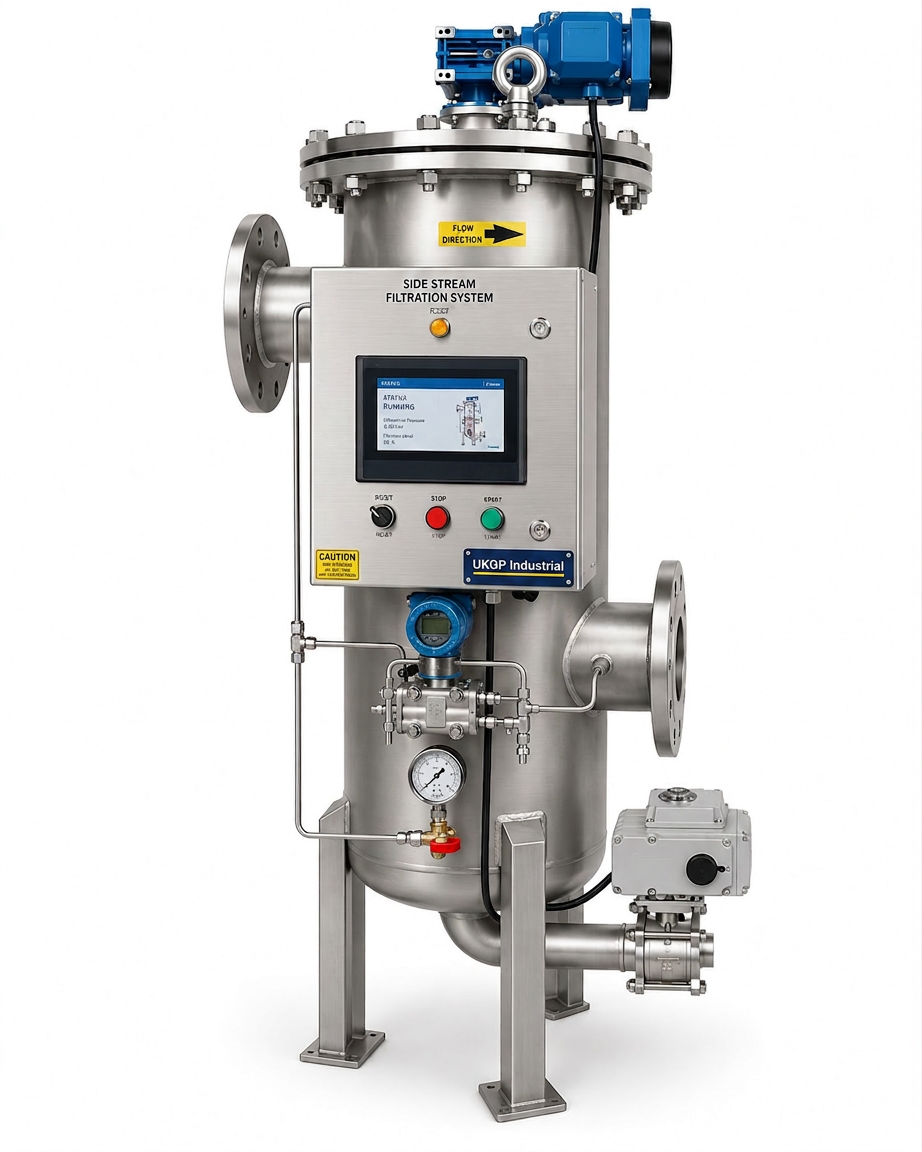
While the air and dirt separator is the primary line of defence in the main flow, larger systems or those with older, iron-based pipework may benefit from side-stream filtration. This approach involves diverting a percentage of the total flow (typically 5-15%) through a dedicated high-efficiency filter. This is often used in conjunction with a separator to achieve the 'ultra-clean' water standards required by modern plate heat exchangers.
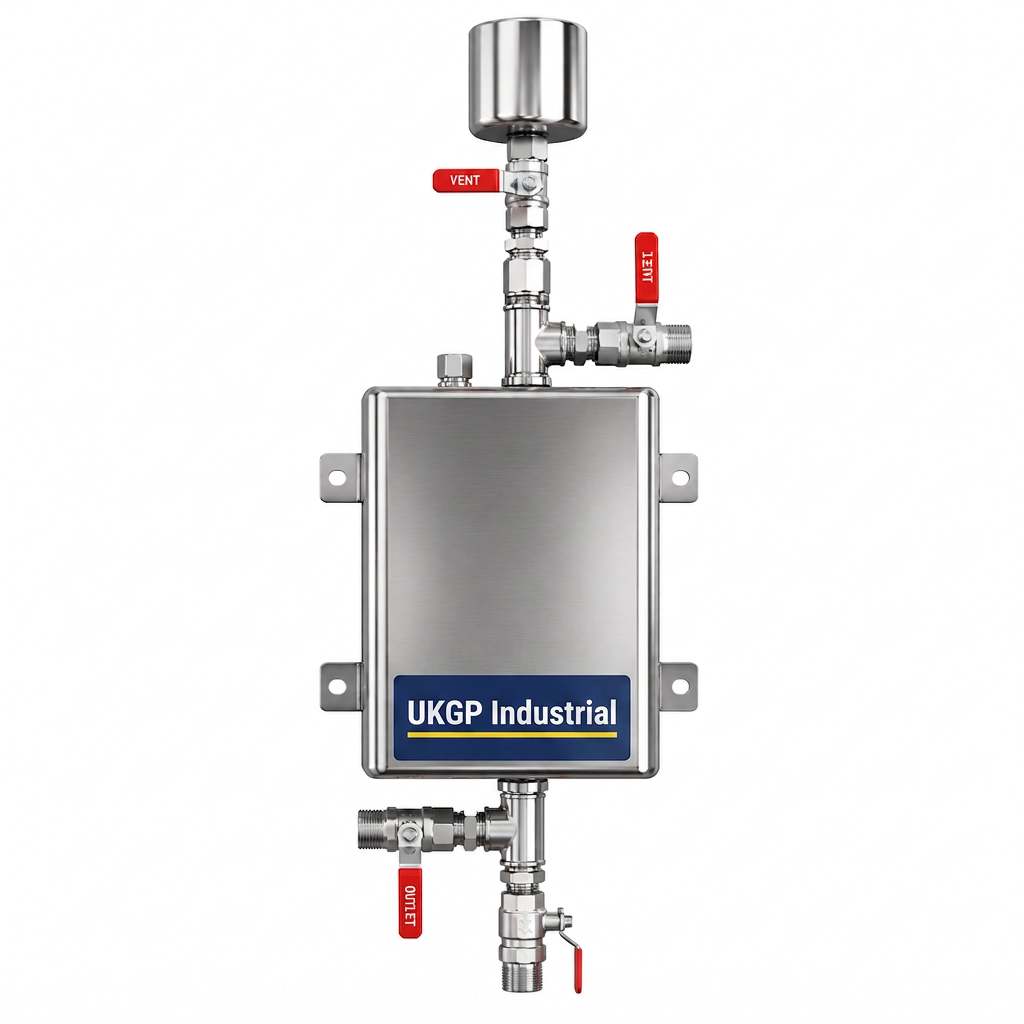
It is also essential to remember that mechanical separation is only part of the solution. The use of chemical dosing pots to maintain the correct concentration of inhibitors is required to passivate metal surfaces and prevent the initial formation of scale and corrosion. Successful plant room design treats air removal, dirt separation, and chemical treatment as a tripartite strategy for system health.
- Side-stream filtration for high-volume debris removal.
- Dosing pots for chemical inhibitor introduction.
Final Engineering Verdict
The comparison between a strainer and an air and dirt separator is not an 'either-or' scenario for the professional engineer, but rather a matter of application. Y-strainers remain essential for 'point-of-use' protection immediately upstream of sensitive components like control valves or expensive pumps to catch any rogue large-scale debris. However, they are insufficient as a primary means of system-wide water quality management.
For any commercial LTHW or chilled water project, a combined air and dirt separator is the necessary standard. It addresses the root causes of system degradation—oxygen and fine particulates—while offering lower lifecycle costs through reduced maintenance and improved thermodynamic efficiency. For consultants and contractors, specifying a high-quality separator is the most effective way to ensure long-term compliance with BSRIA standards and to protect both the plant and the client’s investment.
- Installation should be in the 'hottest' part of the heating circuit to maximize deaeration.
- Ensure sufficient clearance for blow-down valve operation and magnet removal.
Frequently asked questions
Can a strainer replace an air and dirt separator?
- No. While a strainer provides coarse protection for pumps, BSRIA BG29/21 and BG50 highlight that microscopic debris and dissolved gases require the continuous action of a separator to prevent long-term corrosion and efficiency loss.
What are the maintenance intervals for these components?
- Strainers should be checked within the first 24 hours of commissioning and then periodically during maintenance. Separators should be flushed via the blow-down valve weekly during the first month, and then according to the building's maintenance schedule.
Where is the optimum location for an air and dirt separator?
- Separators should always be installed on the flow (hottest point) in LTHW systems to capture liberated air, and on the return in chilled water systems. They should be upstream of sensitive plant like boilers or plate heat exchangers.
What are the risks of a poorly maintained Y-strainer?
- A 'blind' or blocked strainer will increase pump differential pressure, leading to reduced flow rates, increased energy consumption, and potentially triggering low-flow alarms on high-efficiency boilers.