The Critical Role of Separation in Chilled Water Loops
Chilled water systems operate within a narrower temperature differential than LTHW systems, but they are equally susceptible to the catastrophic effects of air and dirt. Entrained air leads to the formation of micro-bubbles which increase the noise profile of the system and, more critically, accelerate the oxidation of metallic components. This leads to the formation of magnetite (black iron oxide), a highly abrasive sludge that can seize control valves and erode pump impellers.
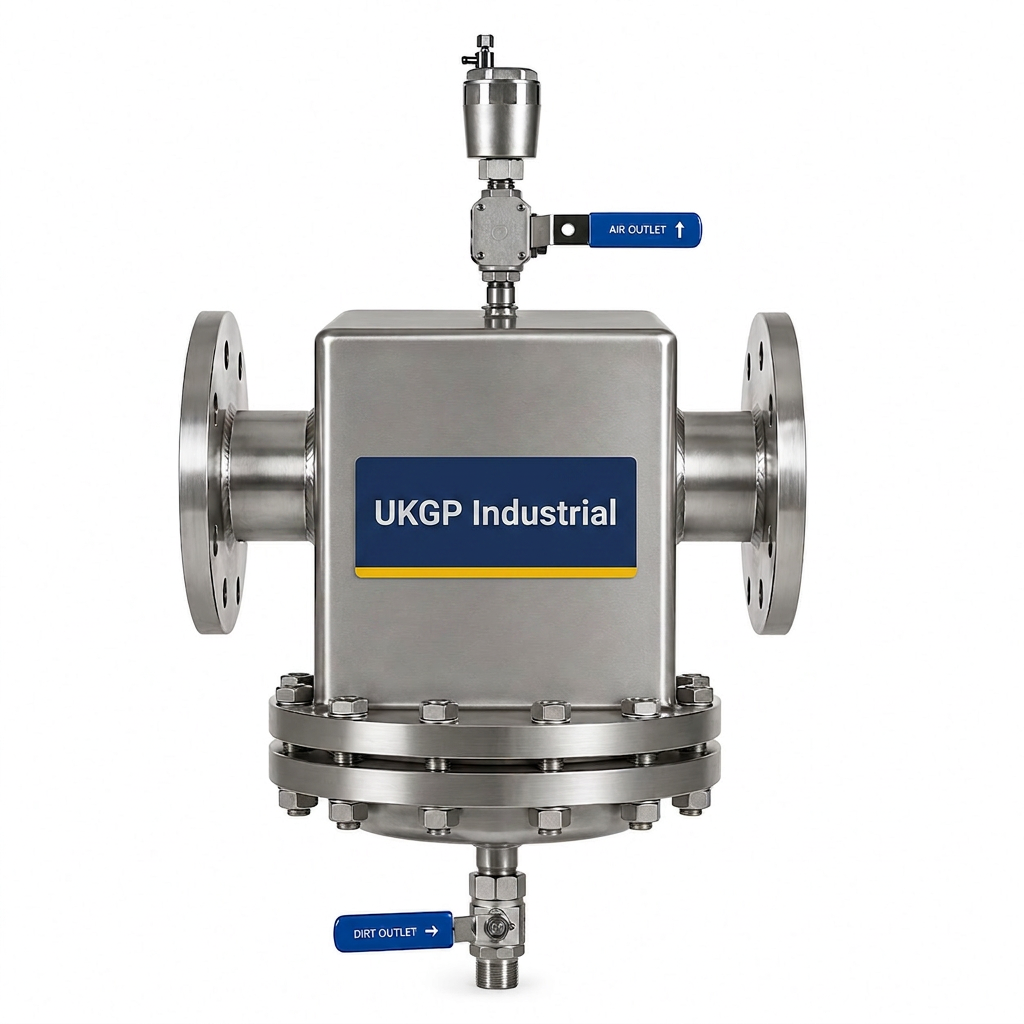
A combined air and dirt separator acts as a dual-function vanguard. By utilising a combination of velocity reduction and internal coalescing media, these units allow micro-bubbles to rise to an automatic air vent while simultaneously forcing suspended solids to drop into a collection chamber. This process is essential for maintaining the heat transfer coefficients of plate heat exchangers and fan coil units (FCUs), where even a thin layer of sediment can drastically reduce efficiency.
UK engineers must also consider the implications of BS EN 12828:2012+A1:2014, which, while focused on heating, establishes the principle of air and impurity removal for system longevity. In cooling applications, the cooling coil’s narrow fins and internal passages are particularly prone to 'plugging' if dirt is not removed effectively at the plant-room stage.
- Micro-bubble removal to prevent 'milky' water and air-locks.
- Removal of magnetite and non-ferrous debris to protect pump seals.
- Reduction in pump energy consumption due to improved fluid density.
- Compliance with BSRIA BG50 'Water Treatment for Closed Heating and Cooling Systems'.
Mechanics of Micro-bubble Deaeration
The science behind deaeration is governed by Henry’s Law, which dictates that the amount of dissolved gas in a liquid is proportional to the partial pressure of that gas. In a chilled water system, gases are often introduced during the initial fill or through permeable components. Unlike large air pockets that can be removed via manual vents, micro-bubbles remain suspended in the flow, creating a 'milky' appearance and reducing the fluid's heat-carrying capacity.
A high-efficiency separator uses an internal element—commonly a stainless steel pall ring or wire mesh structure—to create an area of stagnation. As the chilled water passes through this media, the micro-bubbles collide and coalesce. Once they reach a certain size, their buoyancy overcomes the downward force of the fluid, and they rise to the top of the vessel to be expelled through an automatic air vent (AAV).
For chilled water applications, the separator is usually located on the return line to the chiller. This is because the water returning from the building loads is at its warmest (e.g., 12°C vs 6°C), and according to Henry's Law, this is where the air is most likely to come out of solution, making it the most efficient point for deaeration.
- Henry’s Law: Solubility of gases decreases as temperature rises.
- Pressure influence: Gases are released at the point of lowest pressure.
- The role of the automatic air vent in permanent gas removal.
Sedimentation and Sludge Removal Strategies
Dirt separation within the same vessel relies on the principle of gravity. When the fluid enters the larger diameter of the separator body, its velocity drops significantly—typically by a factor of four or more. This reduction in kinetic energy allows suspended particles with a specific gravity higher than water to settle toward the bottom of the unit, guided by the internal coalescing media.
Stokes' Law describes the settling velocity of particles; in essence, the larger the particle and the lower the fluid velocity, the faster it will settle. However, modern systems often contain fine magnetite particles that are too small to settle by gravity alone. This is why high-grade UKGP Industrial separators often incorporate internal or external magnetic sets to capture these sub-micron ferrous particles, preventing them from recirculating.
The collection chamber at the base of the unit is designed to hold a significant volume of sludge without obstructing the main flow path. This is a critical design feature; if the dirt collection area is too small or located within the main flow, the accumulated debris can be re-entrained into the system during periods of high demand or pump ramp-up.
- Velocity reduction as a catalyst for sedimentation.
- The impact of Stokes' Law on particle settling rates.
- Magnetic filtration as an essential supplement for magnetite removal.
Compliance with BSRIA BG29/21 Guidelines
BSRIA BG29/21 serves as the industry standard for the pre-commissioning cleaning of pipework systems. It emphasises that the removal of construction debris, scale, and iron oxides is paramount before a system is handed over. An air and dirt separator is a vital component during the initial 'circulate and flush' phase, capturing debris that could otherwise bypass temporary strainers.
Furthermore, the guidance notes that water quality must be maintained throughout the life of the building (BG50). A permanent separator ensures that the system remains within the specified limits for suspended solids. Without this, the fine tolerances in modern chillers and heat meters would be compromised, leading to inaccurate billing and premature component failure.
For facilities managers, the presence of a calibrated separator simplifies the maintenance regime. Instead of dismantling line strainers—which requires system isolation and risks introducing more air—the separator can be 'blown down' while the system is live, ensuring continuous operation and compliance with maintenance schedules.
- Pre-commissioning cleaning requirements (BSRIA BG29/21).
- Protection of high-efficiency 'Blue Pump' technology.
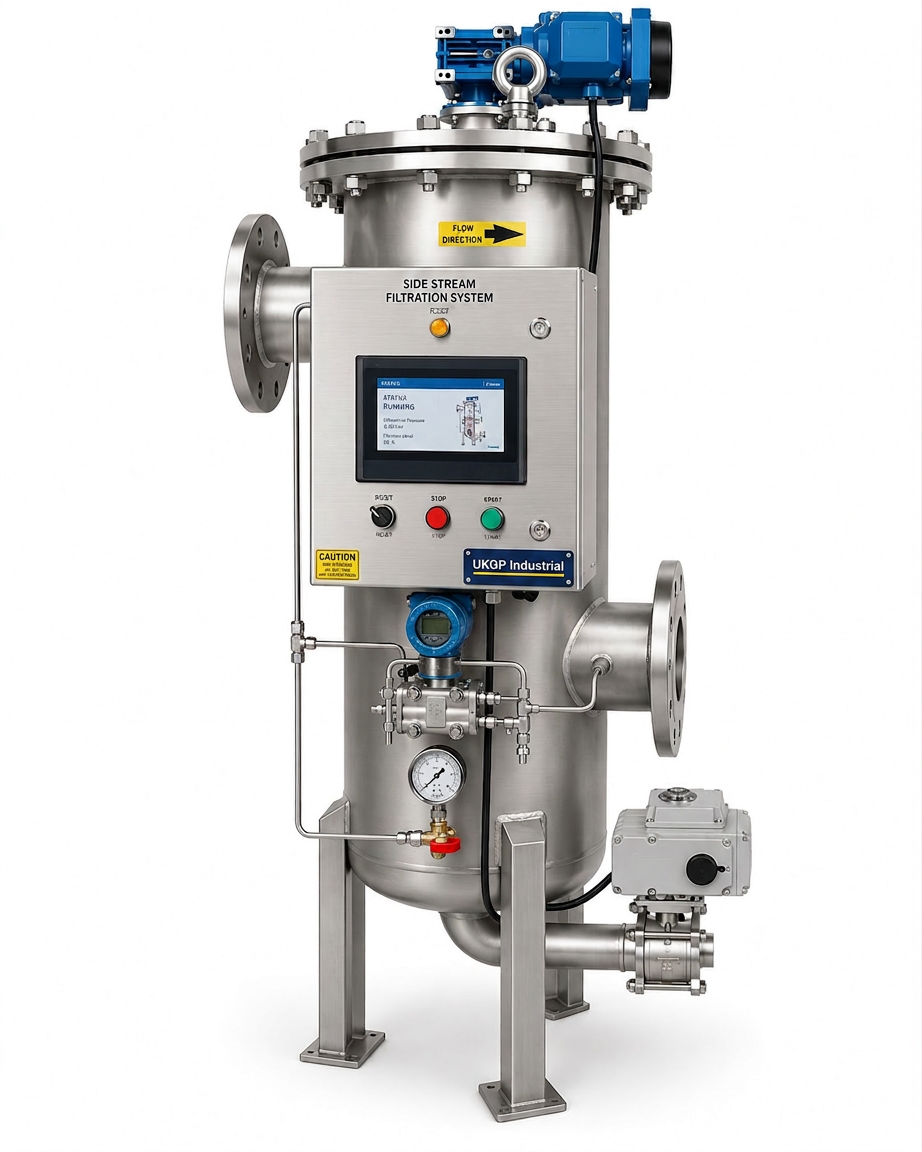
- Reducing the burden on side-stream filtration units.
Sizing and Selection Criteria for M&E Contractors
A common error in plant room design is sizing an air and dirt separator based solely on the nominal pipe size. For effective separation, the unit must be sized according to the actual flow rate (m³/h). If the velocity through the unit is too high, the coalescing process is interrupted, and dirt particles will 'sail' through the vessel without settling. Ideally, the velocity should be kept between 1.0 m/s and 1.5 m/s.
Pressure drop (Δp) is another critical factor. A well-designed separator should offer minimal resistance to flow. UKGP Industrial units are designed to ensure that the pressure drop across the unit remains negligible, typically less than 0.1 bar at design flow rates, ensuring that pump head calculations are not adversely affected.
Material selection is also paramount. For chilled water systems, carbon steel vessels are standard, but they must be treated with an external anti-corrosion coating. Additionally, the engineer must verify that the unit’s pressure rating exceeds the system’s safety valve set point, accounting for static head in high-rise applications.
- Line size vs. flow rate: Choosing based on velocity, not pipe diameter.
- Maximum operating pressures and temperatures (typically 10 bar / 110°C).
- Connection types: Flanged (BS EN 1092-1) vs. Threaded vs. Victaulic.
Installation Best Practices in Chilled Water Circuits
Installation of separators in chilled water systems requires specific attention to insulation. Because the vessel will contain fluid at 6°C, it will inevitably sit below the dew point of the plant room air. Failure to provide a 100% vapour-tight insulation jacket will lead to condensation forming on the shell, which will eventually cause the vessel to rust from the outside in—a process often hidden until structural failure occurs.
The unit should be installed horizontally or vertically depending on the model, but always with the air vent at the highest point and the drain valve at the lowest. It is recommended to install the separator with isolation valves and a bypass, although many engineers prefer to install them in-line to ensure 100% of the flow is treated on every pass.
Space must be allocated for maintenance. The engineer must be able to access the top of the unit to inspect the automatic air vent and have enough clearance at the bottom to connect a hose for sludge discharge. In plant rooms with limited 'headroom', side-entry models or compact separators may be required.
- The danger of interstitial condensation.
- Vapour seals and closed-cell insulation requirements.
- Maintenance access for the AAV and blow-down valve.
Integration with Water Treatment Regimes
Effective air and dirt separation is one half of a robust water quality strategy; the other half is chemical treatment. By removing the air (and therefore the oxygen), the separator significantly reduces the rate at which chemical inhibitors are 'consumed' by oxidative reactions. This makes the chemical dosing more effective and long-lasting.
In chilled water systems, glycol is often used for freeze protection. Glycol is more viscous than water and can hold air bubbles for longer. High-quality separators are essential in glycol-dosed systems to ensure that the higher viscosity does not lead to permanent air entrainment, which would reduce the fluid's specific heat capacity and pump efficiency.
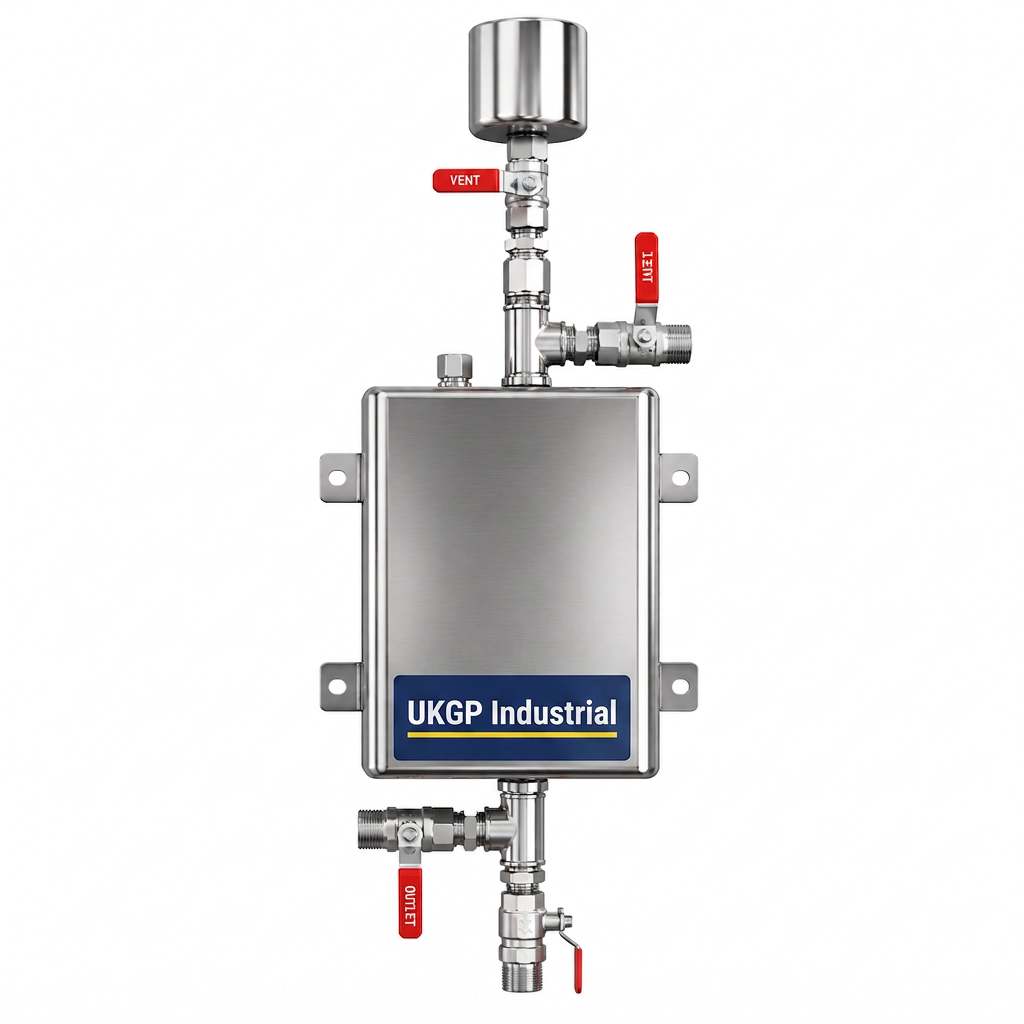
Using a chemical dosing pot in conjunction with an air and dirt separator creates a comprehensive loop. The separator removes the physical contaminants, while the dosing pot allows for the controlled introduction of inhibitors and biocides to prevent microbiological growth, which is a specific risk in chilled water systems operating at moderate temperatures.
- Automated blow-down valves for unmanned plant rooms.
- The synergy between separators and dosing pots.
- Protecting the investment in chemical inhibitors.
The Engineer’s Conclusion: Long-term System Resilience平衡
Specifying an air and dirt separator is a proactive measure that pays dividends throughout the lifecycle of a building. For the M&E contractor, it reduces the risk of expensive call-backs during the defects liability period. For the facilities manager, it provides a simple, measurable way to maintain water quality and energy efficiency.
As chilled water systems become more complex, with the integration of heat pumps and variable speed drives, the margin for error regarding water cleanliness has narrowed. A system bypass or a fouled heat exchanger can lead to significant energy waste and occupant discomfort. Investing in high-quality separation technology is the most cost-effective way to mitigate these risks.
Ultimately, the goal is to create a 'closed' system that is truly closed—free from the ingress of air and the accumulation of debris. By following BSRIA guidelines and selecting the appropriate UKGP Industrial separation equipment, engineers can ensure their chilled water systems operate at peak performance for decades.
- Summary of energy savings through improved heat transfer.
- The long-term ROI of reduced maintenance interventions.
- Ensuring system resilience in a changing climate.
Frequently asked questions
Where is the optimal location for an air and dirt separator in a chilled water circuit?
- According to BSRIA BG29/21, the separator should be installed at the point of lowest solubility. For chilled water systems, this is generally the return leg to the chiller where temperatures are at their highest and pressures are lowest. Avoid installing on the coldest side of the system unless local air venting is the primary concern.
Do I still need side-stream filtration if I have an air and dirt separator?
- While a separator removes circulating debris, side-stream filtration is typically required to remove finer particles (down to 5 microns) and to provide high-volume turnover. A combined separator is the first line of defence; side-stream filtration provides the ongoing polishing necessary for modern, small-orifice heat exchangers.
How does flow velocity affect separation efficiency?
- Velocity is the critical constraint. Most high-efficiency separators require a flow velocity between 1.0 m/s and 1.5 m/s at the inlet to ensure the internal coalescing media can effectively drop dirt particles and release micro-bubbles. Exceeding 3.0 m/s will significantly reduce separation efficiency.
What are the insulation requirements for chilled water separators?
- In chilled water systems, air and dirt separators must be fully insulated using vapor-proof, closed-cell insulation. Failure to do so will result in surface condensation, leading to corrosion of the separator vessel and potential damage to the plant room floor or electrical equipment below.
How often should the dirt collection chamber be blown down?
- In a new build, the drain valve should be opened daily during the initial two weeks of operation. Following this, and once BSRIA BG29/21 standards are met, a monthly inspection and blow-down are usually sufficient, aligned with general plant room maintenance schedules.